15 November 2009

A Chess960 Catastrophe

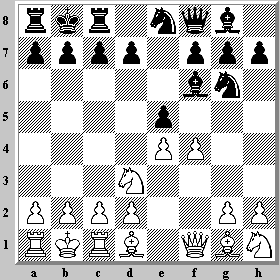
Talk about opening disasters! The diagram shows the position after three moves each in a game between two 2700+ players from Mainz 2005. White played 4.Nc5, threatening the royal fork on d7 (plus the small matter of a smothered mate). However Black responds, White has 5.Qb5, reinforcing the fork and adding mate on b7 to Black's woes.

4th FiNet Chess960 Open (2005 Mainz)
Bacrot, Etienne

Aronian, Levon
(After 3...Bd8-f6)

The start position was RKRBNQBN (SP941) and the initial moves were 1.e4 e5 2.Nd3 Ng6 3.f4 Bf6. Black's last move led directly to disaster, but the preceding moves 1...e5 and 2...Ng6 were probably not the best either. After 1.e4, the CCRL engines (see the 'Resources' link in the sidebar) prefer 1...f5 and 1...Ng6. Is the position after 1...e5 definitely lost? Perhaps the losing move was 2...Ng6; more analysis required.

14 November 2009

Setting up a Chess960 Position

In my previous post, The First Recorded Fischerandom Game?, I wrote, 'For reasons that I'll give some other time, the order by value is my preferred method of setting up a chess960 start position.' By that somewhat cryptic statement, I meant that I use a little procedure -- an algorithm -- to set up the pieces at the start of a chess960 game. That procedure involves placing the pieces in descending order of value.

Setting up the pieces to start a traditional chess game (RNBQKBNR) doesn't take any special effort. Experienced players do this so often that the pieces seem to find their correct start positions without any conscious effort by the players. The fingers grab a few pieces and scatter them on the correct squares the way a coin sorter sorts a bag of random coins; they just drop into the right slots. Sometimes a Bishop and Knight, or a King and Queen, might be switched accidentally, but this is usually spotted before the first move is made.

Setting up a new chess960 position is not so automatic. The pieces are almost always placed according to instructions that differ at the start of each game. It takes a conscious effort to place each piece on the correct square, and even then, there is always a chance that the pieces might not have been placed correctly.

A long time ago I discovered a method of placing pieces on a chess board when setting up a position other than the traditional start position. This is required, for example, when working from a diagram in a book or magazine. It turns out that the same basic method works for chess 960. I described the general procedure for traditional chess in an article I wrote for About.com: Improve Your Middle Game (Part 1 - Patterns).

Here's another trick I use frequently. It's a procedure for setting up a position on a board. First, clear the board. Don't try to set up a position by adjusting the pieces already in place unless the old position is almost identical to the new. Second, place the two Kings on the board. Third, set up the Pawns. Then add the Queens (both White and Black) if they are present, then all the Rooks (White and Black), and finally all of the minor pieces (ditto).

'What's the big deal?', I hear you asking. 'What difference does that make?' Perhaps no difference whatsoever, except that it works for me.

Setting up the Kings first tells me immediately where the most important pieces on the board are located. Are they on their original squares, on the same side, on opposite sides, or in an unusual place?

Setting up the Pawns without the other pieces gives me a quick picture of the Pawn structure. Does one side have a numerical advantage? Are there any classic weaknesses like doubled or isolated Pawns? How many islands are there? Since the Pawn structure changes very slowly, it's often the key to devising a long term plan. This is one of the things Philidor meant when he said, 'The Pawn is the soul of chess.'

Setting up the Queens, then the Rooks, then the minor pieces gives me another quick count on the material. Is there an advantage? An imbalance? How do the minor pieces match? Does one side have two Bishops and a Knight where the other side has two Knights and a Bishop?

By the time I've set up the position, I've already registered a lot of information about what's happening on the board. This makes up for the lack of information from not having played the game from the starting moves.

That same procedure, with a couple of tweaks, also works well for a chess960 start position. The first tweak is that the board doesn't have to be cleared completely. Moving the pieces to the center of the board (or off the board) is even more efficient. The second tweak is that the Pawns don't have to be cleared; they can be placed immediately on the second and seventh ranks, just like when starting a traditional chess game.

After that, however, the pieces are placed in order of their value: first Kings, then Queens, then Rooks, then minor pieces. The advantages to this procedure are:

  • Placing the Kings first helps to see that the most important piece is not placed in the corner, where it is never allowed to start the game.
  • Placing the Queens early allows to see where the most powerful piece on the board is located.
  • Placing the Rooks early provides a quick visual check that the King has been placed between the two Rooks. As a bonus, the castling choices are more obvious when there are no minor pieces on the board.
  • Placing the Bishops at the same time provides another visual check that they are starting on opposite colored squares.

And that's it. On top of these visual checks for the individual pieces, placing the pieces of the same value at the same time for both colors helps to ensure that the right pieces start opposite each other.

I've also discovered that this procedure makes it easier to set up the pieces when I'm sitting on the Black side of the board. I just take my instructions, QRKNBBNR for example, turn them upside down (RNBBNKRQ), and place the pieces using the same method I just described. It's not flawless, but it works much better than placing the pieces randomly.

08 November 2009

The First Recorded Fischerandom Game?

Between Fischer's announcement of his variant -- TWIC 88 (24 June 1996), Fischer Announces Fischerandom -- and the collapse of his kickoff match -- TWIC 91 (14 July 1996), Fischerandom's Inauspicious Start -- TWIC carried another item on Fischerandom.
13) Fischerandom chess game between Bronstein and Douven. Tom Furstenberg reports: IGM David Bronstein - IM Rudi Douven. This game was played on the 1st board during a friendly match on 30 boards between Chess Club Anderlecht of Belgium vs. Eindhovense Schaakclub of The Netherlands on 30.06.96. The time limit used was 1 hour 45 minutes for the first 40 moves, thereafter 15 minutes for the rest of the game.

The initial position for this game of Fischerandom Chess was White: Kd1, Qa1, Rb1, Rg1, Be1, Bh1, Nc1, Nf1. Black: Kd8, Qa8, Rb8, Rg8, Be8, Bh8, Nc8, Nf8

1.d4 d5 2.Nd3 Nd6 3.g3 e6 4.Bb4 a5 5.Bxd6 cxd6 6.a4 Qa6 7.Nd2 Nd7 8.b3 Nf6 9.c4 Bd7 10.e3 0-0 (The black King goes to g8 and the black Rook to f8) 11.Ke2 g6 12.Rgc1 Rfe8 13.Qa3 e5 14.dxe5 dxe5 15.b4 e4 16.Nc5 Bg4+ 17.Ke1 Qd6 18.cxd5 Qxd5 19.bxa5 Qh5 20.h4 Bf5 21.Nxb7 Qg4 22.Bg2 Nh5 23.Nf1 Be6 24.a6 Be5 25.Nh2 Qf5 26.Nd6 Bxd6 27.Qxd6 Qa5+ 28.Kf1 Rxb1 29.Rxb1 Rd8 30.Rb8 Bc8 31.Rxc8 Rxc8 32.Bxe4 Qxa4 33.Bb7 Rc2 34.Qb8+ Kg7 35.a7 Nxg3+ 36.Kg2 Nf5 37.a8Q Nxe3+ 38.Kf3 Rxf2+ 39.Kxf2 Nd1+ 40.Kg3 Qb3+ 41.Bf3 Black Resigns. [TWIC 90, 7 July 1996]

This was followed by the game in PGN format, where Crowther commented, 'Of course I've had to split the game in two because of the castling.' Of course! Even today, 13 years later, there is much chess software that doesn't understand chess960.

When I read Crowther's report, my first reaction to the initial position was 'That can't be right!', because the King was not placed between the two Rooks. Then I realized that Crowther had listed the pieces in order of value (KQRRBBNN), rather than in order of board position (QRNKBNRB). For reasons that I'll give some other time, the order by value is my preferred method of setting up a chess960 start position.

The start position QRNKBNRB is no.491 (SP491). After White's 10th move, the players reached the following position.

R.Douven
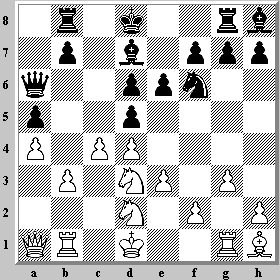
D.Bronstein
(After 10.e2-e3)

Now Black castled 10...O-O (Crowther: 'The black King goes to g8 and the black Rook to f8') and White played 11.Ke2. Here the game starts to look very much like a traditional chess game, except for the Black Bishop buried on h8. After 11...g6, even that difference fades into the game score.

Given the general lack of material about chess960, it's not surprising that there is very little on the web about the Bronstein - Douven game. Google locates David Bronstein herzien?, a Dutch review of a new (2009) edition of 'The Sorcerer's Apprentice' by Bronstein & Fürstenberg. That's the same Furstenberg who reported the game to TWIC in 1996.

Google also does a reasonable job of translating the book review, where we learn the reviewer's main objective: 'The question was whether the need is so new and expanded version. And to answer that question, go look for the differences.' That's a good question, because I have the 1995 edition of 'The Sorcerer's Apprentice', and I would also like to know what's new. It turns out that the chess960 portion of the review is:

And gives a lot Fürstenberg Bronstein - Douven, from a friendly game Anderlecht - Eindhoven, with random chess is played. The reader is warned of passing and the fact that Fischer Random is a derivative of an idea that Bronstein himself has invented twenty years earlier.

Perhaps not coincidentally, near the end of the 1995 edition is a brief Q&A passage explaining why Bronstein, a World Championship challenger in 1951, might have been attracted to chess960 in 1996:

Q: Classical chess appears to be in a state of crisis. • A: Because chess has already been studied so thoroughly. The aura of mystery has vanished! Today chess relies on the splendid memory of the young. They complain that they have to work hard, that our generation does not understand them, does not realize how difficult it is to digest thousands of games, commit a mass of information to memory, and not confuse the proper order of moves in reproducing a 20-move long variation on the board. I appreciate that this involves enormous physical and mental strain. But this has nothing in common with the chess that was played by my generation. (1995, p.289)

What about the statement that 'Fischer Random is a derivative of an idea that Bronstein himself has invented twenty years earlier'? That would also make a good subject for another post.
07 November 2009

Fischerandom's Inauspicious Start

The press release issued for Fischer's press conference in June 1996 -- see Fischer Announces Fischerandom for the full text of the announcement -- contained two mentions of a forthcoming match.
The object of the conference was to publicize the launch of Fischer's new game, Fischerandom Chess, and to announce the match of Fischerandom Chess between Philippine Grandmaster Eugene Torre and two-time Argentine champion International Master Pablo Ricardi which begins July 12.

and

Now the world awaits the first Fischerandom Chess match which will commence at Pasaje Dardo Rocha in the Argentine city of La Plata on July 12. The match between Torre and Ricardi will be played until one player accumulates four victories, draws not counting.

What was the result of that match? The only mention I could find was in TWIC 91 (14 July 1996).

8) Fischerrandom Match between Torre and Ricardi. Eric van der Schilden is there for the match and will cover it on the TASC www page. It has been postponed for a few days due to the continuing illness of Ricardi see: http://www.tasc.nl/frandom

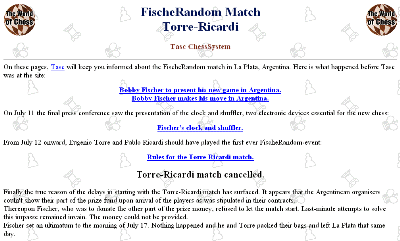
The tasc.nl link is long defunct, but the page lives on in Archive.org: web.archive.org/web/*/www.tasc.nl/frandom/. Here's a screen shot of that page, titled 'FischeRandom Match : Torre-Ricardi'.


After informing us that

On July 11 the final press conference saw the presentation of the clock and shuffler, two electronic devices essential for the new chess: [Fischer's clock and shuffler]. From July 12 onward, Eugenio Torre and Pablo Ricardi should have played the first ever FischeRandom-event: [Rules for the Torre-Ricardi match].

the page ends abruptly with (sic)

Torre-Ricardi match cancelled. Finally the true reason of the delays in starting with the Torre-Ricardi match has surfaced. It appears that the Argentinean organisers couln't show their part of the prize fund upon arrival of the players as was stipulated in their contracts. Thereupon Fischer, who was to donate the other part of the prize money, refused to let the match start. Last-minute attempts to solve this impasse remained invain. The money could not be provided. Fischer set an ultimatum to the morning of July 17. Nothing happened and he and Torre packed their bags and left La Plata that same day.

Over three weeks passed between Fischer's press conference and the cancellation of the kickoff match.

01 November 2009

Fischer's Rules of Fischerandom

When I wrote the post Fischer Announces Fischerandom, I omitted the rules published by Fischer in June 1996. They can be found here...
Bobby Fischer's Rules of Fischerandom Chess
http://www.mark-weeks.com/cfaa/chess960/frcrules.htm

...For a much simpler version of the rules, see Fischer Explains the Rules of Fischer Random. The rules were also copied into Gligoric's Shall We Play Fischerandom Chess?, in the chapter titled 'Fischerandom Rules' (p.86-92). For other copies of the rules, which likely lead to other resources about chess960, see Google: "pieces on their respective back rows receive an identical random shuffle".

Fischer's rules included the following explanation...

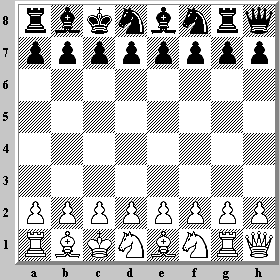
White and Black have identical positions. From behind their respective Pawns the opponents' pieces are facing each other directly, symmetrically. Thus for example, if the shuffler places White's back row pieces in the following position: Ra1, Bb1, Kc1, Nd1, Be1, Nf1, Rg1, Qh1, it will place Black's back row Pieces in the following position, Ra8, Bb8, Kc8, Nd8, Be8, Nf8, Rg8, Qh8, etc.

...where the position used in the example is shown in the following diagram.


Start Position 760

Did the position have some special meaning for Fischer or was it also chosen at random?

***

Later: Gligoric mentions earlier in his book (p.36) that the rules he quotes were formulated in September 1993, almost three years before the press conference announcing them.

31 October 2009

Fischer Announces Fischerandom

Fischer's initial press release about *his* version of chess was an item in Mark Crowther's THE WEEK IN CHESS (TWIC) no.88, dated 24 June 1996. Here's a copy of the press release:
BOBBY FISCHER MAKES HIS MOVE IN ARGENTINA (Press Release from Argentina)

Bobby Fischer returned to Buenos Aires, Argentina after 25 years and it was as if he had never left. At a press conference on June 19 in the Argentine capital, the World Chess Champion was received by hundreds of journalists and chess fans, many of whom had come from all over the world. It was apparent from the feeling of anticipation in the room before he arrived that the Fischer mystique is alive and well.

The object of the conference was to publicize the launch of Fischer's new game, Fischerandom Chess, and to announce the match of Fischerandom Chess between Philippine Grandmaster Eugene Torre and two-time Argentine champion International Master Pablo Ricardi which begins July 12. Both players attended the conference and displayed enthusiasm regarding the match and the new game.

Before taking questions from the assembled press, Fischer spoke out on several topics. He apologized for bringing up subjects unrelated to Fischerandom Chess, and he then began a counterattack on several companies that he claimed had been defrauding him of huge amounts of money as well as trying to destroy his image. He targeted the British publisher Batsford for releasing a forged and unauthorized new edition of his renowned chess classic "My 60 Memorable Games", for deliberately making erroneous changes in the text itself and for never having paid him royalties for the book. He also attacked the motion picture company Paramount, producer of the hit film "Searching for Bobby Fischer", saying he never received "a penny" from the film. He also mentioned a CD-ROM, "Bobby Fischer Teaches Chess", that had been made using his name unlawfully. He strongly criticized US Secretary of Commerce Mickey Kantor for not protecting his intellectual property rights in direct contradiction with Kantor's position on Red China, which Kantor has denounced for alleged violations of international copyrights. Fischer angrily accused the U.S. government of a double standard and disgusting hypocrisy in this regard. He made the point that his new, improved version of classical chess will eliminate the large amount of study and analysis that are involved in chess. He stated that many games are prearranged before the players begin the game, and that even the so-called world championship matches between Russian players Kasparov and Karpov had been prearranged, and that this would be impossible in Fischerandom Chess.

Fischer also ridiculed the U.S. government for indicting him and issuing a federal arrest warrant in his name for his alleged violation of an executive order by then President Bush barring U.S. citizens from doing business with Yugoslavia. Fischer claimed one of the reasons the U.S. government has indicted him and issued the arrest warrant, which is valid all over the USA, was to prevent him from returning to the USA to get access to his enormous file on the first so-called world championship match between Karpov and Kasparov so that he could write a book proving that that match was prearranged move by move.

After making these impassioned remarks, Fischer answered questions from the press for nearly an hour. In explaining the concepts behind Fischerandom Chess, Fischer said that although the rules are basically the same as those of traditional chess, each game begins from a different starting position, randomly chosen by the Fischerandom Chess Computerized Shuffler, making creativity and chess talent more important than analysis and memorization. He also pointed out that due to such long hours in front of the computer screen and with books, many top young players today, such as Kamsky, Kramnik and Anand, wear thick glasses. He also mentioned that all of the study necessary to play conventional chess made it into hard work, and that he had got into chess in order to avoid work!

With many people wondering about the future of chess after the IBM computer Big Blue beat Garry Kasparov earlier this year, Fischer's statement that computers would be at a considerable disadvantage in Fischerandom Chess received a great deal of attention. He stated that without access to databases of the millions of opening variations in traditional chess, computers do not really play chess all that well.

Now the world awaits the first Fischerandom Chess match which will commence at Pasaje Dardo Rocha in the Argentine city of La Plata on July 12. The match between Torre and Ricardi will be played until one player accumulates four victories, draws not counting.

The appearance of Robert J. Fischer in Buenos Aires left no one disappointed. After finishing with the questions, Bobby signed autographs for the dozens of fans who had come to catch a glimpse of the legendary genius. Many of the chess fans had clear memories of his last visits to Buenos Aires in the early seventies. Fischer's popularity here was clearly shown as well by the intense coverage by all the local media. Everyone is eagerly looking forward to Bobby Fischer's next move, whether it be on or off the board.

RULES OF FISCHERANDOM CHESS

[...]

I've truncated the press release to remove the rules, which were longer than the release itself. Since they represent an integral contribution to the history of chess960, I'll post them elsewhere. Crowther had this to say about Fischer's press conference (copied verbatim):

6) FISCHER RETURNS TO THE LIMELIGHT

Bobby Fischer returned to the limelight three years after his match against Boris Spassky in Yugoslavia. Bobby Fischer provokes extreme reactions from most chess fans. I'm very much of the school that found both his play and his life-story fascinating (Bobby Fischer Profile of a Prodigy by Frank Brady is an excellent and very balanced account of his career up to 1972) and find it rather sad he won't return to over-the-board chess. (Brady quote "He [Fischer] accepted an invitation to compete in the great Capablanca Memorial Tournament to be held in Havana, Cuba from August 25th to September 26th. I know some people who cried with joy when they heard the news.") This would certainly be my reaction if he decided to play now. But the press conference and the wait from 1992 suggests that Fischer doesn't have the commitment to work on chess anymore, this press conference is Fischer effectively announcing his retirement.

Whilst I'm sure that he has thought very deeply about the development of the Fischerandom Chess I don't think that things have changed so radically in over-the-board chess as he makes out. Fischer himself brought to new heights the level of opening preparation required to compete at the highest level. Fischer on the way to the World Title in 1972 studied at least as hard as they do nowdays on the openings. Recent International Tournaments show that there is still a lot of creativity possible in the opening, and some players don't work especially hard on their openings. Karpov shows that you can get by playing a limited series of systems and rely upon the middlegame for results. Fischer's obsession with fixed games is certainly as a result of personal observation during his own career (I don't quite believe it was as rife as he says but it is certain that the Russian's did agree draws with each other very frequently in those days) but the rivalry between Karpov and Kasparov makes it impossible to believe they fixed games.

I think it was a big shock to Fischer when he came back against Spassky, it is said that friends from throughout the World sent him masses of analysis that was unlooked at during that match. The sheer volume of material probably brought it home to Fischer that there was no way back to the very pinnacle of World Chess (as a student of 19th Centuary chess Fischer should have known that with Andersson's comments about his match against Morphy) but it doesn't mean that he couldn't have competed at a high level. The message from Argentina is that he has no will to do the work on the openings. His demeanour against Spassky suggested that he did enjoy competing again but this didn't last after the match, perhaps he enjoyed it too much?

One wonders what Reshevsky would have made of all this. Reshevsky struggled against Fischer throughout the 60's when Fischer's superior knowledge of openings had a direct effect on their results (remember Fischer winning in about 12 moves due to a piece of Russian analysis refuted a quite standard Sicilian setup?).

So, its all over for Fischer, he leaves a legacy of superb games, one wonderful book, and a life story packed with incident. I wouldn't be Bobby Fischer for any money. His capacity to surprise, and also shock will remain but it would be the biggest shock of all to see him play chess again.

Crowther appears to have been more interested in Fischer than in the variant he was trying to promote. I suspect that was the case with most observers in the mid-1990s.

25 October 2009

Castling Stats

In More from Mainz 2009, I quoted Alexander Grischuk, the winner of the chess960 open at the 2009 Chess Classic Mainz, on castling in chess960: 'You should not castle too quickly because you still keep the option to castle on the other side. In some positions it's totally clear to which side you will castle. Then it makes no sense to delay it.'

This made me wonder if the choice of which side to castle is consistent between chess960 and traditional chess. In other words, after castling do the Kings end up on the two sides of the board -- Kingside or Queenside (h-side or a-side in chess960 parlance) -- with the same frequency in both versions of the game. The game scores from the 2009 Chess960 Rapid World Championship (RWC), won by Nakamura, seemed to indicate that there was no castling in many games and that castling O-O-O occurred more often castling O-O. This is contrary to my experience in traditional chess and I decided to do a simple analysis.

First I looked at the games from the recent Pearl Spring tournament, won by Carlsen. In the 30 games played there I found that O-O occurred 42 times and O-O-O occurred 14 times. This means that of the 60 times the castling option was presented (30 games x 2 players per game), the players castled 56 times. In those games where the players castled, castling O-O occurred 75% of the time and castling O-O-O 25%. These results were approximately what I expected to see.

The 2009 RWC presented a different picture. In the 20 games played, O-O occurred 9 times and O-O-O occurred 14 times. This means that of the 40 castling opportunities, the players castled only 23 times, and O-O-O was played more often than O-O.

Would previous years confirm this result? The year 2008 saw a match for the Women's RWC title, with fewer games than in 2009, so I skipped to 2007. The 2007 RWC featured 22 games. The move O-O occurred 29 times and O-O-O occurred 8 times. These results were more in line with the Pearl Spring statistics.

My conclusion was that the samples were too small to be meaningful. I'll come back to this question another time when I have more data to analyze.