Showing posts with label Resources. Show all posts

15 February 2025

'What's in a Name?' - It's Back!

Last month's post A Freestyle Fight (January 2025; '2025 Freestyle Chess Grand Slam Tour' [FCGST]), demands two follow-ups:-
  1. The resolution of the 'fight'
  2. The results of the first leg of the FCGST, held in February at Weissenhaus, Germany

First let's have some consequent off-board news that has been lingering since late last year: Wikipedia changed the name of its main Chess960/FRC page from 'Fischer Random Chess' to 'Chess960'; see Talk:Chess960 - Wikipedia (wikipedia.org; 'Requested move 29 October 2024'), for the not-so-consequent discussion. I made a similar choice when I first started to investigate Fischer's idea, a choice that was reinforced a few years later:-

Unlike Wikipedia, I don't have the time to return to the decision every five years. Let's get back to FCGST, which has jumped across all three of my chess blogs. After 'Freestyle Fight' on this blog, the latest chess960 alias popped up on my main blog in World Championship Yahoos 2025 ('1/?'; January 2025). To summarize:-

Those 104 stories were supplemented by two additional pages: 'Magnus Carlsen on Freestyle chess controversy' with 25 stories [...] I'm covering the freestyle saga on my chess960 blog, because 'freestyle' is one of numerous aliases for chess960. [...] The dispute is about FIDE's claim to have the exclusive right to any 'World Chess Championship'.

Any reference to 'World Chess Championship' is automatically a candidate for discussion on my blog of the same name. So far there have been two posts:-

End of story? Maybe, maybe not. Here are the Chess.com reports providing background and comments to all of the above. All reports were signed 'TarjeiJS', i.e. Tarjei J. Svensen, Norwegian journalist and ally of GM Carlsen.

It's clear that Carlsen has an axe to grind with FIDE and has convinced a wealthy backer to support his cause. History tells us that in any dispute between a top player and FIDE, the court of public opinion favors the player. History also tells us that FIDE wins the off-court struggle.

That's enough of the politics. The next post will record the result of the Weissenhaus leg of the FCGST, which finished yesterday.

28 September 2024

A Flawed Chess960 Study

A chess study is a composed position which illustrates some unexpected theme. It is usually a position which could arise naturally from a game between two skilled players. This distinguishes it from a chess problem, which is based on a composed position that is extremely unlikely to arise in a real game. An academic study is something completely different.

When was the last time you saw a research paper based on a study of chess960? There must have been others, but this is the first one I can remember seeing. Titled Machine Learning Algorithms to Predict Chess960 Result and Develop Opening Themes (arxiv.org; 'submitted on 29 Oct 2023'), it lists its authors as:-

Shreyan Deo, DPS Vasant Kunj, Delhi, India • Nishchal Dwivedi, Department of Basic Science and Humanities, SVKM’s NMIMS Mukesh Patel School of Technology Management & Engineering, Mumbai, India

The 'Abstract' offers a useful overview. In its entirety it says,

This work focuses on the analysis of Chess 960, also known as Fischer Random Chess, a variant of traditional chess where the starting positions of the pieces are randomized. The study aims to predict the game outcome using machine learning techniques and develop an opening theme for each starting position.

The first part of the analysis utilizes machine learning models to predict the game result based on certain moves in each position. The methodology involves segregating raw data from PGN files [NB: CCRL was the source] into usable formats and creating datasets comprising approximately 500 games for each starting position. Three machine learning algorithms -- KNN Clustering, Random Forest, and Gradient Boosted Trees -- have been used to predict the game outcome.

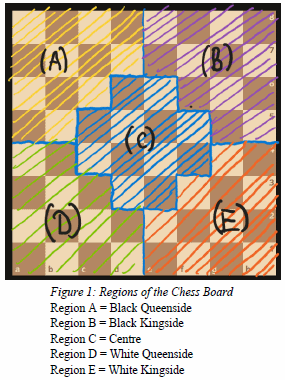
To establish an opening theme, the board is divided into five regions: center, white kingside, white queenside, black kingside, and black queenside. The data from games played by top engines in all 960 positions is used to track the movement of pieces in the opening. By analysing the change in the number of pieces in each region at specific moves, the report predicts the region towards which the game is developing. These models provide valuable insights into predicting game outcomes and understanding the opening theme in Chess 960.

Keywords: Chess 960 [Chess960], Fischer Random Chess, machine learning, game outcome prediction, opening theme, KNN Clustering, Neural Networks, Gradient Boosted Trees.

Note: Trying to see just by looking at the snapshot of an evolved game how accurately we can predict who will win

The 16-page paper is interesting for many reasons. I extracted the section headers to create a table of contents:-

1. Introduction

2. Methodology
2.1. Segregation of Data
2.2. Visualising Chess Positons as Numbers
2.3. Predicting the Outcome
2.4. Developing an Opening Theme

2. Modelling [should be '3.'?]
3.1. KNN Clustering
3.2. Random Forest
3.3. Gradient Boosted Trees

4. Result
4.1. Outcome Prediction
4.2. Theme Analysis

5. Discussion
5.1. Discussing the Accuracy of the Predictions
5.1.1. Comparing the Different Data Sets
5.1.2. Comparing the Different Machine Learning Models
5.1.3. Disparity in the Accuracies of Certain Starting Positions
5.1.4. Possible Reasons for Low Accuracy Rate
5.2. Discussing the Theme Analysis and Its Importance

6. Conclusion

7. Future Developments & Limitations

8. References [eight total]

9. Appendix

The section '9. Appendix' starts,

This section traces the opening theme of each individual starting position. The heading provided is in the form X_Y, where X represents the region in which White pieces tend to develop, and Y represents the region in which Black pieces develop.

This is very useful in individually finding out how each specific starting position should be played. For example, the position BBNNQRKR should be played by the players such that White attacks the Black Queenside whereas Black attacks the White Kingside.

Why choose SP032 BBNNQRKR as an example? Because it's the study's first position in the first group of positions, all of which are under the header 'Black Q Side_White K Side'. A useful diagram ('Figure 1: Regions of the Chess Board') from the study helps to explain how it sees the different sections of the board.

Unfortunately, the explanation ('should be played by the players such that...') of BBNNQRKR is dubious:-

  • 'White attacks the Black Queenside'
  • 'Black attacks the White Kingside'

The position BBNNQRKR clearly shows that the two Bishops ('BB') on the Queenside are attacking the castling pieces ('RKR') bunched together on the Kingside. That indicates how both sides will proceed. How should White attack the Black Queenside? With the Knights ('NN')?

At this point it's worth remembering that at the start of each game both players have identical piece placements. The difference is that one side moves first and thereby has a natural initiative.

The traditional start position (SP518 RNBQKBNR), is grouped under 'Black Q Side_Centre', meaning:-

  • 'White attacks the Black Queenside' [as in the previous example]
  • 'Black attacks the center'

Here it's worth remembering that White has a choice of first moves (1.e4, 1.d4, etc.) with different strategies for developing the pieces. The other 959 start positions also offer a choice of strategies. I can't remember playing many (correspondence) chess960 games where White has a first move that is clearly better (NB: 'SP864 BBQRKRNN' & 'SP868 QBBRKRNN' are not clear). Is it possible to group the subsequent developments of different first moves for one start position under a single header, e.g. 'White attacks... _ Black attacks...' ?

The rest of the paper is equally unconvincing, although there are large portions that I didn't understand. One key illustration ('Figure 3') is incomprehensible because the column headers are clipped to be identical.

An important discussion starts with '5.1. Discussing the Accuracy of the Predictions'. It says,

The results of the machine learning models were quite surprising yet also logical. All the predictions were only [around] 40% accurate, which is only slightly better than randomly guessing an outcome and getting it right, the probability of which is 33.33% (as there are only 3 outcomes possible).

Another section, '5.1.4. Possible Reasons for Low Accuracy Rate', offers several 'possible reasons', but ignores the most obvious. The methodology of the study might well be seriously flawed.

25 November 2023

Organizing an OTB Chess960 Tournament

A couple of months ago, in What about Biel? (September 2023), I wrote,
Before I discovered this video, my objective in the search was to learn about best practices for organizing and directing an OTB (i.e. not online) chess960 tournament. The year 2023 saw both a round-robin and a Swiss chess960 event in Biel. What can be learned from them?

I posted a few more times about Biel, where the most recent was Live Coverage from Biel (November 2023). I didn't learn much about Biel 'best practices', but I did have the time to create my own list of points to consider.

Note that I've never participated in an OTB chess960 tournament, so I have no direct experience here. I've discussed the main points with a few people, always informally. If you have something to say about the subject, you can leave a comment at the end of this post. Here's my list of considerations (SP = Start Position):-

  • Allow SP518 RNBQKBNR?
  • Play same position on each board?
  • Play two games with each SP?
  • Use what time control?
  • Use what ratings for seeding / pairings?

  • Choose SPs how? [A]
  • Announce chosen SP how?
  • Announce SP how long before game starts? [B]

The first five questions can be decided beforehand. The last three are more operational. The comments in brackets ('[]') have further considerations below.

[A]: There are a number of pitfalls to avoid. The first pitfall involves the SP generator on Chessgames.com, which uses nonstandard numbering. I've posted a few times about this:-

The second pitfall is that there are a number of bad algorithms in use. They are bad because they overlook the requirement that all SPs should have an equal possibility of being chosen. See, for example:-

For some novel selection methods -- not necessarily good -- see:-

[B]: One idea is to distribute a short list of SPs before the event starts, then choose one SP from the list before each round. This allows for some brief home preparation. The short list can be longer than the number of rounds, e.g. twice the number, to satisfy purists who want to keep home preparation to a minimum.

While preparing this post, I found an interesting description for the NZ Fischer-Random Championship 2023 (newzealandchess.nz; New Zealand Chess News). The announcement ('Format') said,

There will be two six-round Swisses. The A-grade is restricted to players familiar with Fischer-Random (Chess 960) rules; the B-grade is open to less experienced players (the Organisers reserve the right to move a player to an appropriate section).

We are using FIDE rapid ratings for seeding, and will apply FIDE rapid chess rules (eg 2nd illegal move loses the game). The time control is 25 minutes for the game with 5 seconds increment per move from move one.

Positions will be drawn at random and displayed. Players will be expected to set up the boards themselves, and there will be 10 minutes between the start of the round and the start of the clocks, for players to study the position (without moving any pieces).

One of the problems in researching 'best practices' is the large number of synonyms for chess960, like 'FRC', etc. Add that to the large choice of relevant keywords and I was never sure if I was overlooking good announcements.

30 September 2023

What about Biel?

The annual chess960 tournaments at Biel (Switzerland) have been running for some years now and I've never given them a good look. In a recent post, Talking About Chess960 (July 2023), Biel appeared twice with links to the results:-
'ACCENTUS Chess960 (ACC) - Biel International Chess Festival (bielchessfestival.ch; w/ PGN)' *and* 'Swiss Rapid Fischer Random Championship (bielchessfestival.ch) • The runner-up was popular streamer "IM Rosen Eric"; possible action: review his resources.'

That first tournament, 2023 ACCENTUS, was streamed live; the coverage starts at 9:10 in the following video:-


Biel Chess Festival 2023: GMT Chess 960 (2:59:21) • 'Streamed live on Jul 15, 2023'

The description doesn't add much except an error:-

Biel Chess Festival 2022 [?; sic] live from Biel/Bienne, Switzerland.

Before I discovered this video, my objective in the search was to learn about best practices for organizing and directing an OTB (i.e. not online) chess960 tournament. The year 2023 saw both a round-robin and a Swiss chess960 event in Biel. What can be learned from them?

It turns out that this video is the first of two parts and that there are previous year streams going back to 2020. Before I go any further with this post, I need to determine exactly what I'm looking at.

29 July 2023

Talking About Chess960

Almost every month, when I'm preparing a post for this blog, I check on recent chess960 news. By 'recent', I mean going back no more than a year, and by 'news', I mean a straightforward Google search on all web pages. Since I have no particularly compelling topic for this post, I'll report on the results of this month's search. Many of the results referred to last year's World Championship (FWFRCC), which I will skip, instead referring visitors to my post 2022 FWFRCC Wrapup (December 2022).

The No.01 and No.02 results for 'chess960' were for the Wikipedia and Chessable pages on chess960/FRC. The No.03 result was for:-

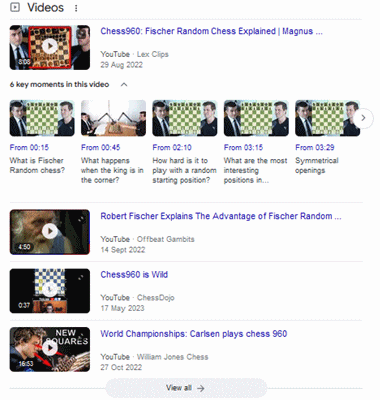
In fact, that clip was the lead video in what looks like a blatant promotion for Google's Youtube service. I captured the entire entry in the following screen shot.

No.04 and No.05 were for Digital Game Technology (DGT) and Chess.com. The following entries show other resources that I found interesting. Pages explaining the basics of chess960, for example, are excluded.

I used to classify chess960 tournaments as 'rare birds', because there were so few of them. See, for example, First Post, New Year (January 2019), where I wondered,

Should I retire the 'rare birds' series, last seen in (Not so?) Rare Birds, Summer 2017 (July 2017)? No, I'm a patient person, so I'll give it more time. I haven't seen any relevant announcements and all of the events mentioned above could have been one-offs.

That was indeed the last post in the series, until this current post. Now there are enough chess960 tournaments that there is no danger of imminent extinction. The next entry is one of several local tournaments that I could have flagged.

I stopped the exercise at no.60. After 'chess960', I did the same search on 'chess fischer random'. No.01 and No.02 were for Wikipedia and Youtube videos. No.03 and No.04 were both for Chess.com, while No.05 was for Chessable. Following are a few more, (mostly) not repeating what I discussed above.

I again stopped the exercise at no.60. All in all, there are some good leads for future posts.

24 June 2023

Chess960 in the Cloud

In a recent post, When Chess960 Reduces to Chess (May 2023), I wrote,
The point where castling is no longer an option is exactly where chess960 starts to look and feel like chess starting from the traditional position (SP518 RNBQKBNR). This is the point where a chess service like Chessify becomes fully viable.

A few weeks before writing that post, I had the opportunity to use Chessify on live chess960 positions. I was traveling for two weeks without any of the software tools I normally use for correspondence chess960. Before leaving home, I loaded six games into Chessify by using their 'Import' function to enter the current FEN position for each of the games. Most of the games had already reached the point where castling was no longer an option, but there were a couple of exceptions. A week into my trip I finally had some time to look at the games.

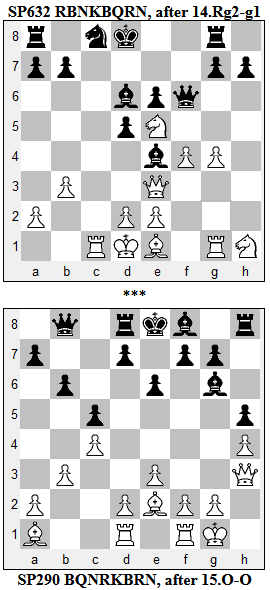
In the diagram's top position White has lost the castling privilege, while Black can still castle to both sides. I was playing Black. Stockfish NNUE on Chessify told me that 14...g5 was by far the best move, leading to a slight advantage for White. I vaguely remembered from my previous analysis that Black had an advantage in the position and decided that it must have something to do with castling. Since ...O-O-O isn't happening any time soon, the correct line must involve ...O-O. The move 14...O-O is a blunder because of 15.Nd7, which suggests 14...Nb6 to protect d7. Using Stockfish to continue the analysis and manipulating the FEN to simulate ...O-O, I decided that 14...Nb6 must be the right move and played it.

When I returned home, I looked at my previous analysis and discovered that 14...g5 was indeed the right move, leading to a significant advantage for Black. With 14...Nb6, I had spoiled my position and gone from a probable win to a struggle for a draw.

In the bottom position White has just castled, while Black can still castle ...O-O-O. I was again playing Black. Still using Stockfish NNUE, I decided that 15...O-O-O was premature and played 15...f6 instead. Back home I was happy with this move and after 16.f4, continued 16...O-O-O.

A few moves later I started to see weirdness from Chessify's Stockfish. I always calculate multiple variations (MPV in chess jargon) and reached a position where around depth 25, a key move disappeared from White's candidate moves and another move appeared twice. With the help of Chessify support (top notch in my opinion) I discovered that the FEN for the position was wrong. It indicated that both White and Black could still castle to the side where they had already castled. I corrected the FEN and the Stockfish analysis appeared normal. I decided that there was a bug in Stockfish triggered by faulty FEN.

In my four other games nothing unusual happened. While traveling I made a move or two in each game and when I returned home confirmed that my play was correct. My conclusions from this exercise? 1) Playing using only cloud tools is feasible; and 2) Playing chess960 with an engine that doesn't understand chess960 castling is possible, but risky. Always double check the chess960 FEN...

17 June 2023

Two PGN Challenges Met

At the end of my previous post, Two PGN Challenges (May 2023), I wrote,
Here are two challenges for a future post: 1) Locate the PGN for both events, and 2) Locate a PGN viewer that understands chess960.

Not long after writing the post, I received an anonymous comment pointing to a number of resources on Lichess; see that post for details. I also discovered that the PGN for the two events is available from TWIC:-

I added the first of the three links to the list because I found it using a search on 'chess960'. The other two links appeared on searches for '9LX' and 'random' (i.e. FRC).

The Lichess comment described a method for embedding games from Lichess. Here's a game from the 2022 FWFRCC.

After I post this, I'll check if the Lichess functionality has survived the Blogger/Blogspot environment.

***

Later: Re 'I'll check if the Lichess functionality has survived the Blogger/Blogspot environment', the functionality to scroll through the game is there, but the moves have disappeared and there is a useless scrollbar on the right. The embed provided by Lichess had dimensions 600x371. Since I use width=400 for images, I resized to 400x248 to get the results shown above.

Resizing to 400x300 eliminates the scrollbar, but doesn't make the moves appear. I tried width=420, which is close to the maximum for my blog template, but the moves still don't appear. The following uses 400x300, which is the best I can do for now. Note the three vertical dots between the left and right arrows. They open a menu for additional functions including viewing the game on Lichess.

27 May 2023

Two PGN Challenges

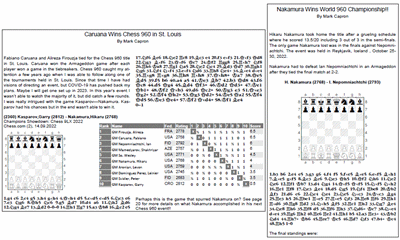
A few days ago I was working on a post for my main blog, 2023 CJA Awards Announcement (May 2023; Chess Journalists of America), and took the time to catch up on The Chess Journalist Magazine (chessjournalism.org). The issue for October 2022 carried a couple of small articles by its editor, both shown in the following composite image.


By Mark Capron
Left: 'Caruana Wins Chess 960 in St. Louis'
Right: 'Nakamura Wins World 960 Championship!!'

Since I had no idea that anyone associated with the CJA leadership had any interest in chess960, this caught me by surprise. In his introduction to the St.Louis article, editor Capron explained,

Chess 960 caught my attention a few years ago when I was able to follow along one of the tournaments held in St. Louis. Since that time I have had visions of directing an event, but COVID-19 has pushed back my plans. Maybe I will get one set up in 2023.

That is all very good news indeed and I could end this post here, but the two small articles got me thinking about chess960 reporting in general. Both articles use the same structure: an introduction, a selected game with a diagram, and the final result of the event. [NB: The eight top finishers of the World Championship (aka '2022 FWFRCC', as used below) have been cropped out of my image. The last line says, 'The final standings were:' ...]

Both diagrams have been used to identify the game's start position. This could have also been done with the relevant portion of the FEN string -- RBBNKNRQ and BRKRQNNB, respectively -- leaving the diagram to convey a more interesting position from the game. Of course, we have more powerful tools online ... or do we?

In the nearly 15 years that I've been blogging about chess960, I can't remember ever using a chess960 PGN viewer to present a game online. There were no such tools when I started and I haven't been paying sufficient attention to know if any have been developed since then.

Even that assumes the PGN is available for download in digital format. I wrote blog posts on the two events mentioned in the CJA journal...

...and I can't remember downloading PGN for either event. Here are two challenges for a future post: 1) Locate the PGN for both events, and 2) Locate a PGN viewer that understands chess960. I would hope that both challenges are trivial, but I suspect that I'm dreaming.

20 May 2023

When Chess960 Reduces to Chess

Let's talk turkey. Once in a while I like to document my recent experience playing chess960 online. Earlier this year I posted The Fascinating World of Chess960 (January 2023), where I wrote,
Last month's post was also about switching to a different online service for playing chess960. [...] I continued playing on LSS until last year. I was playing chess960 in a couple of multi-stage events, where success in one stage promotes a player to the next stage. I decided to skip the next stages, essentially taking a year off from serious play. [...] I switched to Chess.com in May 2022, playing one or (maximum) two games of correspondence chess at a time.

A month later I wrote a post about a Chess.com service, Chess.com Reviews a Chess960 Opening (February 2023). Since then I've stopped playing Chess.com for reasons that I won't discuss in this post. I went back to LSS, partly with the intention of evaluating Chessify for chess960.

This is the first time I've mentioned Chessify on this chess960 blog, although I've discussed the service several times on my main blog. In Chessify Resources (March 2023), I wrote,

The main problem with chess960 in a traditional chess environment stems from the castling rules. Since chess960 games tend to become extremely tactical after a few moves have been played, there is nevertheless some value in trying to confirm the tactics with a traditional, non-chess960 engine. [...] I'll continue using Chessify to look at chess960 positions.

There are three phases of a chess960 opening (often overlapping with the early middle game):-

  • Both sides can castle.
  • One side loses the castling privilege.
  • The other side loses the castling privilege.

I say 'loses the castling privilege', because it can arise when castling, when the King moves, or when both Rooks move. The point where castling is no longer an option is exactly where chess960 starts to look and feel like chess starting from the traditional position (SP518 RNBQKBNR). This is the point where a chess service like Chessify becomes fully viable.

18 March 2023

Myth No.6 - 'Forced Wins for White'

Upon encountering chess960 for the first time, one of the first questions a new player asks is 'Are all 960 positions fair?'. I included a statement of this concern in Top 10 Myths About Chess960 (May 2012), where one bullet said,
Some start positions are forced wins for White

Remembering that I wrote this more than 10 years ago, at a time when I wasn't absolutely 100% sure that such unfair positions didn't exist, my standard response to the statement was, 'Which positions are forced wins? Please provide a specific example'. I never received a single example. Ten years later I can say with more confidence -- although still not 'absolutely 100% sure' -- that while some positions are difficult for Black to play, none of the 960 positions is lost before a single move is made.

In January a new study titled, Analyzing Chess960 Data | Alex Molas | Towards Data Science (towardsdatascience.com), appeared. Its subtitle announced,

Using more than 14 million chess960 games to find if there’s a variation that's better than the others.

There is considerable knowledge presented in the study and I don't pretend to understand all of it. I might well need several posts to unravel its subtleties, so I'll start by summarizing its references; in the following discussion, '>>>' means a direct quote from 'Analyzing Chess960 Data'.

>>> 'The original post was published here...'

[NB: I'll come back to this reference later; see '(A)' below. First I need to point out that there's an important issue with terminology. When chess players use the term 'variation', they mean a sequence of play arising from a specific position; e.g. 'In this position I had two variations and I had to work out which variation was better for me.' • In the Molas study, I'm convinced that the word 'variation' refers to one of the well-defined 960 start positions that are legal for chess960. I read the subtitle of the towardsdatascience.com article as 'to find if there’s a *start position* that’s better than the others' and the title of the amolas.dev post as saying 'Discovering the best chess960 *start position*'. I won't repeat this caveat each time, but it's important and helps to understand the discussion.]

>>> 'Ryan Wiley wrote this blog post where he analyzes some data from lichess..'

>>> 'There’s also this repo with the statistics for 4.5 millions games (~4500 games per variation)...'

[NB: There's an issue with the word 'variant' here, but it's not as important as the previous 'NB'. Chess960 purists will know what I'm talking about.]

>>> 'In this spreadsheet there’s the Stockfish evaluation at depth ~40 for all the starting positions...'

>>> 'There’s also this database with Chess960 games between different computer engines. However, I’m currently only interested in analyzing human games, so I’ll not put a lot of attention to this type of games...'

>>> 'Lichess -- the greatest chess platform out -- maintains a database with all the games that have been played in their platform...'

>>> 'To do the analysis, I downloaded ALL the available Chess960 data (up until 31–12–2022). For all the games played I extracted the variation, the players Elo and the final result...'

>>> 'The scripts and notebooks to donwload [sic] and process the data are available on this repo...'

At this point the article launches into 'Mathematical framework; 'Bayesian A/B testing; [...]'. This, of course, is the essence of the study and I won't go any further in this current post. Let's get back to '(A)', where there's another key reference.

>>> 'This post got some attention in Reddit...'

I could end the post here, but I need to make an admittedly subjective observation. There are two example of bias in the above references.

The first bias is 'I’m currently only interested in analyzing human games'. Huge caveat here. In my not-so-humble opinion, the CCRL is the best source of chess960 opening theory. Period. Full stop. The CCRL engines are rated at least 1000 points higher than most human players on Lichess. The engines don't make simple tactical errors and they calculate deeper into every position than any human can. If there is an unfair chess960 start position, the engines will find it, just like they find errors in most games played between humans.

I can understand ignoring the engines because humans grapple with different challenges in chess960 openings, but the purpose of the study was 'to find if there’s a *start position* that’s better than the others'. Ignoring the experience of the best players on the planet is severely limiting.

The second bias is 'Lichess -- the greatest chess platform out'. The main alternative here is Chess.com. Why ignore games played on the world's largest chess platform? Maybe there's a good reason, but I can't think of one. On a personal note, last year I investigated which of the two sites would be better to continue my own chess960 correspondence play. I determined that Chess.com was more serious about eliminating human players who cheat by using engines in games with other humans. Since my goal was playing no-engine games, I went with Chess.com. How much of the Lichess data involves concealed engine use?

Biases notwithstanding, the Molas study is an important step in evaluating the fairness of all 960 positions in chess960/FRC. I'm looking forward to understanding it in more depth.

28 January 2023

The Unusual World of Chess960

If the previous post was about The Fascinating World of Chess960 (January 2023), then this post is about the other side of the coin. Here are a few topics I've noted in the recent past that don't fit in with any other discussions.

FRC Human Openings

While the most recent TCEC Superfinal ('S23 Sufi') was underway, the TCEC announced upcoming events as:-

!next • Now !Sufi * FRC human openings bonus?, Subfi, ...

I reported the Sufi results in TCEC S23, CCC19 Rapid : Stockfish Wins Both (November 2022), but made no mention of the subsequent FRC bonus. Curious what the title 'human openings' meant and finding no explanation in the usual places, I followed my standard procedure on the event's PGN: I downloaded it to my PC, loaded the headers into a database, and ran some simple queries.

I discovered that 48 games were played and that they included only the following six start positions (SPs). The numbers in parentheses show how many times each SP was played.:-

  • BRKRQNNB (x2)
  • NQRBKRBN (x6)
  • NRKQBRNB (x12)
  • NRNKBRQB (x12)
  • QRBNKBRN (x10)
  • RNBBKQRN (x6)

A year ago I ran a similar analysis and recorded my findings in TCEC FRC4 Unbalanced Books (January 2022; 'Is there a correlation between 'unbalanced books' and the degree of scrambling?'). The same question could be asked again, but first I checked whether there was any overlap between the 'unbalanced books' SPs and the 'human openings' SPs.

I found one position on both lists: SP317 NQRBKRBN. Four games from a year ago plus six games from the current exercise makes enough games for further exploration.

'Nyuk, Nyuk' from NIC

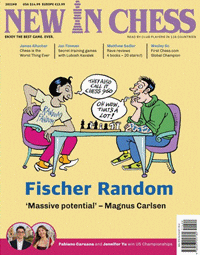
Seen on the cover of New in Chess 2022/8 (newinchess.com; New in Chess): The woman on the left, wearing a 'Random Fandom' t-shirt (nice; I love it!), says, 'They call it chess960'. The man on the right, with chess pieces tatooed on his arm, says, 'Oh wow, that's a lot!' Wait until he discovers chess960-squared, aka DFRC.

Google returns three times more references to 'Fischer Random' in the magazine than it does to 'chess960'. I suppose NIC respects the preference of its contributors. Follow the money?

Google Gets Its Wires Crossed

I recently noticed a real mystery in Google search. The home page for this C960/FRC blog showed up in the results for a search on 'chess960' with the following description:-

Chess960 (FRC) • 'It is played in the Chess 960 or Fischer Random format. Created by Bobby Fischer in the late 1990s, Chess 960 shuffles the pieces on the home rank, with 960 ...'

That's all very nice, except I didn't write it. I never split the word 'chess960' into two parts and I try not to capitalize it. Why not? Because the word 'chess' hasn't been capitalized in a long, long time. As for 'created in the late 1990s', everyone knows that it was created by Fischer in the early to mid-1990s and announced in 1996.

So where does the description come from? Apparently from 2022 Champions Showdown - Chess 9LX (uschesschamps.com):-

What is Chess 9LX? • Chess 9LX is a tournament hosted by the Saint Louis Chess Club. It is played in the Chess 960 or Fischer Random format. Created by Bobby Fischer in the late 1990s, Chess 960 shuffles the pieces on the home rank, with 960 representing the number of possible starting positions. Players will not know the order of the home rank until 15 minutes before each round.

Thanks, Google, but please note that I have nothing to do with writing copy for the Saint Louis Chess Club. I could also mention that the moniker '9LX' is an aberration, but I won't. To the Saint Louis Chess Club: Please note that I haven't plagiarized your text.

More?

There are a few more remarks I could make on minor points, but that's enough for this post. The first rule of chess960 is the same as the first rule of chess: 'Just have fun!'

23 July 2022

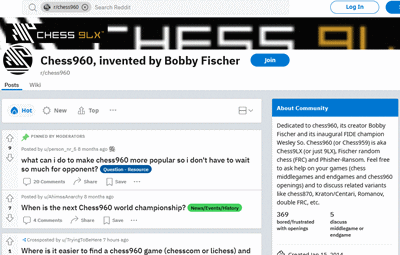
Reddit Chess960

Last year, in SP864, Reddit, Chessgames.com (April 2021), I briefly introduced chess960 on Reddit. The forum has come a long way and is now under regular management.


Chess960, invented by Bobby Fischer
(reddit.com)

That snapshot of the current home page includes two excellent pinned questions:-

  • What can I do to make chess960 more popular so I don't have to wait so much for an opponent?
  • When is the next chess960 World Championship?

The answer to that second question includes news from '16 days ago':-

Next 9LX World Championship: The Fischer Random championship will be broadcasted by the end of October. The FRC will also mark the anniversary of the 1972 WCC Fischer - Spassky.

That's great news indeed. I hope we'll be hearing more about the event soon. The Reddit post suggests that the event will be held in Iceland.

There's nothing to prevent anyone from touting a chess960 tournament as a 'World Championship'. The last legitimate claimant to the title was the event I covered last month in FWFRCC PGN (June 2022), held in 2019 and won by Wesley So. Let's see how the Icelandic organizers justify their event as a World Championship.

25 June 2022

FWFRCC PGN

Last week's post, FWFRCC Game Scores (June 2022), started, 'The year 2019 was the year of the 'FIDE World Fischer Random Chess Championship' (FWFRCC)', then developed a table documenting the tournament's various stages. It finished,
That table should allow me to identify the individual game scores. The games from later stages are more important than those from earlier stages.

The first important stage, 'Qualifying Stage 3: Knockout Qualifier Phase [Q3]', consisted of six knockout (KO) events, each with 16 strong players. Let's look more closely at the first KO event [KO1], which was reported in Nepomniachtchi Qualifies For FIDE World Fischer Random Chess Championship (chess.com; 13 August 2019).

Each of the 15 KO1 matches had at least two games (some had more). Three of those games were embedded in the Chess.com news article. Embedded games have an 'analysis' icon (lower left) that opens an analysis window, which in turn has a 'share' icon (lower right) that displays the PGN, permitting its download. That's fine for embedded games, but what about the other games?

Each player on Chess.com has a profile page. For example, the winner of 'Q3-KO1' has a page titled GM Ian Nepomniachtchi (lachesisQ) - Chess Profile (chess.com). The profile pages lead to a page 'Chess Opening Explorer & Database', initialized for that player. Unfortunately, a help page How do I use the Game Explorer? (support.chess.com), informs,

Currently, the Explorer does not index Live Chess games shorter than 5|0, Chess960 games, or any games of fewer than four moves in length.

Fortunately, the site offers an API which is documented in Published-Data API (chess.com). For GM Nepomniachtchi, all of his Chess.com games are available via lachesisq/games/archives. One of the entries there is lachesisq/games/2019/08, i.e. the month when 'Q3-KO1' was played. The FWFRCC chess960 games are mixed in with other games that Nepomniachtchi played that month, but these could be separated.

We seem to have all the pieces to build a database of 2019 FWFRCC PGN game scores. It would be a non-trivial job to gather all of the games, but it should be possible.

***

Later: Strike everything that's misleading! Re '"Chess Opening Explorer & Database" initialized for that player', I overlooked a checked option under 'Live Games' named 'All Live Types'. Uncheck that and check 'Live Chess 960' instead. For GM Nepo's games in 'Q3-KO1', the result is lachesisQ's Games (8).

It would still be a non-trivial job to gather all of the games, but nevertheless a lot easier than my original suggestion. There's no need to get into the weeds for '[player]/games/archives'. The Chess.com interface works great.

18 June 2022

FWFRCC Game Scores

The year 2019 was the year of the 'FIDE World Fischer Random Chess Championship' (FWFRCC). After posting a dozen times on the event, I summarized them in FWFRCC Wrapup (December 2019). The summary post finished with a question:-
2019-11-23: 2019 FWFRCC Final Live • 'First question: where are the game scores?'

Where indeed? I returned to that question attempting to locate as many game scores as possible. The first step was to identify the many smaller events that went into the FWFRCC. While the info probably exists in several places, a useful reference is FIDE World Fischer Random Chess Championship Quarterfinals (chess.com; October 2019), which has a detailed explanation of all stages/phases. Following is a summary of their titles plus a code in brackets ('[]') for easy reference:-

Online Qualifying; Location: Chess.com
Qualifying Stage 1: Non-Titled Open Qualifying Phase [Q1]
Qualifying Stage 2: Titled Play-In Qualifier Phase [Q2]
Qualifying Stage 3: Knockout Qualifier Phase [Q3]

Live Quarterfinals, Semifinals & Finals; Location: Baerum, Norway
1. Quarterfinals Stage 1 [L-QF]
2. Quarterfinals Stage 2 [-"-]
3. Semifinals [L-SF]
4. Finals and Third Place Match [L-FI]

The following table cross references my blog posts with the stages/phases listed above. It includes only the last post for a particular phase, which might not have been mentioned in the title of the post. For example, the 'So Beats Carlsen' post includes a writeup of the semifinals, with relevant links to Chess.com. A couple of Chess.com pages are also mentioned in the table, because they include links to the many individual events that made up the stage.

Stage/
Phase
Blog Posts
[L-FI] 2019-11-23: 2019 FWFRCC Final Live
[L-SF] 2019-11-16: So Beats Carlsen in FWFRCC Final
[L-QF] 2019-10-19: Quarterfinals of FWFRCC Completed
[Q3] 2019-09-21: Phase Three of FWFRCC Completed
[Q2] 2019-08-17: Phase Three of FWFRCC Underway; Chess.com: 2019 Fischer Random Play-In Titled Qualifier Results [12 tournaments]
[Q1] 2019-06-22: Titled Players Join the FWFRCC; Chess.com: World Fischer Random Championship: Qualified Players [32 tournaments plus 1st 6 (of 12) titled tournaments]

That table should allow me to identify the individual game scores. The games from later stages are more important than those from earlier stages.

21 May 2022

Bobby Fischer in 1996

Yesterday in a post on my main blog, Bobby Fischer Day by Day (May 2022), I introduced 'a site that offers [Bobby Fischer] newspaper clippings in chronological order'. What can we learn from that site about the development of chess960?

Last year in a post on this blog, The Early Evolution of Fischerandom (February 2021), I listed other posts that had tracked developments in the first half of the 1990s. I wrote,

We see that Fischer's early [chess960] activities were bunched into two time periods. The first period took place in 1992-1993, when Fischer developed the rules of his emerging invention. The second period took place in 1995-1996, when Fischer revealed his invention to the world.

A key event in that period was the announcement of 'Fischerandom' in June 1996. The site that records Fischer newspaper clippings is in fact a family of blogs, where each blog covers a full calendar year. The blog covering 1996, Bobby Fischer 1996, currently consists of only two posts:-

The February 1996 post answered the 'Where Is' question with 'Budapest, Hungary'. It confirms another of my own posts from last year, tracking Fischer's movements from 1992 and afterwards: From Sveti Stefan to Budapest (March 2021).

All of the posts in the family of Fischer blogs include a link to the original clipping. The June 1996 post links to Bobby Fischer Presents New Chess Game (newspapers.com), and adds a transcript of the clipping:-

Buenos Aires, Argentina (AP) -- Former world chess champion Bobby Fischer wants to bring the fun back into chess. To do it, he has created "Fischerandom," a computerized shuffler that randomly distributes chess pieces on the back row of the chess board at the start of each game. That creates 960 possible variations of starting positions -- the first modification to the game in 500 years, the Argentine Chess Club said.

While that appears to be a great start to clippings about the history of chess960, it's the only mention that I could find on the Fischer blogs. I checked all years from 1992, the year of the second Fischer - Spassky match, through 2001, the year of Fischer's most infamous radio broadcasts, and came up empty handed.

30 April 2022

ChessBase CKO

Last month an intriguing comment appeared against an old post on my main blog, A Database of Chess960 Start Positions (December 2008). It said,
I'm looking for a key file (*.CKO) to use with base of games chess 960 with ChessBase 14.

Since the last time I used ChessBase software was, well, never, I first had to decipher the request. What's a *.CKO file?

I already knew that ChessBase management is no fan of chess960; see Purported Problems with Chess960 (April 2018) for the nitty gritty. If that isn't convincing, the user manual for Fritz 18 has a little more than one page out of 425 on Fischer's greatest invention, titled '3.2.10 Chess 960'. The space in front of '960' pretty much guarantees that it will never be found in any normal search. The page instructs you to 'pick a number for one of the predefined Fischer-Random positions', i.e. no built-in random position generator. After that,

Games you have played against the program are saved in the file Autosave-960.cbh in the users folder. Saved Chess 960 games in a database are given with the number of the predefined position with which they were played.

Back to *.CKO files, the best explanation I could find was ChessBase Support - Details : A tip for Full Analysis. It starts,

The function "Full analysis" on Fritz & Co produces a complete analysis of one or several games, including variations, textual commentary and even opening references. The analysis also contains indications of games which were played with that opening system.

For 'indications of games', I understand 'references to games' from another Chessbase database. The explanation continues,

With the help of a large reference database the program is able to classify the opening played in the game, integrate recent games for comparison and indicate the position at which the game being analysed diverges from opening theory.

How does that work?

If no openings key is present in the database you have defined as your reference database, the program cannot produce a reference. [...] If there should be no openings classification, the program automatically offers to classify them by means of a pre-existing key. [...] An openings key always has the file extension *.CKO.

Bingo. A chess960 CKO file would somehow index the 960 start positions. I also found references to a Chessbase CPO file ('positions, openings'). This might serve the same purpose for chess960 as a CKO file, although actionable information on this filetype was even sparser than for the CKO extension.

Will ChessBase someday offer a CKO/CPO solution for chess960? Maybe, but I wouldn't bet any money on it. If the company doesn't see a need to offer a random position at the start of a chess960 game, it won't see a need for more sophisticated functionality.

26 March 2022

Facebook to Lichess to ...

In the previous post, More from Google Search on Chess960 (March 2022), I wrote,
A resource from Facebook.com, 'Fischer-Random Chess (Chess960/FRC)', crept into the mix. I'll look at that page another time.

Since there's never a better time than the current time, let's go a little deeper. First, I'll repeat that link, Fischer-Random Chess (Chess960/FRC), which leads to a Facebook group. Most of the 'Discussion' posts consist of links to tournaments on Lichess. I found a notable exception at 'AS Mastur shared a link; 9 March [2022] at 16:33':-

Written by someone who obviously knows a lot about both chess and chess960, the blog post links to HarryO's 'Chess960 Jungle' blog (also on the right sidebar here) and to this 'Chess960 (FRC)' blog. It also introduced me to two resources that I hadn't seen before:-

  • 960 Brilliancies Project (lichess.org)
  • Nine-Sixty (netlify.app) • 'Guide to 960: Helping you find your way in 960 since today', apparently by the same writer behind the 'Ultimate Guide'.

I'll look at those last two resources another time. Down the rabbit hole once again...

19 March 2022

More from Google Search on Chess960

Once in a while I like to feature some curiosity from a Google search on chess960 noticed during recent explorations. Here's a list of relevant past posts:-

In the post behind that last link, 'A Googly Gadget', I mentioned,

One curiosity I've noticed is that those two reference pages (both on m-w.com) rarely show up in the search results at the same time.

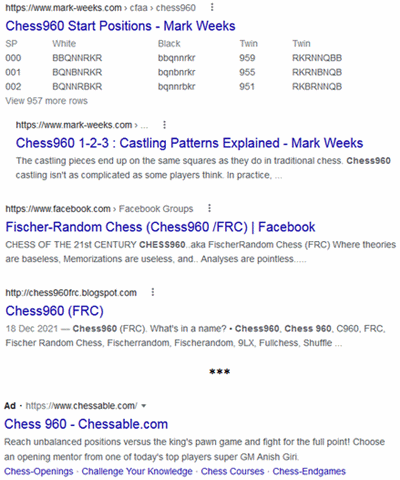
For the last six months, Google has frequently been displaying both reference pages together, as shown in the top portion of the following image (above the '***'). For good measure, it often includes a link to this blog, also shown in the image. Sometimes the three resources are shown bunched together, but in this case a resource from Facebook.com, Fischer-Random Chess (Chess960/FRC), crept into the mix. (I'll look at that page another time.)

For the last month, the two reference pages on m-w.com have reverted to appearing alone, with the other page nowhere to be found. I have no explanation for why this flip-flop occurs.

The bottom portion of the image shows an ad that appeared this past week on my weekly search for chess960. The link behind the ad went to Chess 960 - Chessable.com, a not very interesting comment dated 2017. I suppose the real purpose of the ad was to display the four Chessable links under the text snippet, which itself has nothing to do with chess960. Despite this disconnect, it's good to see a major commercial site in online chess bidding on the chess960 keyword. Another old post on this blog also featured a Google ad:-

  • 2017-05-20: Play Chess960, Not War • 'Seen on this blog in the Google Adsense space on the right navigation bar. ... Under the title 'PLAY CHESS NOT WAR', former President Obama of the USA plays chess (or chess960) with President Putin of Russia.'

I doubt that anyone would run that ad -- or a similar ad -- in today's political climate. Putin's invasion of Ukraine strikes too close to any playfulness intended by the ad.

27 November 2021

The Engine Iceberg Looms Larger

Last week's post, An Engine Iceberg (November 2021), looked at runtime data from 'TCEC C960 FRC3', which I covered on this blog in March 2021. I wrote,
Since the data covers only the first move of 25 SPs (50 games) out of the full set of 960 SPs, it's obviously just scratching the surface. Suppose we had data for the first few moves of all 960 SPs from many different engines played over a long period of time. What might we learn from this?

For this current post I repeated the exercise on the final match of the CCC C960 Blitz Championship (October 2021). I wrote,

In the final match Stockfish beat Dragon +10-1=589. Yes, more than 98% of the final games were drawn.

I loaded the PGN for all 600 games into my database and ran a preliminary analysis. There were two small surprises.

The first surprise was that the data for individual moves was not the same for both the TCEC and the CCC. Here are examples for the first move of the first game in both events.

TCEC: 1. e4 {d=36, sd=36, mt=147236, tl=1657764, s=81363821, n=11979602252, pv=e4 Nb6 Nb3 e5 g3 g6 Ne3 c6 f4 exf4 gxf4 f5 exf5 gxf5 Bf2 Qf6 c3 Nd5 Bc2 Nxe3 Qg1 Ne6 Bxe3 Bc7 O-O-O O-O-O Nd4 Bf7 Rf1 Bh5 Rde1 Nxd4 Bxd4 Qf7 b3 Be2 Rf2 Bg4 Kb2 Rxe1 Qxe1 Rg8 Qf1 Bb6 Bxb6, tb=0, h=99.9, ph=0.0, wv=0.26, R50=50, Rd=-11, Rr=-1000, mb=+0+0+0+0+0,}

CCC: 1. d4 {+0.45/32 9.6s, ev=0.45, d=32, pd=g6, mt=00:00:09, tl=00:04:55, s=148396 kN/s, n=1415409674, pv=d4 g6 e3 d5 g4 c6 c4 dxc4 f4 g5 fxg5 Na6 Nf2 e5 Bxc4 Nb4 Na3 exd4 Qf3 Be7 exd4 Qxd4 O-O O-O Bb3 Ne6 h4 Qg7 Be3 Nd5 Ne4 Nxe3 Qxe3 h6 Nc4 hxg5 Ncd6, tb=0, R50=50, wv=0.45}

Fortunately, the important 'wv' and 'pv' fields are available for both events. Any other fields I decide to use might require some sort of conversion.

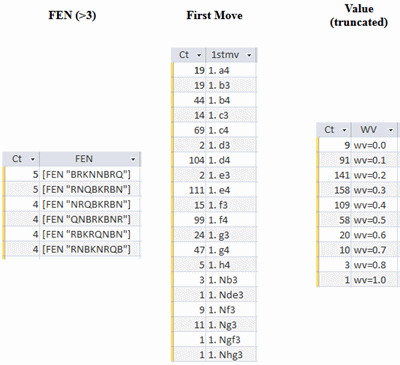
The second surprise was that the CCC start positions (SPs) were not repeated for a second game, colors switched, between the engines. Instead, a new SP was assigned to each game. The left table in the following chart shows that some SPs were nevertheless repeated up to five times.

In addition to the six SPs shown in the table, 24 SPs were repeated three times and 90 were repeated twice. I assume that the SPs are chosen randomly for both the TCEC and the CCC, perhaps with the exception of SP518 RNBQKBNR, but I know from past investigations that several bad algorithms are in use elsewhere; see Start by Placing the Bishops (September 2017) for examples.

The center table in the chart shows the number of times a certain first move was chosen across all 600 games. For example, the initial moves 1.a4 and 1.b3 were both chosen 19 times. Just as in SP518, advancing a center Pawn two squares (1.c4, 1.d4, ...) is the most popular opening strategy. Although any single SP has a maximum of four initial Knight moves, sometimes only two or three moves, all eight moves are possible across the 960 SPs.

There are a number of questions for further exploration. When is the advance of an edge Pawn -- 19 x 1.a4 or 5 x 1.h4 -- desirable? I suspect these are position where the Queen starts in the corner behind the Pawn. Why the large difference between the counts on the two edge Pawns? Perhaps this is because of castling O-O/O-O-O considerations. Also worth noting is that O-O/O-O-O was never chosen for the first move.

The rightmost table in the chart gives a rough distribution of initial 'wv' values, i.e. what value did the engine calculate for its first move? These are truncated values, e.g. the CCC 'wv=0.45' shown above is counted in the table as 'wv=0.4'. I could have used roundoff and a bar chart to display the counts more accurately, but I ran out of time.

One big question presents itself here. Why are there so many 'wv' greater than 0.5, but so few decisive results during the match? I also need to determine if Stockfish and Dragon calculate values in the same statistical range. I doubt that they do.

The three tables in that chart lead to many questions and few answers. I'll take this up again some other time.