12 December 2009

What Are the Odds?

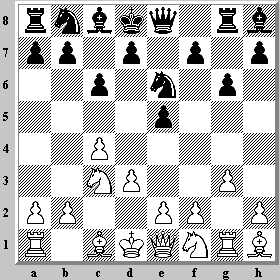
Since posting about Chess960 @ Chess.com, I've played a handful of correspondence games at the site ('online chess' they call it, as opposed to 'live chess'). By an unusual coincidence, my first two games started with the same position (SP638: RNKQRBBN) and I had White in both games.

A little thought convinced me that 1.e4 was a good first move. It opens diagonals for the Queen and light-squared Bishop, just as in traditional chess, with the added bonus that the e-Pawn is defended by the central Rook. My opponents must have used similar reasoning because they both played 1...e5, to which I answered 2.Nc3. That brought the games to the diagrammed position.
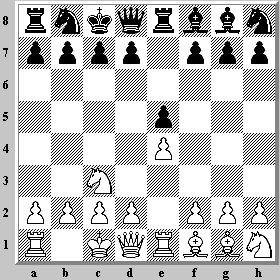

1.e4 e5 2.Nc3

In the first game, my opponent played 2...f6, activating the other Bishop, and I followed suit with 3.f3. Now, however, he (she?; Chess.com users are mainly anonymous) overplayed his (her?) position with 3...d5. This let me snatch the Bishop pair with 4.exd5 Bxd5 5.Nxd5 Qxd5, then menace the Queen with 6.Bd3. I thought I already the better game, but my opponent blundered a few moves later and resigned on the 16th move.

In the second game, my opponent followed my lead by playing 2...Nc6. This let me interfere with his normal development by playing 3.Bc4, when 3...f6 is not possible. He copied me again with 3...Bc5, but after 4.Ng3 g6, I forced his Bishop off the active diagonal with 5.Na4. He retreated with 5...Be7, then after 6.f3, tried to copy my plan with 6...Na5. Following the idea I used in the first game, I played a better retreat with 7.Bd3, leaving e2 for the Queen. Now after 7...f6 8.Qe2 Nf7, I was able to castle 9.O-O-O and again felt I had the better game.

06 December 2009

Four Cornered Bishops

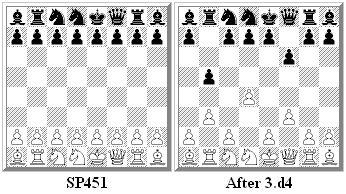
In Attention to the Chess960 Center, I gave a position from the Nakamura - Aronian match, Chess960 World Championship, Mainz 2009, where the players paid attention to the center starting with the game's first moves (1.e4 e5). The positions in the diagram are from the second game of the same match.

Comparing the first diagram (SP451, BRNNKQRB) with the second, an inexperienced chess960 player might get the impression that the players have been moving their Pawns at random. There is, in fact, an instructive chunk of logic behind the moves leading to the second diagram.


One of the main features of this start position is that the four Bishops all start in the corners. Another feature is that all Bishops are protected by their respective Rooks.

The Bishops in the corners usually dictate a positional duel at the beginning of a game, since both players are forced to develop their Bishops on the long diagonals, where they come into contact immediately. The player who is the first to open a long diagonal can exchange Bishops as soon as the opponent opens the same diagonal. Balancing this, the decision to open either diagonal first leaves the opponent the opportunity to open the other diagonal first.

In the current game, White chose to open the a1-h8 diagonal with 1.b3. If Black plays 1...g6, White can exchange Bishops and Black will no longer be able to castle O-O. Black followed a similar strategy on the a8-h1 diagonal with 1...b5, but grabbed more space than White and left the possibility of ...Nc8-b6.

Now White continued the duel on the diagonals by playing 2.f3. This prepares a subsequent g2-g3 without allowing the exchange of Bishops on h1, thereby preserving the option to castle O-O. Black followed an identical strategy with 2...f6.

Now White made an overt play for space in the center with 3.d4, preparing Nc1-d3 and leading to the second diagram. He might not have noticed that his third move closed the a1-h8 diagonal, giving Black the chance to play the surprising 3...f5, advancing the f-Pawn for the second consecutive move. Consequently, Black's dark squared Bishop will have more freedom on its long diagonal than White's light squared Bishop will have.

After three moves each, the contours of the subsequent struggle have been defined and the game is launched. The PGN for the full game, courtesy Chesstigers.de, is:

[Event "CCM9 - Chess960 Rapid WCh"]
[Site "Mainz"]
[Date "2009.07.30"]
[Round "8.1"]
[White "Aronian, Levon"]
[Black "Nakamura, Hikaru"]
[Result "0-1"]
[WhiteElo "2800"]
[BlackElo "2777"]
[Variant "chess 960"]
[SetUp "1"]
[FEN "brnnkqrb/pppppppp/8/8/8/8/PPPPPPPP/BRNNKQRB w GBgb - 0 1"]
[Source "Chess Tigers"]

1.b3 b5 2.f3 f6 3.d4 f5 4.Nd3 g6 5.Qf2 Bf6 6.g3 Qh6 7.e3 Ne6 8.Qe2 Nb6 9.Nc3 a6 10.Nc5 Nxc5 11.dxc5 Qg7 12.Qd3 b4 13.cxb6 cxb6 14.Nd5 Bxa1 15. Nc7+ Kf7 16.O-O Bc3 17.f4 Bxh1 18.Kxh1 Qf6 19.Rbd1 Qc6+ 20.Qd5+ Qxd5+ 21. Rxd5 Rb7 22.Nxa6 Ra8 23.Nxb4 Bxb4 24.a4 Bc5 25.Re1 e6 26.Rd3 d5 0-1

Nakamura appears to have outplayed Aronian already in the opening.

05 December 2009

Attention to the Chess960 Center

In More from Mainz 2009 I quoted GM Grischuk saying,
The first year [at Mainz] I was playing like g4/b4, but in order to play like this successfully you have to be either Aronian or Nakamura. They look to be the only two persons who do it successfully. Kamsky does it but he tries more like f4/c4, but they are g4/b4. It works for them, but for me it was just terrible. Since then I try to play a more central approach at the starting stage.

After playing chess960 for almost a year and a half, I have some idea what Grischuk is saying. There are two distinct, fundamental ways to treat a chess960 opening. The first way is to follow traditional chess opening principles, of which one of the most important is to pay attention to the center. The second way is to pay less attention to the center, but by taking into account the specific start position, to emphasize the rapid development of the pieces to good squares, even if this means making early moves like g4 or b4.

Grischuk didn't pick the names Aronian and Nakamura at random; they have been among the most successful competitors at recent Mainz events. Aronian won the main chess960 event at Mainz on several occasions (see Chess960 @ Chess Classic Mainz for a list of his accomplishments), although he finished second to Nakamura in the most recent tournament (see CCM9: Nakamura, Grischuk, and Rybka).

This year the two 2700 GMs played two games in the preliminary stage of the closed Rapid World Championship and then met in the final stage. Nakamura lost to Aronian +0-1=1 in the preliminaries, but won +3-0=1 in the finals.

Most of the six games between the two players were more like the g4/b4 variety, but one game used more classical principles in the attention paid to the center. The following diagram shows a position from game three of the final match.

Chess960 World Championship, Mainz 2009
Aronian, L.

Nakamura, H.
(After 8...Bh6-g7)

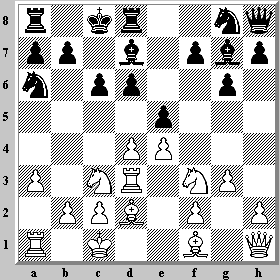
At first glance the position might be mistaken for the Philidor Defense (1.e4 e5 2.Nf3 d6) in traditional chess, but the Queens in the corners, the Kings on the c-file, and the position of the Rooks, especially the Rook on d3, are a dead giveaway that the position is chess960 (SP666, RNKRBBNQ). White continued 9.Be3, defending the attacked d-Pawn a third time and letting the Rook on d3 retreat if necessary. The PGN for the full game, courtesy Chesstigers.de, is:

[Event "CCM9 - Chess960 Rapid WCh"]
[Site "Mainz"]
[Date "2009.07.30"]
[Round "9.1"]
[White "Nakamura, Hikaru"]
[Black "Aronian, Levon"]
[Result "1-0"]
[WhiteElo "2777"]
[BlackElo "2800"]
[Variant "chess 960"]
[SetUp "1"]
[FEN "rnkrbbnq/pppppppp/8/8/8/8/PPPPPPPP/RNKRBBNQ w DAda - 0 1"]
[Source "Chess Tigers"]

1.e4 e5 2.Nf3 g6 3.Nc3 c6 4.g3 d6 5.d4 Bd7 6.Rd3 Na6 7.a3 Bh6+ 8.Bd2 Bg7 9.Be3 exd4 10.Bxd4 Nc5 11.Rd2 Nf6 12.Ng5 Rf8 13.O-O-O O-O-O 14.e5 Ng4 15.f4 Ne6 16.Nxe6 Bxe6 17.h3 dxe5 18.Bxa7 Nf6 19.Ba6 e4 20.Qg1 Rxd2 21. Bxb7+ Kxb7 22.Qb6+ 1-0

The ratings (WhiteElo and BlackElo) are special chess960 ratings calculated by Chess Tigers. In my next post, I'll show a position from another game between the two players where less attention was given to the center.

29 November 2009

Learn to Castle Correctly (Mechanics)

It's the sixth and last round of a SchemingMind.com chess960 dropout tournament (see Pyramids and Dropouts for more about these events) held a few years ago. The starting field of 85 players has been whittled down to 10. These are the survivors, the crème de la crème at Scheming Mind, battling for the annual chess960 championship at one of their favorite online play sites.

After a few days play, a game starting NQRBBKNR (SP217) and continuing 1.Nf3 c5 2.c4 Nb6 3. b3 Nf6 4. e4 O-O reaches the following position

Black

White
(After 4...O-O)

Now White timidly asks Black, 'Can you tell me, please, how can I castle? It's enough to move the king to g1 or there's something else I should do?'. Black's first reaction must have been, 'What the...? How did this guy survive the first five rounds, two games per round, without knowing the rules of castling?' The second reaction might have been, 'Now I get it! He doesn't know how to execute the castling move on Scheming Mind', followed by the same refrain, 'How did this guy survive the first five rounds without knowing the mechanics of castling?'

I looked at White's previous games in the tournament and verified that he had never castled. Game after game, with the King stuck in the center and a Rook out of play, White must have been an exceptionally good defensive player to have faced increasingly skilled competition without ever castling.

When castling in traditional chess, most software works the same way. You click on the King, then click the square located two squares toward the castling Rook. The software understands your intention exactly and moves both the King and the Rook to their castled squares.

In chess960, the castling intention is not so straightforward. Sometimes both pieces move, sometimes only the King moves, and sometimes, most illogically for traditional chess players, only the Rook moves. How to tell the software that, for example, clicking on the Rook this time means castling, but next time means a normal Rook move? There is no standard way to do this and the mechanism for castling depends on the software being used.

Before you play chess960 using new software or on a new site, make sure you know how to execute a castling move. Take the time (for once?) to read the instructions. Later in your games, it will save you much defensive maneuvering and perhaps a little embarrassment.

28 November 2009

Learn to Castle Correctly (Rules)

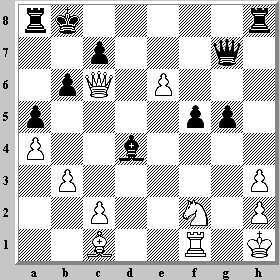
Here's a war story from the fourth game of a match between two super grandmasters at Mainz 2004 -- Gerling Match : Chess960 World Championship : Svidler vs Aronian. A problem occurred in the following position.

Chess960 World Championship, Mainz 2004
Aronian, L.

Svidler, P.
(After 32.e5-e6)

The story as told on the Chesstigers.de page involved an error in castling O-O-O.

This position caused quite a stir in the fourth game of the Gerling Match between Levon Aronian and Peter Svidler. Levon Aronian took his rook on a8, jumped over the King and put it on d8. However, he forgot to take his King which had to be placed on c8 to fulfill all the requirements for a-side castling in Chess960. If he would have done that, the game would be over: Qa8 check and mate!

Peter Svidler stopped the clock and arbiter Sven Noppes came to see what was going on. Castling was possible, the mistake Aronian made was that he took his rook first, so he had to castle a-side.

Peter Svidler showed that he is a gentleman on the board and allowed Aronian to correct his move. The Armenian had to play Ra7 and kept the better position. However, after this faux-pas Aronian completely lost control and finally lost the game.

Was this just a mistake by the young Armenian, or did he try to win with a dirty trick? Aronian joked during the press conference : "Off course I wanted to cheat, just like in his game against The Baron in the computer match." Peter Svidler said: "I do not have a problem with Aronians mistake, and when you have only 40 seconds on the clock, like in this case, it is possible that you mix up the castling rules".

The complete PGN game score (SP725, RKBBNQNR), again courtesy Chesstigers.de, is:

[Event "CCM4 - Gerling Match (Chess960 WCh)"]
[Site "Mainz"]
[Date "2004/8/6"]
[Round "4"]
[White "Svidler"]
[Black "Aronian"]
[Result "1-0"]
[FEN "rkbbnqnr/pppppppp/8/8/8/8/PPPPPPPP/RKBBNQNR w HAha - 0 1"]
[Input "DGT1805"]

1.e4 e5 2.f4 exf4 3.Qxf4 Ne7 4.Ngf3 d6 5.d4 f5 6.e5 Nd5 7.Qd2 Nb6 8.Nd3 dxe5 9.dxe5 g6 10.a4 a5 11.b3 Ng7 12.Be2 Ne6 13.Bb2 Nd5 14.O-O h5 15.Nf2 Nb4 16.Bc4 Qh6 17.Qc3 Be7 18.Rad1 Nc6 19.Nd3 h4 20.Bb5 Ncd8 21.Nf2 g5 22. Bc1 Qg7 23.Nd4 Bb4 24.Nxe6 Nxe6 25.Qf3 Bc5 26.Kh1 h3 27.gxh3 Nd4 28.Qd5 b6 29.Rxd4 Bb7 30.Bc6 Bxc6 31.Qxc6 Bxd4 32.e6 Ra7 33.Ba3 Qe5 34.e7 Bc5 35.Nd3 Qxe7 36.Nxc5 bxc5 37.Bxc5 Qe5 38.Qb5+ Ka8 39.Bxa7 Qxb5 40.axb5 Kxa7 41.Rxf5 Rxh3 42.Rxg5 Kb6 43.Rg3 Rh4 44.Rc3 Rh5 45.Rc6+ Kb7 46.Rc4 Rxb5 47.h4 Re5 48.Kg2 c5 49.Kf3 Kc6 50.Kg4 Re2 51.h5 a4 52.bxa4 Kd5 53. Rc3 Kd4 54.Rh3 Rxc2 55.h6 Rg2+ 56.Kf5 Rg8 57.h7 1-0

Not all opponents would be as forgiving as GM Svidler. Learn how to castle correctly in chess960. It's not that difficult!

22 November 2009

Grischuk - Mamedyarov, Mainz 2009

In More from Mainz 2009, I gave a partial transcript from an interview -- Grischuk post-FiNet win -- on Chessclub.com, and promised to feature a game from winner Grischuk in a future post. During the interview Grischuk mentioned his game against Mamedyarov, so it looks like a good choice.

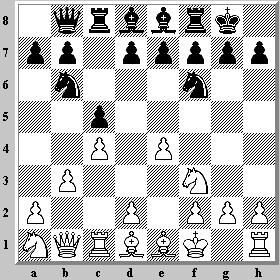
The start position (SP535, RNBKQNRB) is not too far from a traditional chess game. The royalty is in the center and the Queenside pieces ('a-side' for the purists) are in their traditional places ('RNB'). Only the Kingside pieces ('h-side') are scrambled. The first four moves were 1.g3 g6 2.c4 e5 3.Nc3 Ne6 4.d3 c6, bringing the game to the following position.

8th FiNet Open, Mainz 2009
Mamedyarov, S.

Grischuk, A.
(After 4...c7-c6)

Here is an explanation, as I see it, of those first moves.

  • 1.g3: Opens the diagonal for the Bh1. The move 1.g4 is an alternative, but as Grischuk explained in the interview, he's wary of the b4/g4 ideas.
  • 1...g6: The same thinking as for 1.g3, from Black's point of view.
  • 2.c4: Prepares the development Nb1-c3 and takes control of d5, an important central square. The move is reminiscent of the English opening in traditional chess.
  • 2...e5: Prepares the development ...Nf8-e6 and takes control of d4, also an important central square. The move is reminiscent of an important counter to the English opening in traditional chess (1.c4 e5).
  • 3.Nc3: Follows through the previous move and develops the Knight to its best square.
  • 3...Ne6: Ditto.
  • 4.d3: Prepares the development of the Bc1 on its long diagonal.
  • 4...c6: Counters the influence of the White Bishop on the long diagonal and prevents a White piece from moving to d5.

So far, both players have developed their pieces in classic style by developing a Knight to a good square, opening a diagonal for a Bishop, and paying attention to the center. Now White probably considered what to do about further development. The move 5.Ne3 forces the Bishop on c1 to go eventually to d2, where it blocks the Queen from developing. The move 5.Be3 forces the Knight on f1 to go to d2, where it also blocks the Queen.

This thinking leads to the idea 5.Bh6, where White has to calculate the tactical consequences of the Bishop trap 5...g5. After these fifth moves for both players, the game continued 6.h4 gxh4 7.Be4 Bf6 8.Ne3 hxg3 9.O-O-O. White is temporarily two Pawns down, but Black is lagging badly in development on the Queenside.

Since this is a chess960 blog, and the only real difference between traditional chess and chess960 is the opening phase, I'll stop here. White has castled O-O-O, while the Black King will find shelter on c7. Here is the complete game score...

[Event "CCM9 - 8.FiNet Open"]
[Site "Mainz"]
[Date "2009.07.31"]
[Round "8.1"]
[White "Grischuk, Alexander"]
[Black "Mamedyarov, Shakhriyar"]
[Result "1-0"]
[Variant "chess 960"]
[SetUp "1"]
[FEN "rnbkqnrb/pppppppp/8/8/8/8/PPPPPPPP/RNBKQNRB w GAga - 0 1"]
[PlyCount "97"]
[EventDate "2009.??.??"]
[EventCountry "GER"]
[Source "Chess Tigers"]
[SourceDate "2009.01.01"]

1.g3 g6 2.c4 e5 3.Nc3 Ne6 4.d3 c6 5.Bh6 g5 6.h4 gxh4 7.Be4 Bf6 8.Ne3 hxg3 9.O-O-O d6 10.fxg3 Bg5 11.Rh1 Bxh6 12.Rxh6 Qf8 13.Nf5 Na6 14.Qf2 Bd7 15.Rdh1 Nac5 16.b4 Na6 17.a3 Kc7 18.Kb2 Rd8 19.Qxa7 Rb8 20.Rxh7 Ng5 21. R7h5 Bxf5 22.Bxf5 Ra8 23.Qe3 Qe7 24.Rc1 Kb8 25.g4 Nc7 26.d4 f6 27.d5 c5 28.b5 Ne8 29.Rh2 Qc7 30.Ne4 Nxe4 31.Qxe4 Qa5 32.Qe3 Ka7 33.Qc3 Qd8 34. Rch1 Ng7 35.Bc2 Ne8 36.Qf3 Qa5 37.Rh7 Kb6 38.R1h4 f5 39.Rf7 fxg4 40.Qg3 Qd2 41.Rhh7 Ra7 42.Qh4 Qd4+ 43.Kb1 Qg1+ 44.Ka2 Nc7 45.Qe7 Nxb5 46.Qxb7+ Rxb7 47.Rxb7+ Ka5 48.Rxb5+ Ka6 49.Rhb7 1-0

...courtesy of Chesstigers.de. For an explanation of the PGN specific to chess960, see my previous post Chess960 PGN.

21 November 2009

Who Is the 'Father of Chess960'?

In The First Recorded Fischerandom Game?, I noted that the 2009 edition of 'The Sorcerer's Apprentice' by Bronstein & Fürstenberg mentions that 'Fischer Random is a derivative of an idea that Bronstein himself has invented twenty years earlier'. That quote is from a Google translation of a Dutch review of the book and not a quote from the book itself. Whatever the book says will remain a mystery to me until I get my hands on a copy. In the meantime, I can still explore the idea of who is responsible for the invention of Fischer Random, better known on this blog as chess960. The title 'Father of Chess960' hangs on the outcome of the research.

The ChessVariants.com page on Fischer Random Chess says,

Fischer Random Chess is somewhat similar to the older Shuffle Chess, or Prechess (or other related variants), yet has a unique style of its own. An extensive introduction and history of the game was written by Eric van Reem.

The van Reem article, The birth of Fischer Random Chess, is available on multiple web sites. It dates the 'birth' to Buenos Aires 1996, the event that I covered in Fischer Announces Fischerandom. Gligoric, in his ground-breaking 'Shall We Play Fischerandom Chess?', gave a more detailed account. After mentioning Capablanca's erstwhile efforts to improve the game that he felt was under threat from draws, Gligoric wrote,

Fischer's concentration on this problem went much deeper. During his stay in Saint Stefan [better known outside Serbia as Sveti Stefan] in 1992, he recommended shuffling all the pieces at random on the back row before the beginning of each game. [...]

It turned out that Fischer's first plan would make 2400 different commencing positions. Immediately after his sensational return to the chess scene in 1992, he began experimenting privately with this kind of chess against colleagues and chance visitors. Although Fischer was pleased that the mathematical sum of starting positions was very large, he soon discovered that eventually having two Bishops of the same color made an unpleasant impression, producing one-sided and limited opportunities on the chessboard. It was also clear that obstructing the right to castle would mean a step backward toward the primitive distant chess past and if the intermingling of pieces on the back row made castling impossible for both sides, this would inflict irreparable damage on playing strategy as well.

The result of Fischer's constant meditation on how to give alternative life to the game of chess, threatened by the exhaustion of its creative resources, was the formulation, in September 1993, of the rules of "Fischerandom Chess" which are quoted in a separate chapter of this book. [p.36]

I covered those rules in Fischer's Rules of Fischerandom.

Prechess, mentioned above in the ChessVariants.com quote, is a variant of shuffle chess where the players take turns placing single pieces on the back rank. Since the rules don't appear to have been formalized anywhere, restrictions on the Bishops and possibilities for castling depend on who is playing and what was agreed beforehand.

Who is the 'Father of Chess960'? There are three key requirements: (1) shuffle chess with the White and Black pieces starting opposite each other; (2) the two Bishops for each side on different colored squares; and (3) castling into the familiar O-O and O-O-O positions. Other would-be inventors might have proposed (1) and (2), but Fischer proposed (3). That last contribution, which steers the game from a shuffled variant into positions fully reminiscent of traditional chess, gives Fischer the title.