02 May 2010

Four Weak Pawns (SP835)

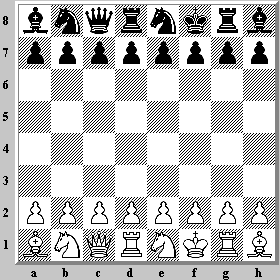
In my previous post, Four Weak Pawns (SP115), I looked at the first of two chess960 start positions that feature four underprotected Pawns. The second of the positions is shown in the diagram below. Mirroring SP115, its twin, SP835 starts with the a- & h-Pawns undefended, while the c- & d-Pawns are protected only by the King.


SP835: BRKNRQNB

Once again, the four weak Pawns aren't particularly vulnerable to any immediate attack. Of the 52 games in the CCRL collection, the following first moves were played by White...

21 1.b4
11 1.b3
7 1.Nf3
7 1.e4
3 1.g3
3 1.Nc3

...In this position the players don't have the option of castling on the first move, but the other moves are mainly mirrors of the most popular moves for SP115, for the same reasons. I can't explain the overwhelming preference for a push of the b-Pawn, especially 1.b4, where the equivalent SP115 move (1.g4) was one of three equally popular openings. Perhaps it's just a statistical quirk of the small CCRL samples. After 1.b4, the most popular responses for Black were...

8 1...b5, and
6 1...e5

...All six games that started 1.b4 e5 ended in victory for White. Is this another statistical quirk or is there a structural problem with Black's position that needs special attention?

My favorite method to start evaluating a new chess960 start position is to first look at the castling options. In SP835, both players can castle O-O-O by simply moving the d-Knight out of the way. Castling O-O requires more preparation. Both Knights have to move off their start squares and the Queen has to move somewhere. The best square for the Queen is far from obvious and will likely depend on the opponent's scheme of initial development.

My first candidate move here mirrors my choice for SP115: 1.e4. It again stakes a claim in the center, opens a diagonal for the Queen, creates a strong point for the Knight on e3, and is protected by the Rook. That's a lot for a single move to accomplish.

01 May 2010

Four Weak Pawns (SP115)

In the post Four Weak Pawns, where I discovered twin positions with four weak Pawns: SP115 BNQRNKRB and SP835 BRKNRQNB, I noted,
In SP115 the a- & h-Pawns are undefended, while the e- & f-Pawns are protected only by the King. This is quite extraordinary and it would definitely be worth seeing how master level players have coped with these two SPs in practice.

I don't have a large collection of master level chess960 games. My ~1200 games from past Mainz events cover about 25% of the 960 start positions and neither of the two SPs is present. The CCRL collection (see the link under 'Resources' on the right) currently has 60 examples of SP115 and 52 of SP835, so I downloaded them to take a look.

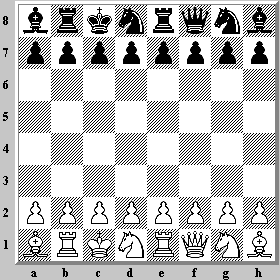
After some practical experience with CCRL games, I'm less enthusiastic about their value to chess960 opening knowledge. The engines don't play with a book (meaning they don't 'learn') and they have no notion of what it means to follow a strategic opening plan. In my own games I have often found an initial move that none of the machines had played and that seemed like a reasonable move to me. After playing my own moves a few times and suffering no unexpected drawbacks, I stopped looking at the CCRL collection for ideas. With that in mind, let's look at SP115, pictured below.


SP115: BNQRNKRB

A quick analysis of the position reveals that none of the four weak pawns are susceptible to an immediate attack. The a- and h-Pawns are not easily attacked by any diagonal piece. The a-Pawn might be captured in three moves by a Knight, but in the time it takes to execute that plan, many countermeasures are possible. The moves most favored by the CCRL engines were...

12 1.Nc3
11 1.g3
11 1.g4
9 1.O-O
6 1.d4
5 1.b3
4 1.b4

...where the plan to develop one of the cornered Bishops by moving the b- or g-Pawn was used in half of the games. Whether to move the chosen Pawn to the third rank or to the fourth requires further consideration.

The move 1.Nc3 is first on the list, although I can't see a convincing reason for it. Is it with the idea of continuing Nc3-b5, attacking the a-Pawn? The most popular responses...

6 1...b6
3 1...O-O
2 1...d5

...indicate that Black isn't particularly concerned with rushing to the defense of the a-Pawn. Another popular move is 1.O-O, which I hadn't noticed until I looked at the CCRL games. It immediately transforms the 'weak Pawn' status of the e-, f-, & h-Pawns: the e-Pawn is now undefended, the f-Pawn is protected twice, and the h-Pawn is defended only by the King. In general, I'm not a big fan of castling on the first move. I prefer to see how my opponent develops a few pieces before I commit to castling on either side.

The other move on the preferred list, 1.d4, would be my personal choice for further inspection. It stakes a claim in the center, opens a diagonal for the Queen, creates a strong point for the Knight on d3, and is protected by the Rook. It also blocks the a1-h8 diagonal, allowing the Bishops on that diagonal to enter the game without being swapped immediately, a natural hazard of games which start with all Bishops in the corner.

All in all, the four weak Pawns don't play much of a role in the initial considerations. It's useful to know that they can't be easily attacked, but don't really serve as a guide for developing the other pieces.

25 April 2010

More Arguments Against Chess960

I ended my previous post on Tim Krabbé's objections to chess960, Some Arguments Against Chess960, with his comment that
Any form of shuffle chess puts chess back 200 years.

That's a remarkable statement from a player and writer who is a recognized authority on the game, its culture, and its history. To find out more about his reasons we go to his diary entry no.123 (17 June 2001: 'Count Van Zuylen van Nijeveltrandom chess, anyone?'), found in Diary 121-140. After rephrasing the thoughts covered in my previous post (the diary entry came first chronologically), he ends with a summary condemnation of Fischer's invention.

I'm not sure shuffling is a good idea at all. Its main purpose is to avoid openings theory, which is supposed to be an alien element in chess skill. I don't see why; willingness and ability to learn a vocabulary are essential in mastering a language. Without the openings, chess wouldn't be chess. The openings are not just a few memorizable tricks; through them, knowledge about the middlegame has accumulated during 500 years. Without that knowledge, the fantastic, wild games of today could not be played - chess would be put back 100 years. Shuffle games are not very interesting; playing them over is like following a guide who has never been to the museum himself.

One way in which grandmasters distinguish themselves from ordinary players, is their greater knowledge and better handling of the characteristics that arise through the openings. Could they beat amateurs just as easily in shuffle chess? It would be more interesting to have not just a Leko-Adams match but, for instance, a 4-way tournament between Leko, Adams, and two sub 2200-players who had won a qualifying shuffle tournament.

There are several thought provoking, arguable points in those two paragraphs. I'll address them in order.

Krabbé: 'Opening theory is supposed to be an alien element in chess skill'.

From Merriam-Webster.com: Theory: '1 : the analysis of a set of facts in their relation to one another • 2 : abstract thought : speculation • 3 : the general or abstract principles of a body of fact, a science, or an art • ...'

An often noted disconnect in chess terminology is that when chess players talk about 'opening theory', they mean opening variations which are thought to be best play for both sides, i.e. what is known. This is only compatible with a standard definition of 'theory' in the sense that we think these moves are best, because no one has found better.

Another aspect of opening play is where move selection is guided by general principles like 'develop your pieces', 'control the center', etc. This is the real nucleus of opening theory, more than learning sequences of chess moves by heart. A consequence of this disconnect is that non-master chess players often know intricate opening variations by heart, but can't explain the general principles behind those moves.

Krabbé: 'Willingness and ability to learn a vocabulary are essential in mastering a language.'

A comparison of chess to language is unconvincing. I could also compare opening theory to the memorization of long passages from a novel, a poem, or a play. Memorizing these passages doesn't make one a novelist, a poet, or a playwright, any more than memorizing opening variations makes one a chess master. I can even imagine memorizing these passages without having any idea what they really mean, like a high school English student memorizing Shakespeare.

Krabbé: 'Knowledge about the middlegame has accumulated during 500 years'

The opening and subsequent middlegame positions that arise from the traditional start position are just a subset, perhaps a small subset, of the multitude of fascinating positions that can arise from the complete set of chess960 start positions. Which is more challenging - to work with the known or to explore the unknown?

Krabbé: 'Without that knowledge, the fantastic, wild games of today could not be played'.

How often does it happen that you play through a 'fantastic, wild game' only to discover that the players are repeating 'theory' and that the first original move occurs well into the complications? How often does it happen that GM level players make a mistake just after their preparation ends, or worse, offer a draw so that they can study the continuation at home on their computer?

The first game of the Anand - Topalov World Championship match was played yesterday. Where did the game really start? According to the pundits, the players followed 'theory' for 16 moves, then followed preparation for a few moves (the exact number is unknown), then Anand blundered on the 23rd move. How many original moves were played over the board in this game? Some commentators are saying that the blunder was the first original move by either player.

Krabbé: 'Shuffle games are not very interesting; playing them over is like following a guide who has never been to the museum himself.'

It's true that Krabbé's example game from 1851 isn't interesting. It isn't even chess960, because the Bishops for each side start on the same color. Since the players never castle the game never approaches positions similar to traditional chess.

Playing over a chess960 game isn't like playing through a traditional game, where we whip through the first moves -- Ruy Lopez, Closed Variation, Breyer Defense (or whatever) -- and eventually arrive at a position we've never seen before. Then we play the moves more slowly to see how the game evolves and to compare the player's ideas with what we already know about that particular opening system.

Playing over chess960 requires playing slowly from the very first move, just like playing a chess960 game requires real thinking from the very first move. Why did the minor pieces go to those particular squares, or why did the players castle to those sides? Moves that aren't played also require attention. In chess, when Black plays a Sicilian, we know that the alternatives are an Open game, the French, the Pirc, etc. In chess960, the alternatives are unknown and mysterious.

Krabbé: 'Could [GMs] beat amateurs just as easily in shuffle chess?'

When Krabbé wrote this in 2001, interest in chess960 was getting started. We now have experience from the open events at Mainz, where GMs face 'sub 2200-players' in the early rounds. Guess what? The GMs win. There is more to chess skill than detailed knowledge of specific opening variations and middlegame patterns that arise from the traditional start position. That really isn't too surprising, is it?

The choice between traditional chess and chess960 isn't mutually exclusive. Players who value preparation will continue to play traditional chess. Players who value creativity and inspiration can play chess960. I enjoy playing both and will continue to enjoy traditional chess for a long time.
24 April 2010

Some Arguments Against Chess960

Last month, in a post titled Chess960 @ Chessville.com, I quoted some extremely critical comments by Tim Krabbé concerning chess960 that I found 'wildly misinformed'. I won't repeat the comments in entirety here, but will hone in on specific points that are worth addressing. The first of Krabbé's points concerns Fischer's right to chess960 paternity.
Krabbé: For one thing, "Fischer Random Chess" is not an innovation - the idea of shuffling the pieces on the first rank dates back to the 18th century. It is amazing that Fischer managed to get his name attached to it.

This argument is made frequently, so I'll just copy a paragraph that I wrote this week in a Chess.com forum (see Chess 960 tournaments: variety)

Fischer didn't invent shuffle chess, but he did invent the castling rules, including the restrictions on the initial placement of the King and Rooks. This is what sets chess960 apart from other types of shuffle chess and brings a random start position quickly into patterns similar to traditional chess (SP518: RNBQKBNR). So, yes, he did invent chess960.

I'm not sure why so many people want to deny Fischer's authorship. Perhaps it's a reaction to the rabid anti-Semitism he displayed later in life, like saying 'Anyone who believes such crazy notions can't possibly have invented anything worthwhile'. The early name change from 'Fischer Random Chess' to 'chess960' was another reaction to make the new game palatable to players offended by Fischer's rants.

If that's not the reason, perhaps it's that they haven't tried chess960 and aren't familiar with the subtlety and the genius of the castling rules. In his 2002 book on Fischer's creation, Gligoric accepted the American's authorship and I have seen nothing to suggest that someone else had the idea before Fischer.

The second of Krabbé's points is simply wrong.

Krabbé: All Fischer did was spoil [shuffle chess] by introducing an idiotic electronic shuffler to determine the starting position. Imagine two Fischer Random players on a desert island - even if they had board and pieces, they still couldn't play, until such a shuffler washed ashore.

I first read this long before I became interested in chess960 and agreed that it was a serious weakness in Fischer's idea. In fact, once you know the algorithm it's easy to construct a random start position. I presented the method in an early post -- A Database of Chess960 Start Positions -- and recently saw a YouTube video demonstrating it. After you place the Bishops, Queen, and Knights randomly, the positions of the King and Rooks are automatically determined.

The method requires choosing five random numbers : from 1 to 4, 1 to 4, 1 to 6, 1 to 5, and 1 to 4, in that order. Chess960 players on a desert island could generate these random numbers by picking up a handful of pebbles or a pinch of sand and determining the modulus in each step by eliminating the excess, e.g. modulus 4 to place the Bishops. I'm sure there are better ways to do this, but I won't give it any more thought until I'm stranded on a desert island myself.

The next of Krabbé's points is more interesting.

Krabbé: [Fischer] invented it because in classic chess, as you know, all grandmaster games have been fixed since 1972.

I certainly can't claim that I know exactly what Fischer was thinking, but he had a problem with what he called 'prearranged' games (see Fischer Announces Fischerandom). I've come to the conclusion that he was referring to games where both players come to the board and essentially reel off a certain number of moves that they have studied in their preparation. In other words, the opening of the game is not a battle over-the-board, it's the result of memorization that happened off-the-board.

In his heyday, Fischer was one of the best prepared players in the world and it seems inconsistent that he would object to other players using the same methods that were so successful for him. The difference between circa-1970 and today is that there are more top-notch players using these techniques, powerful computers that play better than any human are involved in the preparation, and many variations have been studied well into the middlegame (sometimes even into the endgame). Chess960 offers an alternative to this style of play.

The last of Krabbé's points is more of an opinion than a fact.

Krabbé: Finally, any form of shuffle chess puts chess back 200 years - see my Diary, item 123.

I'll come back to it in a future post.

18 April 2010

Four Weak Pawns

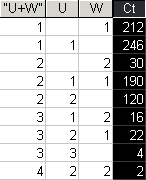
Combining the results from Undefended Pawns in Chess960 Start Positions and Naturally Weak Pawns, I worked out the table on the left. It shows a count of chess960 positions that have the same number of naturally weak Pawns in common.

The column labelled 'U' is a count of undefended Pawns in a position and the column labelled 'W' is a count of Pawns that are defended only by the King. The column labelled 'U+W' is, as you've undoubtedly guessed, the sum of 'U' and 'W'. The last column 'Ct' shows the number of chess960 positions with that specific number of weak Pawns. For example, the fourth row says there are 190 positions with both a single undefended Pawn and a single Pawn protected only by the King.

The sum of the last column shows that, of the 960 positions, there are 842 with at least one weak Pawn. The most interesting positions are those with a high number of 'U+W'. In my previous post on 'Undefended Pawns', I already listed the four positions with three undefended Pawns, but the two positions with four weak Pawns are something new.

As you would expect, the two positions with four weak Pawns are twins: SP115 BNQRNKRB and SP835 BRKNRQNB. In SP115 the a- & h-Pawns are undefended, while the e- & f-Pawns are protected only by the King. This is quite extraordinary and it would definitely be worth seeing how master level players have coped with these two SPs in practice.

17 April 2010

Naturally Weak Pawns

After four consecutive 'at' posts -- Chess960 Groups @ Chess.com, Chess960 @ Chessville.com, (Almost) No Chess960 @ CCM10, and No Chess960 @ Doeberl -- I'm going to return to the first mentioned topic ('@ Chess.com'). It turns out that many members of the Chess.com group called Chess960 RandomChess believe that 'naturally weak squares' are a good starting point for evaluating a chess960 start position (SP).

By 'naturally weak squares' they mean Pawns that are either undefended or defended only by the King. For example, SP679 QRBKNNRB has two naturally weak squares: the Pawns on the e-file and the f-file. The e-Pawn is protected only by the King, while the f-Pawn is unprotected.

I covered Undefended Pawns in Chess960 Start Positions some time ago, but never considered Pawns that are defended only by the King. To investigate this further I dragged my chess960 database of SPs out of storage and developed the necessary queries.

It turns out that there are 472 SPs with at least one Pawn defended only by the King. The first in the list of SPs is SP008 QBNNBRKR, where you can easily see that the g-Pawn is defended only by the King, which is sandwiched between its Rooks and which has no Knight on the e-file to cover the g-Pawn. The traditional start position SP518 RNBQKBNR, with its notoriously weak f-Pawn belongs to this group, as does its twin SP534 RNBKQBNR.

Although I expected to find a few SPs with two Pawns defended only by the King, I was surprised to discover that there are exactly 48 of them. The first is SP097 BQNBRNKR, where the King is the only piece protecting the f- & g-Pawns.

How are the 520 Pawns (472 SPs with at least one Pawn plus 48 with two) distributed over the files? Like this...

b: 78
c: 88
d: 94
e: 94
f: 88
g: 78

...The first entry means that, across all 960 SPs, there are a total of 78 b-Pawns protected only by the King. The rules of chess960 preclude any a- or h-Pawns protected only by the King, but it's not immediately obvious why there should be more center Pawns on the list or why the counts increase when moving from the b/g-files to the center files.

The next step in this analysis will be to consider undefended Pawns together with Pawns defended only by the King. I'll do that in my next post.

28 March 2010

No Chess960 @ Doeberl

Chess960 was introduced at the 2009 Doeberl Cup -- 'Australia's Premier Grand Prix Chess Tournament' according to the event's home page -- but is missing from the list of events for 2010. What happened? After the cancellation at Mainz 2010 (see No Chess960 @ CCM10 for more), is this a double whammy? I contacted Shaun Press, the proprietor of the ace Australian blog Chessexpress and an arbiter at the 2009 chess960 tournament ('I was a little lenient on illegal castling'),
The tournament turned into a battle between two groups. In one corner were the Sydney chess960 experts, led by Blair Mandla, Neil Wright and George Xie. In the other were the group of Indian IM's who seemed not to have played it much before, but came to grips with it very quickly. At the halfway point it looked like the Sydney crew would take home the money, but the Indian's finished the stronger to capture the top 3 places. (2009 O2C Doeberl Cup - Chess 960)

and asked him, 'I believe that you had something to do with getting chess960 on the program for 2009 and I wondered if you have any comment on it being dropped.' He replied,

We have always had a traditional lightning (blitz) event at the Doeberl Cup, but unfortunately we didn't have space in the calendar for both lightning and chess960. So when we introduced chess960 we decided we were going to run it in alternate years with the lightning. So last year was chess960, this year will be lightning.

The 2009 chess960 event wasn't accepted in all quarters. Another popular Australian blogger, Amiel Rosario of The Closet Grandmaster, badmouthed the event at every opportunity he had:-

It's a pity that the decision -- (1) traditional chess at blitz vs. (2) chess960 -- is an either/or choice. In these early days of chess960 there are bound to be more players attached to traditional chess than to chess960, just like circa 1492, when chess saw its last major evolution with the introduction of new moves for the Queen and Bishop, there were bound to be more players attached to the slower medieval chess.

Maybe the 'closet grandmaster' should ask GM Levon Aronian, a real grandmaster, what he thinks about chess960 and why he plays it every year at Mainz. Will chess960 be seen at the Doeberl Cup in 2011? I'm sure the Australian blogs will let us all know. Don't you just love the chess blogosphere!