23 April 2011

The Path of Bliss?

The site ChessInTranslation.com appeared in the first half of last year and immediately became a big hit with fans of top level chess. I mentioned it on my main blog in July 2010 (see ChessInTranslation.com) and have been following it ever since. A recent post translating GM Shipov's comments on a game from the 2011 European Championship at Aix-les-Bains, France, sounded like a promotion for chess960: The massacre of the innocents.
Kids and Hulking Brutes: To catch your opponent out in an opening line, to arrive for a game and, without making even a single move of your own at the board, to get a won position – that's the dream of any chess player. And if, in former times, such victories were won through the blood, sweat and tears of long home analysis – moreover, without complete confidence in the quality of the analysis, and knowing that your opponent would sometimes find strong refutations at the board – the situation has now changed.

Nowadays you need to choose the sharpest of lines, where you've looked at the complications with a computer, while your opponent hasn't. And the game's in the bag!

It's as if there's a fight between young school pupils, but from behind the back of one of the kids an older hulking brute towers up and lands crushing blows against his defenceless young opponent.

According to Shipov's notes, Black(!) unleashed a novelty on move 9, followed preparation for a few moves ('14…Be6!; This was the first move in the game on which [Black] spent even a little time thinking'), and accepted his opponent's resignation on the 19th move. I could comment on the notion that 'the dream of any chess player' is 'to get a won position without making even a single move of your own at the board', but I'll leave that to scholastic chess coaches and other proponents of chess in the schools. Instead, I'll just point out that when Shipov asks,

What is there for us, kids, to do in the current traumatic situation? There are only two options.
1. Prepare hard with a computer around the whole perimeter of the opening repertoire.
2. Avoid topical and sharp lines, taking Svidler's approach.

then answers,

There's also a third, purely hypothetical, possibility: to reach the level of Kasparov and Kramnik, i.e. to become a hulking brute yourself! To learn to play an unfamiliar position at the same strength as a decent computer program.

he is overlooking another possibility that isn't hypothetical and doesn't require becoming a 'hulking brute'. Readers of this blog will know exactly what I mean.

A reference at the bottom of that post points to another Chess In Translation post that had appeared a few days earlier and that I had also selected for mention on this chess960 blog: The future belongs to 1.g3!. Here's Shipov, again on a game from Aix-les-Bains:-

I've just returned to the hotel after watching the start of the fourth round. I'm in a state of shock. At the tables I said hello to the five-time Russian Champion Peter Svidler, then I had a look at his game – and was dumbfounded. The move 1.g3 had been made on the board, and his opponent – the Greek grandmaster Mastrovasilis – was spending a long time studying the position and, it seems, couldn't believe his own eyes. No doubt he'd been preparing from yesterday evening to lunch today for the normal 1.e4, had unearthed a couple of deep saving resources – and then he gets an incredible surprise like that at the board. He sat there, trying hard to think, and simply wasn't able to find a decent reply.

Here's the game on Chessgames.com: Peter Svidler vs Athanasios Mastrovasilis; 12th European Individual Championship 2011. Later Shipov added,

[Svidler] had the urge to simply play chess – to leave the beaten paths and recall his youth. After all, in our childhood all of us, out of ignorance, played mischievous setups in which you had to start thinking from the very first move. And everyone will confirm that was the happiest period of their life. So why not try to recover at least a fraction of that carefree past?

That truly is happiness – not to have to cram up on a ton of variations in the morning before the next round, not to have to study new games, not to have to sit at the computer expecting miracles from chess engines.

If that 'truly is happiness', then chess960 is bliss.

16 April 2011

Parallel Games II

In my previous post, Parallel Games, I used a pair of games from Schemingmind.com's Chess960 League - Season One, so it's natural that I follow up with two games from Season Two. The opponents are again both top-10 players on the site and, as luck would have it, I've already had the opportunity to play both of them, finishing 0-2.

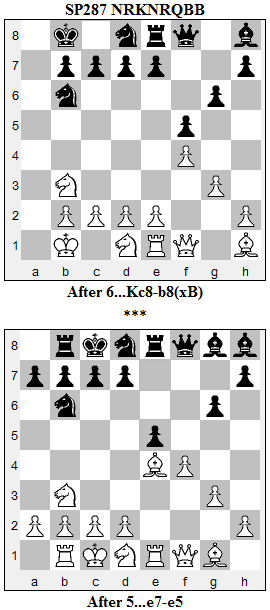
The players were assigned start position SP287 NRKNRQBB, which reminded me of the position discussed in NR****Q* & *Q****RN. The difference is that in the current games we have NR****B* instead of NR****Q*, where the Bishop instead of the Queen is positioned to attack the undefended a-Pawn on the diagonal. The top diagram shows the position after 1.f4 f5 2.Bxa7 Bxa2 3.g3 g6 4.Nb3 Bxb1 5.Kxb1 Nb6 6.Bxb8 Kxb8 in the first game; the bottom diagram shows the position after 1.f4 Nb6 2.g3 f5 3.Nb3 g6 4.e4 fxe4 5.Bxe4 e5 in the second. I show one extra move pair in the first game to close the sequence of tactical recaptures.

Both players chose to open 1.f4, a move which attacks the a-Pawn with the Bishop on g1. In the game with NR****Q*, Black had the option of sacrificing the a-Pawn in return for a gain of time by encircling the Queen. In the present position, Black doesn't have this option, because the Bishop on a7 attacks the Rook on b8, threatening to win the exchange. In place of the Pawn sacrifice, Black has the possibility of copying White's tactic with 1...f5. Now the Bishop on g8 attacks the Pawn on a2, threatening to win the Rook on b1.


It's instructive that in one game, Black copied the tactic to win the exchange, while in the other Black declined by blocking the diagonal with ...Nb6. This apparently forced White to do the same. In the first game both players forfeited the castling option by capturing the Bishop with the King. In the second game you might guess that the players would castle O-O-O; in fact, only White castled and, in the other direction, by O-O. Here are the PGN scores of both games, again courtesy of SchemingMind.com.

[Event "Chess960: Chess960 League"]
[Site "SchemingMind.com"]
[Date "2006.05.10"]
[Round "-"]
[White "Tyler"]
[Black "dmichael"]
[Result "1/2-1/2"]
[SetUp "1"]
[FEN "nrknrqbb/pppppppp/8/8/8/8/PPPPPPPP/NRKNRQBB w KQkq - 0 1"]

1.f4 f5 2.Bxa7 Bxa2 3.g3 g6 4.Nb3 Bxb1 5.Kxb1 Nb6 6.Bxb8 Kxb8 7.d4 e6 8.c3 d5 9.e3 Nf7 10.Nf2 Nd6 11.Kc2 Qh6 12.h4 Kc8 13.Nc5 Kd8 14. Bf3 Ke7 15.Qh1 Nbc4 16.b3 Na3+ 17.Kd3 Qf8 18.Ra1 Ra8 19.h5 Bg7 20. hxg6 hxg6 21.g4 c6 22.Kd2 b6 23.Na4 Ndc4+ 24.Ke2 fxg4 25.Nxg4 Qf5 26. Ra2 g5 27.Qc1 Qb1 28.Qxb1 Nxb1 29.Kd3 b5 30.bxc4 Rxa4 31.Rxa4 bxa4 32. Bd1 dxc4+ 33.Kc2 Na3+ 34.Kb2 Nb5 35.Bxa4 gxf4 36.exf4 1/2-1/2

[Event "Chess960: Chess960 League"]
[Site "SchemingMind.com"]
[Date "2006.04.29"]
[Round "-"]
[White "dmichael"]
[Black "Tyler"]
[Result "0-1"]
[SetUp "1"]
[FEN "nrknrqbb/pppppppp/8/8/8/8/PPPPPPPP/NRKNRQBB w KQkq - 0 1"]

1.f4 Nb6 2.g3 f5 3.Nb3 g6 4.e4 fxe4 5.Bxe4 e5 6.Bc5 d6 7.Bxb6 axb6 8.Qh3+ Ne6 9.fxe5 Bg7 10.Nd4 c6 11.Nxe6 Rxe6 12.exd6 Qxd6 13.Bd3 Qd7 14.Ne3 b5 15.a3 Kc7 16.Qg4 Qe7 17.Qf4+ Be5 18.Qg4 Rd8 19.O-O h5 20. Qf3 h4 21.g4 Bd4 22.Qf4+ Kc8 23.Rfe1 Bc5 24.Qf3 Qg5 25.b4 Rf8 26.Qh3 Bb6 27.Bf1 Rd8 28.Kh1 Rxd2 0-1

Since the games ended with different results, it's natural to look for the reason in the early moves. Is it a coincidence that the draw resulted from the game where two pieces -- a Rook and a Bishop -- disappeared from the board in the first few moves?

02 April 2011

Parallel Games

In my post Chess960 Short Cuts, I introduced chess960 leagues and team play on Schemingmind.com.
The matches feature two concurrent games between each pair of players, both games using the same start position with colors switched. This should allow some useful comparisons and contrasts about how good players tackle start positions. The current season marks the fifth year for the league.

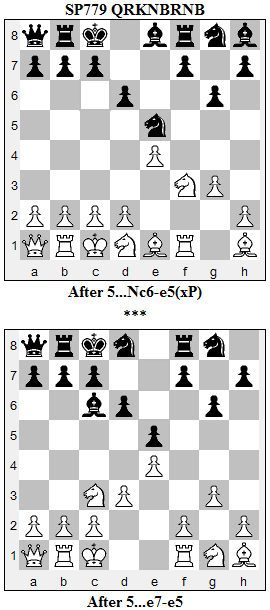
The first games I looked at were from Chess960 League - Season One (the link only works if you are a member and signed-in, but it's free to a point, like most online play sites these days), between a couple of top-10 players assigned start position SP779 QRKNBRNB. The position after five moves in both games is shown in the diagram. The first game started 1.f4 g6 2.g3 d6 3.e4 Nc6 4.Nf3 e5 5.fxe5 Nxe5, the second 1.d3 g6 2.Bc3 Bxc3 3.Nxc3 d6 4.g3 Bc6 5.e4 e5.

Although the two games have followed different paths, there are a number of similarities. Both players in both games have quickly activated the Bishop in the corner by pushing the g-Pawn to the third rank, and both have taken a stake in the center by pushing the e-Pawn two squares. It also looks probable that both White and Black will castle O-O-O in both games, which is what happened.


The problem piece is the Queen. There is no obvious way for it to get into the game, so I looked a little further to see how the players developed it. In both games, Black played ...a6 and brought the Queen into play via a7. White did similar in the second game, although a2-a4 was played instead of pushing the Pawn a single square. In the first game, White followed a different plan: d2-d3, Be1-c3, and b2-b3.

White won both games, but it would take a more detailed analysis to determine why. Here are the PGN scores of both games, courtesy of SchemingMind.com.

[Event "Chess960: Chess960 League"]
[Site "SchemingMind.com"]
[Date "2005.07.31"]
[Round "-"]
[White "dmichael"]
[Black "Chess Tiger"]
[Result "1-0"]
[SetUp "1"]
[FEN "qrknbrnb/pppppppp/8/8/8/8/PPPPPPPP/QRKNBRNB w KQkq - 0 1"]

1.f4 g6 2.g3 d6 3.e4 Nc6 4.Nf3 e5 5.fxe5 Nxe5 6.d3 Bd7 7.Nxe5 Bxe5 8.Bg2 O-O-O 9.Bc3 a6 10.b3 Bxc3 11.Qxc3 Qa7 12.Nb2 Qe3+ 13.Qd2 Qc5 14.O-O-O f5 15.d4 Qa7 16.exf5 Bxf5 17.Nc4 Nf6 18.Ne3 Be6 19.Qa5 h6 20.Qc3 Rf7 21.Qd3 Rg8 22.Rf2 Nd7 23.Rxf7 Bxf7 24.Bh3 1-0

[Event "Chess960: Chess960 League"]
[Site "SchemingMind.com"]
[Date "2005.08.01"]
[Round "-"]
[White "Chess Tiger"]
[Black "dmichael"]
[Result "1-0"]
[SetUp "1"]
[FEN "qrknbrnb/pppppppp/8/8/8/8/PPPPPPPP/QRKNBRNB w KQkq - 0 1"]

1.d3 g6 2.Bc3 Bxc3 3.Nxc3 d6 4.g3 Bc6 5.e4 e5 6.O-O-O Ne6 7.f4 O-O-O 8.Nge2 Nh6 9.h3 a6 10.f5 gxf5 11.exf5 Nd4 12.Bxc6 Nxc6 13.Nd5 f6 14. a4 Ng8 15.Qa2 Qa7 16.Qc4 Nge7 17.Nec3 Nxd5 18.Nxd5 Qd4 19.Rf4 Qxc4 20. Rxc4 h5 21.Rg1 Rf7 22.c3 Rh8 23.Kd2 Kd7 24.a5 Rc8 25.Rh4 Nxa5 26.Rxh5 Rcf8 27.h4 Nc6 28.g4 Ne7 29.Nxe7 Kxe7 30.Rh6 Rg7 31.Ke3 Rff7 32.Rg6 Rh7 33.h5 Rf8 34.Kf3 1-0

For each game, was the seed of victory in the diagrammed position or was it introduced later?

26 March 2011

NR****Q* & *Q****RN

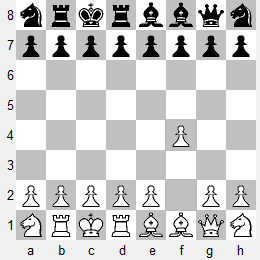
One of my first games on Chesscube (see How I Spent My Free Day) began with the setup shown in the diagram (SP362 NRKRBBQN). I had the Black pieces and my opponent opened 1.f4, attacking the Pawn on a7 with the Queen.

It's not obvious how to defend the a-Pawn. The move 1...Nb6 cedes the center after 2.e4. This might be playable, but the rapid time control left no time to work out the nuances. The move 1...a6 has the same defect as the move 1...Nb6, without doing anything for Black's development. Ditto for 1...b6 with the additional disadvantage of blocking the best square for the Knight on a8.

SP362 NRKRBBQN

After 1.f2-f4

I decided to sacrifice the a-Pawn with 1...d5. It's not an important Pawn and if White captures it, Black gets some initiative with 2.Qxa7 Nb6 3.Qa3 Ra8, which is what happened in the game. After 4.Qb3, we continued 4...e6 5.a3 Bd6 6.Bf2 Nc4 7.e3 Na5 8.Qc3 Ng6 9.Nb3 Nxb3+ 10.Qxb3 Ba4 11.Qc3 f6 12.d3 Qf7. Although Black hasn't recovered the Pawn, the initiative and better development still offer some compensation. Now White made a mistake with 13.Rd2, giving up the option of castling O-O. After 13...O-O, I was happy with my game and eventually won.

Getting back to the sacrifice of the a-Pawn, I had already seen the tactical trick involving the Queen vs. the Rook & Knight in another game, but couldn't remember where. I wondered how many such positions there are in chess960, queried my database of start positions to find out, and discovered that there are 18 positions with the N, R, and Q on the a-, b-, and g-files. Since each of those positions has a corresponding twin (N, R, and Q on the h-, g-, and b-files), there are exactly 36 positions with a similar tactic, or 3.75% of all positions.

An analysis like I did in Introduction to Chess960 Geometry, would tell me why there are 18 positions of the type NR****Q*, but I'll leave that for another time. Right now I'd rather know the best way for White to play after the sacrifice of the a-Pawn in the game, and I'd like to know if 1...Nb6 is playable.

***

Later: In fact, it's not difficult to derive that there are 18 positions of type NR****Q*. Of the five unassigned squares, one Bishop can be placed on three of them and the other Bishop on two. That leaves three squares to place the second Knight. The King and second Rook must then be placed according to the rules of chess960: King between the Rooks. The arithmetic is then 3 x 2 x 3 =18.

19 March 2011

Chess960 Short Cuts

Posting only once a week on chess960 means a lot of good topics fall through the sieve. Here are a few points that are worth mentioning and that might provide useful material for future posts.

LSS: The Lechenicher SchachServer, Lss.chess-server.net, listed to the right under 'Correspondence (Turnbased)' online play sites and better known as LSS, has offered chess960 since June 2009. I've played traditional chess there for several years, but haven't tried the chess960 play because the unusual c960 time controls aren't compatible with a busy schedule. I'm sure I'll try it one of these days. The site recently released its first PGN archive of chess960 game scores. Since the file includes the players' ratings they should be a good source of games between strong players.

Scheming Mind: Another 'Correspondence' online play site is Schemingmind.com, where I've been playing chess960 since I first took it up. Thanks to an invitation from one of the team captains, I just found out that they have leagues and team play. This in itself wouldn't be worth mentioning, except that the matches feature two concurrent games between each pair of players, both games using the same start position with colors switched. This should allow some useful comparisons and contrasts about how good players tackle start positions. The current season marks the fifth year for the league.

Chess960 Jungle: HarryO, who has been commenting on this blog since last summer, has started his own blog called Chess960 Jungle, also linked on the right sidebar. He has a different angle on things than I do, so I'm sure our two blogs will be complementary.

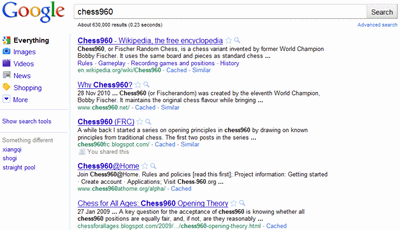
The Google Lottery: As the following image attests, both this blog and my main blog, Chess for All Ages (CFAA), appeared in the top-5 links on a chess960 search. Appearing at 3rd & 5th on the list probably says more about the lack of good chess960 sites than it does about my skills as a blogger, but I was still pleased to see it.


Since then, this blog has fallen back to its usual place around 9th-10th, and CFAA has disappeared off the radar. Oh, well! Glad I took the snapshot of the screen for my scrapbook.

12 March 2011

Chess960 Online Play Sites

To keep track of chess960 online play sites, I added two new widgets to the right sidebar:-
  • Crossboard (Live) Chess960
  • Correspondence (Turnbased) Chess960

I haven't played on all of the sites and I'm not sure whether the list is complete, but it's a start. If you know of another chess960 online play site, add a comment to this post or send me an email using the address listed in my profile.

05 March 2011

How I Spent My Free Day

As I mentioned a few weeks ago, in No Place for Chess960, 'I've been posting about chess960 twice a week since end-August 2009, which makes exactly a year and a half. I'm going to ease off the pedal a bit and return to posting once a week.' Since I post once a day on one of my three blogs, following a fixed weekly schedule, the upshot of that decision was that I had a few hours to do something else. Here's what I considered doing:-
  • (A) Repairing & painting the kitchen wall where we removed a radiator
  • (B) Cleaning the back patio
  • (C) Posting on one of my other blogs
  • (D) Playing live chess960 on Chesscube.com
  • (E) Nothing at all

After a little thought, I eliminated three options: Choice (B) is best done when winter is officially over; (C) just shifts the burden of writing elsewhere, something I can always do in the future; and (E) doesn't really appeal to me. That left (A) and (D). My wife would have been happy with (A) -- and that's what I should have done -- but I finally settled on (D). It's been over two years since I first considered playing on Chesscube (see Chess960 on Chesscube.com) making it the oldest open action on my 'Chess960 TODO' list.

After developing an interest in chess960, I've played close to 50 games on Schemingmind.com and Chess.com, two sites that offer only correspondence chess960. My experience from those game is that, before making the first move, it takes some time to understand the peculiarities of whatever start position has been dictated by the server. I typically spend at least 30 minutes, sometimes double that, studying the position before I make my first move in a chess960 game. How to reconcile that with the fast time controls used in live chess?

After poking around Chesscube for a while, getting a feel for its layout and offerings, I decided to play at the relatively slow control of 15 minutes per player per game with no increment per move. The site assigned me an initial rating of 1500, and I accepted the default range offering opponents rated within 300 points of my own rating.

I've played traditional chess on a lot of different online sites and my experience is that established players don't like playing unrated players. Among other issues, the provisional rating is too inaccurate. Tagged as a newbie and wanting a slow game, would I be able to find opponents on Chesscube? As it happened, there was absolutely nothing to worry about. Within 30 seconds of creating my SEEK, I was playing White in my first live game of chess960. I played 1.f4, my opponent answered 1...g5, and we were off. It was, in a word, exhilarating. Already on the third move I was faced with tactical and strategical problems that I had never seen before, unlike a traditional chess game where these challenges usually start about ten moves later. I won the first game, played two more which I also won, and ended up with a rating around 1600.

Although I started to work out the contours of a routine to evaluate a new start position quickly, it's too soon to share it. Before playing live chess960 the next time, I'll warm up with the Random Position Generator on Chessgames.com, deciding what my first move would be as White in a half-dozen or so random positions. It would be nice to have the same sort of facility from Black's point of view -- seeing a random position with White's first move already made -- but that would require some software development.

It would also be useful to have the possibility of playing an online chess960 game against a computer. I wouldn't want to play a complete game, just the first few moves to practice coordinated development and to exercise the tactical eye. Unlike human opponents, computers never complain when you hit the RESET button to start a new game. Maybe I should just dig out the engines I've collected that understand chess960. I haven't used them in ages, but they should be somewhere on my hard drive.