08 March 2014

World Champions on Chess960

One of the resources I discovered while working on the previous post, More from Moscow 2014, was the Russian Wikipedia page Chess 960; (that link is for the ru.wikipedia.org page fed to translate.google.com). As usual with computer translations, the text is 75% comprehensible, 25% nonsense, but the meaning still shines through. Unfortunately, the automatic translation stopped at the beginning of the most interesting section, 'Professional opinions about chess players Fischer', so I fed the rest paragraph by paragraph into the translator. Here's what I got.

[Start of translation]

Professional opinions about chess players Fischer: Opinions of professionals and amateurs of chess Fischer random chess expressed different - from enthusiastic to extremely negative. But the most well-known players refers to them as is evident from their statements, at least cautiously optimistic. There were criticisms of the features of the rules. For example, some players were unhappy professionals random selection starting position for each game, and they expressed offers to hold tournaments chess Fischer, in which the initial position was chosen to be one for the whole tournament, and detects and reports the players in advance (for a few days or weeks before the tournament). Such rules would allow pre-prepare for the tournament, reducing the time spent thinking about opening moves. At the same time, the effect of the failure of opening theory would remain - for a short time to undertake a full analysis of the position can not be willy-nilly would confine common basting.

Anatoly Karpov:

Do "Fischer Chess" future is hard to say. Now hold separate tournaments rules Fischer. The idea is, but how it will be received in the future is hard to say because there are pluses and minuses.

Plus quite obvious: at the time of computers Fischer tries to get away from home training and believes that in this way he removes the importance of a set of a team working with computer

Actually, to "Fischer Chess" prepared especially not necessary. Endgame positions and endgame knowledge and "Fischer Chess" can also be used with even greater success. But as the opening theory, there is, of course, everything is broken. And here the basic principles - who understands better and faster and decides who intuition who are better prepared for battle. Therefore do not need to prepare especially, the main thing - to be in excellent condition, to head to work, legs, hands moving.

Garry Kasparov: According to Garry Kasparov at chess Fischer has a future, mainly because they give a person a more equal position to play with the computer - the computer will not be able to rely on accumulated centuries debut base. Nevertheless, the ex-champion predicted major upheavals when introducing new chess.

But my main comment is new chess - a dream Losers ! After all, everyone thinks about Losers honors that he crams the book and why it's best estimates . Those who are just too lazy to learn the theory , do not realize that the so -called " Fischer Random Chess " sharply increase the gap between the very strong and chess grandmasters just strong. After all, today a certain alignment between these players is because they are approximately equal the opening stage . Each learned his option and may, at its "own territory" fight successfully even with the world champion.

Vladimir Kramnik: Vladimir Kramnik offered his version of reducing the effect of home preparation and analysis of individual computer systems debut: the draw debuts at which the initial position of the classical random, but also with certain restrictions that exclude obviously dubious beginning, given the first few moves. Then the players play as usual. About chess Kramnik Fischer said:

I played a little bit in the "Fischer - rand ." Of course, this is completely knocks opening preparation . But the problem is that you lose some games harmony . It is difficult to explain it in words , but when the starting position elephant standing on h8, the knight on g8 rook on f8, then lost sense of aesthetics of chess. By the way , I asked players - many have the same feeling that something " is not " somehow ugly ... And fans are accustomed to the beauty of interaction figures under normal initial position .

Therefore, if we want to clean up the opening preparation , it seems to me to toss a successful exit . In this case study of the theory began to go in a more general way: hardly a chess player would be forced to study hard variants with a large number of branches anywhere in Benoni protection simply because they can not remember . Rather, people will learn debuts with a positional point of view: the general plans , strategy. Unlikely to be a lot of parties where chess 25 moves spend one minute. This will cause more people to play the board .

Boris Spassky:

To chess Fischer positive attitude, because it's the same rules of the game, you just freed from theory and doing. By the way, the idea of gently reorganize classical chess were also to Fischer. What can I say, if my uncle called: let's change places with elephants and horses, all will be fine. Fischer, however, there are a number of ingenious inventions - a clock, for example. Generally, it is in contrast to the current champions, always fighting for the quality of play.

Mark Taimanov:

Perhaps " Fischer Chess " - the panacea for computer dominance in the game, return to the improvisational creativity. With classic chess nothing happens, nothing will happen as with the story. Lovers , as before, will enjoy the works of the great masters , studying the games of past years ... And it will , of course , a little different game. Offer Fischer overcomes monstrous zakompyuterizirovannost debut stage , overcome routine. Do you like to play two famous grandmasters and 26 stroke repeat everything they recorded in the files of your computer? This is - what? Fighting ? Creativity ? Now chess theory develops polushazhkami somewhere between 20 and 25 strokes . No new policies , no new ideas , no new systems ... Innovation will begin the game of chess with the 2nd course , not the 26th. But, as I imagine , somewhere in the course of 12 starts regular chess game chess on ordinary laws. I think Fischer Random Chess - Chess XXI century!.

[End of translation]

I was surprised to see that all of the comments were at least mildly supportive of chess960. Maybe I shouldn't have been surprised. The anonymous authors of the Wikipedia page have no incentive to include negative comments.

As for Taimanov's comment about 'monstrous zakompyuterizirovannost debut stage', when I split the long word into two, I got 'zakompyuteriz ation'. That makes a little more sense.

01 March 2014

More from Moscow 2014

Let's have another post on the 'Chess960 Training Tournament', Moscow 2014. At the time I wrote last week's post, Chess960 Live on the Small Screen, I didn't have much information about the event, but it created a small buzz that is well worth noting. One of the main web sources of chess news in Russia is the aptly named Chess-news.ru. The site had two reports in English.

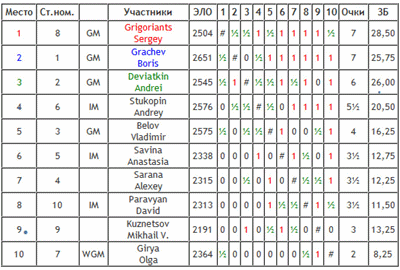
I copied the final crosstable, shown below, from that first report.

The same site had more reports in its primary language, available to non-Russian speakers like me through the magic of translate.google.com. I list all reports because the most interesting remarks are often in the comments.

The site also conducted a follow-up interview with two of the participating GMs.

Of particular interest is a discussion of the poll results that 'Fischer Chess Won't Replace Classical Chess'.

E.SUROV: We have just summed up the survey, which took place at our site. The vast majority - about 70 percent - is skeptical about the future of chess Fischer. Anyway, to the formulation, in which we asked about this, namely: "Replace ever Fischer Chess conventional chess?". Say no. Andrew, how do you comment on these results?

A.DEVYATKIN: I have to say that I - a supporter of the Fischer chess and, therefore, perhaps be a little subjective. First, it seems to me that 70 percent still can not be called by an overwhelming majority, an advantage. And secondly, the question itself is really quite categorical: replace or not?

Actually, why replace chess, why cancel and switch to the classic chess Fischer? Here, rather, we are on a parallel system of competition, about how to organize more and more tournaments chess Fischer. But in any case there will be those who will say that they are for the classics. One can hardly say that they ever completely replace each other, that is on the earth there will be no person who would like to play in classical chess. This is unlikely to happen.

The big news here is that 30% of the respondents believe that 'Fischer Chess *Will* Replace Classical Chess'. I wouldn't have expected more than a single digit number. I do agree, though, that it's not a zero-sum proposition. Traditional chess and chess960 can co-exist side-by-side forever. There are still people who play chaturanga, aren't there?

I contacted GM Deviatkin (that's how he spells his name using the English alphabet) and asked him about the organization of the tournament.

I was also one of the main organizers. The tournament seems to be the first serious Fischer chess event in Moscow ever, although I'm not 100% sure. It could be a Swiss tournament had the regulations been set (and invitations been made) earlier. The time control was 20+10 which sometimes seemed too short, because the very first moves in Fischer chess are of great importance and can take half of one's time!

Anyway, the Moscow event ran very smoothly, it was anything but boring, the participants looked happy, and I hope this is just the beginning. Most likely, in 2014 we'll have more events like this one in Moscow.

The start position was chosen by the arbiter before each round using Fritz (New game -> Chess960). Maybe it would be an improvement to give the players a few minutes to think over a new position after the drawing of lots. White's clock was started before the 1st move.

I'm sure that 20 min per game isn't really much, even if we give additional minites, start clocks after White's first move, etc. My initial idea was to give players at least 30 min per game (with increment), but then the tournament would be too long, and we could use the venue only for two days.

There were also a few reports on the main chess news sites;

Fide.com? Maybe I was wrong a few weeks ago when I asked Who Needs FIDE? To be continued...

22 February 2014

Chess960 Live on the Small Screen

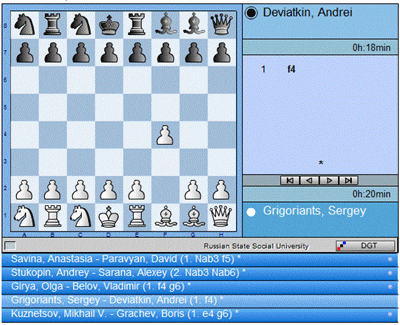
While writing this post I'm watching my first live crossboard (OTB) chess960 games, direct from Moscow: Indoor training rapid chess tournament (chess-results.com; title by Google Translate). I tuned into the event just as the last round was starting and captured the moment in the following screenshot.

The start position in all games was SP190 NRNKRBBQ, and the screenshot shows the first move from a game between GMs Grigoriants and Deviatkin. The players' were placed first and third before the game with a one point difference, so the game will be important for the final standings.

It turns out that SP190 was seen in another important game, Nakamura vs. Aronian at Mainz 2009. My post for that game linked to a previous post with a photo of the two players from the same game.

I mentioned GM Deviatkin on this blog near the end of last year -- the last time was The Week in Chess960 -- and he's featured in another post that I haven't finished yet. I'll try to contact him for any thoughts on the Moscow tournament.

Meanwhile, the game Grigoriants - Deviatkin just ended in a draw. In a parallel game, GM Grachev won as Black. Since he was placed second going into the last round, he appears to have tied GM Grigoriants for first place. I expect the final standings to be posted shortly on chess-results.com. Whether or not I got it right, congratulations to the winners.

***

Over on Chess960 Jungle, HarryO is posting furiously for the first time since summer 2012, and recently released a Chess960 database - compilation of games 2001-2013. I'll take a closer look at that resource in a future post.

15 February 2014

Shall We Organize Chess960 Tournaments?

Continuing with my previous post, Who Needs FIDE?, where I wrote,
If the chess960 community is serious about the future of their game, they should not rely on FIDE or on any other traditional chess federation, just as they should not rely on the chess publishing industry to advance interest in chess960. The entrenched chess interests have too much at stake to humor the upstart.

The post earned a few good comments, one of them on another post, It's Not About Short Draws, where GeneM made several remarks that deserve a response. First, there is the question of ratings.

GM: Mark is mistaken about FIDE’s source of strength: I believe it comes primarily from FIDE’s rating system.

MW: A rating system is important, but it puts the cart before the horse. You need tournaments before you need a rating system. Today there are few chess960 tournaments. Traditional tournaments were held for many decades before rating systems were introduced, because ratings are a refinement, not a prerequisite. The job can be outsourced to any rating agency. FIDE doesn't have a monopoly on the service.

Next, there is the raison d'être for chess960.

GM: Mark is unjustified in asserting that the goal of chess960 is to remove the effect of at-home opening phrase preparation. Yes that was Fischer’s goal, but Fischer speaks only for himself.

MW: Fischer spoke for more people than himself. His concern was the extensive use of computer-based preparation, where the players memorize variations calculated by an engine. This was not an issue until the 1990s.

Finally, there is the promise of partial progress.

GM: My main comment today is to urge Mark to switch to a glass-half-full perception from his glass-half-empty perception.

MW: Let's say that 'X' chess960 start positions (SPs) are 'authorized' for tournament use, where 'X' is one or two. The glass is neither half-empty nor half-full. It is (X+1)/960 percent full, where the '+1' is the traditional start position, SP518 RNBQKBNR. If someone wants to organize a tournament limited to one (nontraditional) SP, I'm all for it. Better that than nothing at all, but I'm not going to forget that the ultimate objective is full play in all 960 SPs.

HarryO flagged a post on his own blog with a concrete proposal: Let's crowdfund the first ever Chess960 simultaneous.

We crowd-fund the first ever official chess960 simultaneous between Hikaru Nakamura and the Chess Tigers club in Germany. The event is held some time this year before the next world championship match.

As for me, I was thinking about a more democratic option: running a tournament or series of tournaments on one of the online servers that support live (crossboard, as opposed to correspondence) chess960 play. There are three servers listed on the sidebar. Are they active? What would it take to organize a tournament on any or all of them? What would it cost?

Lots of questions, not many answers. I'll look at some of the details in future posts.

08 February 2014

Who Needs FIDE?

My previous post, It's Not About Short Draws, made me think about the FIDE presidential election, where Garry Kasparov has decided to go up against incumbent Kirsan Ilyumzhinov. Let's say Kasparov wins. What impact would this have on the acceptance of chess960 within the traditional chess community? The same question applies to an Ilyumzhinov victory.

The Kasparov quotes in the 'Short Draws' post make it clear what the 13th World Champion thinks. If chess960 has any future with him in charge, it will be a watered down version with one or two new start positions 'authorized' by FIDE. As for Ilyumzhinov, nothing has happened under his leadership since my post titled Chess960 Rules Formalized by FIDE, almost five years ago. Chess960 is not on his radar.

A few days ago, on my main blog, I posted Chess Leaks Like a Sieve, with links to various resources that document contractual shenanigans on both sides of the election. The business of FIDE is chess and it's possible to put a price on the number of delegate votes necessary to remain in charge of FIDE.

One of the resources I studied for the 'Leaks' post was an interview with Bessel Kok, Ilyumzhinov's opponent in the 2006 FIDE election: Bessel Kok: "The normal way to win Ilyumzhinov impossible and now". The original page is in Russian and Google Translate is far from perfect, but Kok's thoughts shine through the translation.

[FIDE] is a very dense structure, the main role played by the environment in which the incumbent president. Many people in the federation are serving on committees or commissions, they have a little money, they are touring the tournaments ... That's their life. A little travel, organize meetings completely senseless.

This does not mean that they are directly corrupt, profit can be anything: contributions to the tournaments, the judges, the hotel is lo ... very advanced system. And why would they take and give up now? Do they return to their wives and will sit at home? These little bureaucrats? For them, the meaning of life. It is very important to understand. Many people think that there is some big conspiracy.

Kok's professional career was spent at the head of several important telecom companies, so I'm willing to wager that he knows a thing or two about bureaucratic structures. Since chess960 isn't important to Kasparov, Ilyumzhinov, or FIDE's 'little bureaucrats', why should FIDE be important to chess960? One answer might be 'to have access to the national federations', since FIDE's power is based solely on its usefulness to those federations. Under FIDE election rules, it's one country, one vote.

Speaking realistically, is there any reason to believe that interest in chess960 by the national federations is any greater than interest by FIDE? I suspect there is little interest and that talk about chess960 is just an annoyance for them, like flies buzzing around the room at one of their meetings.

If the chess960 community is serious about the future of their game, they should not rely on FIDE or on any other traditional chess federation, just as they should not rely on the chess publishing industry to advance interest in chess960. The entrenched chess interests have too much at stake to humor the upstart. What can be done to make independent progress? I have some ideas that I'll save for a future post. In the meantime I would love to hear what other chess960 fans think.

01 February 2014

It's Not About Short Draws, Garry

When the 13th World Champion talks, people listen. When he talks about chess960, I listen very carefully. Here are some of the things he's said, or that have been said about him, that I've noted in past posts on this blog.
  • Kasparov's Chess960 Proposal • GM Kasparov: 'I’m in favor of at least investigating doing one position per year from chess960.'
  • Why Not Announce Positions Beforehand? • GM Kasparov: 'I have always liked the idea of choosing a few decent positions. And, I don't think you need more than 15 to 20, out of the 960 possible random chess positions, many of which violate our sense for normal chess geometry.'
  • Not Everyone Likes Chess960 • GM Kasparov: 'As for Fischer Random or similar ideas, I'm very much in favor. Let's be very specific. Fischer Random in its purity is not such a great idea. It creates a mess at the chess board from the very beginning. Out of 960 positions, 95% are quite bad.'
  • Kasparov *Did* Play Chess960 • GM Shipov: 'I remember we played six games of Fischerandom chess, and there was no battle there at all! In completely unfamiliar positions, Kasparov's advantage over me was far greater than in normal chess.'

Kasparov recently visited the 2014 Tata tournament at Wijk aan Zee, where he conducted a press conference sitting next to Dirk Jan ten Geuzendam of New in Chess. The full session can be viewed on Youtube: Tata Steel Chess 2014 - Press conference - Garry Kasparov. At about 38:35 into the clip, ten Geuzendam asks him a question.

Q: When you became World Champion you created a revolution by the way you approached the game: big emphasis on preparation, you were incredibly well prepared. Now we have Magnus Carlsen and things have become slightly different. Where do you think chess is going at the moment?

A: Magnus' victory was very symbolic, and significantly, because four or five years ago, there was a big talk about chess being a drawish game. Sofia rules are very much a reflection of this fear because nobody believed that you can actually force players to go back to this fighting spirit. Magnus almost singlehandedly changed this perception.

I believe that the short draws are very much a psychological problem. The players feel that they are not obliged to play fighting chess. They have no responsibilities for the public and for the world of chess. The way Magnus played, and he's still playing, pushed them in this direction.

No one is talking any more about tournaments being too dull, too many draws. Look at this tournament [Tata] or look at any other tournament. The leader obviously influences the whole pack. The way he plays, it just offers us hope that -- without drastic reforms, this reshuffling of pieces in the opening position -- we still can go on for quite a few years with the classical chess and people can still enjoy it. I'm really grateful for Magnus for being such an inspiration for many players.

In this context, the mention of chess960, aka shuffling the pieces in the opening position, tells me that Kasparov believes it is intended to tackle the problem of short draws. While that might be a (welcome) side-effect, players are still free to agree a draw on the third move if they are so inclined (*). I really shouldn't be surprised by this. It's consistent with an observation I made in 'Kasparov's Chess960 Proposal'.

The purpose of [Kasparov's] suggestion seems to be letting professional players continue with the working methods they have used for decades -- preparing opening systems in advance, committing them to memory, and playing their ideas in important games against unsuspecting opponents.

The Sofia rules address the problem of short draws. Chess960 addresses the problem that the opening phase in chess is more and more about memorizing computer generated variations. It gives players a choice between studying opening theory (chess) or working things out themselves (chess960). The idea that chess960 is all about short draws is so prevalent that it deserves to be added to my list of Top 10 Myths About Chess960.

While I'm on the subject of GM Carlsen, I'll mention a previous post, Carlsen's First Chess960 Move? Perhaps he'll come back to it again some day.

***

(*) 'So inclined': Next Short Draw: 2750.

25 January 2014

Making Money from Chess960?

This week I announced on my main blog that I'm Gone Fishing, at least for a few weeks. I don't have the time for a proper chess960 post either. What to blog about? My tried-and-true method is to use a picture. The only problem is that chess960 doesn't lend itself to easy imagery. While I was scrolling Google Images, looking for an idea, I noticed the following.


http://www.chesscreator.com/wp-content/uploads/2012/03/Chess960.jpg

'That looks familiar', I thought, then compared it with my file c960strt.zip, available under 'RESOURCES: SPs & Twins' on the right sidebar.

The snippet in the image is indeed identical to the equivalent portion of my own file. The file was originally prepared more than five years ago for my main blog, documented in another blog post, A Database of Chess960 Start Positions.

It turns out that the file is being sold as a PDF from a page whose image I've captured on the left. Another snippet of the file is visible in the upper left corner of the page's body. The page is titled Chess book Fischer Randon chess 960 chess960 FRC Fischerandom | ChessCreator.com. ('Fischer Randon'?), and the book lists for 'Price: $1.99', marked down from $2.99.

The description starts, 'This is a 16 page reference e-book (PDF) featuring all possible Fischer Random chess 960 starting positions.' A 16-page book would have 60 chess960 positions per page in the book.

The web page also mentions,

Popular products on ChessCreator:
- Set of chess Bookmarks
- Ultimate chess puzzles no.1
- Fischer Random chess960

That last link points to the same 'Fischer Randon' page. It's hard to believe that chess960 is a popular product, but so it says. My own online copy of the file is downloaded by visitors less than once a day.

I don't mind someone giving away my material. I am, after all, giving it away myself. Charging for it is another matter. And how about some attribution?