26 January 2013

Castling Diversity in Chess960

After posting First Move Diversity in Chess960, I wondered if I could develop any sort of similar statistics for castling -- how many times did players castle to the same side, the opposite side, that sort of thing. What should have been a simple exercise turned out to be more difficult than I expected as I grappled with limitations in the database software I used. Excuses aside, here are the results I calculated on the same 4340 games collected for the 'First Move Diversity' post. First, here are the number of players who castled in each game:-
  • 0: 1516 (no castling)
  • 1: 1607 (only one player castled)
  • 2: 1217 (both players castled)

These numbers are surprising. Of the 8680 opportunities to castle, more than 50% of the time a player did not execute the option. I went back to recheck my calculations and couldn't find any errors on my part, so the reason must be elsewhere. The 'First Move Diversity' post mentioned that there were 45 games abandoned before the first move was made. I discovered that there were nearly 150 more games that had been abandoned after only a handful of moves had been made. Indeed, short games account for many of the games where no castling occurred. How many, I can't say for sure.

Of the 1607 games where only one player castled, here are the counts for castling to one side or the other:-

  • O-O:     883
  • O-O-O: 724

Of the 1217 games where both players castled, here are the relevant counts for castling:-

  • Both O-O:     659
  • Both O-O-O: 313
  • Both sides:    245 (both O-O & O-O-O)

It would be useful to compare these chess960 results with similar counts for traditional chess, but I didn't have time to do this. My gut feeling is that castling O-O-O occurs far more frequently in chess960 than in traditional chess.

It might also be useful to examine the castling patterns for the 56 different start positions of the King and Rooks (see Castling Patterns Visualized for a discussion of the basic patterns). Unfortunately, a sample of 4340 games probably isn't enough to produce valid results. I still might look at it if I find the time.

19 January 2013

First Move Diversity in Chess960

When I start playing chess960 on a new site like The Lechenicher SchachServer (LSS), one of the first things I do is to check for a chess960 game archive. For LSS I found
Database with all LSS Chess960 tournaments finished up to and including December 2011. 4340 games.

After downloading the file, I imported it into a standard database (not a chess database) for further analysis. Taking averages into account, I expect a sample of 4340 chess960 games to have about 4-5 games per start position (SP). For the LSS games, I counted 858 SPs, meaning a little more than 10% of the valid chess960 SPs haven't been played in a single game.

Of the SPs that have been played, I was curious to know how many different first moves have been tried on average, so I produced the following table. It says that 55 SPs have seen only one first move, 228 SPs have seen two different first moves, and two SPs have seen nine different first moves.

1: 55
2: 228
3: 189
4: 198
5: 115
6: 51
7: 17
8: 3
9: 2

Not shown in the table are 45 games that had no first move, because the games were abandoned before any move was made. As you would expect, the 55 SPs with only one first move were mainly SPs which had fewer games on LSS. What about the two SPs with nine different first moves? Here they are:-

NNBRKBQR 9
RQKNBNRB 9

[Apologies for not adding the SP numbers, like 'SP001' or 'SP534'. Although these are calculated for all LSS games and recorded as a comment before the first move, the number is missing for many games. I could have worked around this, but it wasn't important for this current exercise.]

The second SP in the list ('RQKNBNRB') is in a class by itself. When I look at the counts of games having a particular SP, this is what I see for the first five in descending order (the counts are all even because LSS events are composed of two-game mini-matches where the opponents play both White and Black using the same SP):-

RQKNBNRB 42
NRNKRQBB 18
NRKQRNBB 16
RKNRQBBN 14
BRNBKNRQ 14

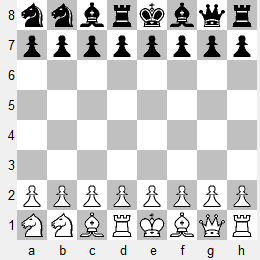
In other words, 'RQKNBNRB' was used in 42 of the 4340 games on the database. Why it was used more than twice as many times as any other SP is a mystery. The other SP with nine different first moves ('NNBRKBQR') is more normal. It is shown in the following diagram.


SP070 NNBRKBQR

Here are the nine first moves that were played on LSS, along with a count of the number of times they were tried (e.g. three games for 1.d4):-

3 : 1.d4
2 : 1.e4
1 : 1.b3
1 : 1.c4
1 : 1.f3
1 : 1.g3
1 : 1.g4
1 : 1.Nb3
1 : 1.Nc3

Where do I go with this data from here? I can't say for now, but I'm sure something will come to mind.

12 January 2013

Updated Database of SPs (2013-01)

Has it really been nine months since I last updated my database of start positions? Apparently so, according to my previous post on the subject, Updated Database of SPs (2012-03). As the database grows, the work required to update it increases, so I'm going to try to do it more regularly, like every six months.

05 January 2013

Castling into an Attack

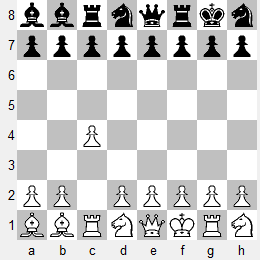
My first complete chess960 game at The Lechenicher SchachServer (LSS) was another example of Castling Too Soon. LSS tournaments are round robin events made up of two game minimatches, where the opponents play both sides of the same start position. Against this particular opponent, the assigned position was SP608 BBRNQKRN. Note that castling O-O is possible on the first move.

In my game with White, I opened 1.c4 and my opponent played 1...O-O, reaching the position shown in the diagram. In the 'Too Soon' post, I pointed out the disadvantages of premature castling:-

  • It's primarily a defensive move, which renders it somewhat passive, and
  • it fixes the position of the King as a target for the opponent's pieces.

Both drawbacks apply here as well, to an even greater degree than that first example.


After 1.c4 O-O

In the current game, 1...O-O practically grants an extra tempo for development to White. Even worse, the castled King is under the gun of the Bishops which are well coordinated on adjacent diagonals. The game continued 2.b3 e5, where Black's second move also looks like a positional mistake. After an inevitable ...c5, the square d5 will be permanently weak.

I followed a simple attacking plan of Nh1-g3-f5, g2-g4, f2-f3, and Qe1-h4, eventually checkmating the Black King with 12.Qh7+. My game with the Black pieces isn't finished yet, but it has followed a similar course. White played 1.O-O and the White King was under attack before I had even played my first move.

29 December 2012

Top Posts of All Time

As a year-end post on each of my three blogs, I had intended to highlight the top-10 most popular posts of the year for that blog. It turns out that the Blogspot.com toolset doesn't return statistics for the past year. They are available only for the past day, week, and month, or for 'all time'. For 'all time' it will be.

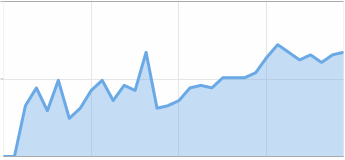
First, here's a chart showing monthly traffic since this chess960 blog started in May 2009. That peak near the middle, followed by the steep drop, is June 2010. Since then, the trend has been mostly 'up'.

Second, here's a list of the top-10 most popular posts of all time. A post introducing a list of online play sites heads the list, followed by two posts centered on Fischer himself.

It might be useful to look at keywords used on searches that found the blog, but the toolset no longer provides those statistics.

22 December 2012

The Lechenicher SchachServer

Since I was first bitten by the chess960 bug -- Shall We Play Fischerandom Chess? -- I've been playing chess960 primarily on Scheming Mind. It's a great site with first class management and I have only good things to say about it. The site offers several formats of which my favorites are the league and dropout competitions, both involving two simultaneous games per round with rounds starting at intervals of several months. For me, it's the right balance of chess960 to go with my other responsibilities.

For the 2013 Chess960 Dropout tournament, the site announced a change of format.

Please note that for this tournament, we are trying a new "Countdown" time control. Under countdown time, each player is allocated a fixed time at the beginning of the game (in this case sixty days) - this time is for the entire game, no increments will be added and holiday will not be applied to these games.

Even though the countdown time control is intriguing, I decided that it might be too demanding on my time budget, especially since my games against good players often go into the endgame. How would I pace myself over 60 days, not knowing how many moves the games would last? There was also the issue of no vacation. I tend to minimize online access while on vacation and I'm certain my wife would not be happy if I spent too much vacation time at a chess board. Signing up for the tournament meant up to six rounds with two games per round, plus a high risk that I would eventually crash & burn for lack of time.

While wondering whether to join or not, I remembered that the Lechenicher SchachServer (LSS) also offers the countdown time control, its only format for playing chess960. I had hesitated to play there partly because of the question of unknown game length and partly because I had enough games on Scheming Mind (SM) to keep me busy. The LSS countdown control is 90 moves for the game with 14 days of vacation, more relaxed than the SM equivalent. The five-player double round robin means eight games starting at the same time, but I can time my participation to coincide with those times of the year when I have less to do.

The upshot of this is that I started to play my first chess960 tournament on LSS and hope to report on the site's chess960 culture from time to time. I also started a new tag category to collect the posts; see 'Labels' in the right navigation bar. One other post deserves to be linked because of a long comment that mentions LSS:-

After gaining countdown experience on LSS, I can always return to SM to try the faster control.

15 December 2012

An Attack Is Playing to Lose?

In my previous post, Initial Pawn Moves and Castling, I found the graphic technique useful to understand the difference between the twins I discussed. It was so useful that I returned to the post before that, Twin Research, to identify the next pair of twins on that particular list.

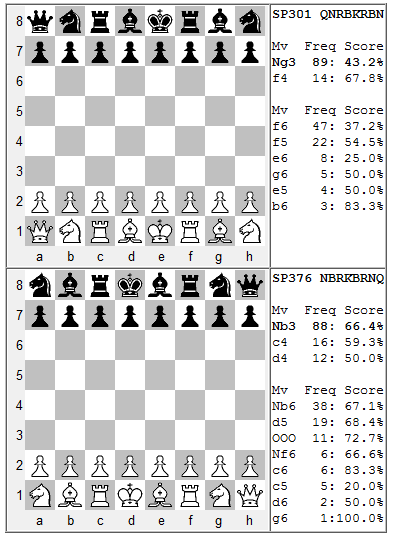
The second pair of twins exhibiting widely varying success rates for White and Black were SP301 QNRBKRBN and SP376 NBRKBRNQ. The position SP301 had an average success rate for White (%W) of 47.0%, while SP376 had %W of 62.9. That means SP301 was more successful for Black, and SP376 more successful for White.

The following chart shows the two SPs next to the results collected from the CCRL's engine vs. engine data (once again, see the sidebar for a link to the CCRL data). For example, the data for SP301 says that the most popular move, 1.Ng3, was played in 89 games and had a 43.2% success rate for White (%W again). The second most popular move was only played in 14 games. I haven't listed the other first moves given by the CCRL for that SP, all of which were seen in less than 10 games. The second block of stats for SP301 shows all of the responses to 1.Ng3. The move 1...f6 was played in 47 of the 89 games and was largely responsible for the low %W.

The data for SP376 tells a different story. While 1.Nb3 (the logical counterpart of SP301's 1.Ng3) was again the most popular first move, the response 1...c6 (the counterpart to SP301's 1...f6) is further down the list. The top response to 1.Nb3 was 1...Nb6, a move whose SP301 counterpart 1...Ng6 is nowhere to be found. What's going on here?

As luck would have it, I've already discussed this pair of twins in another post: Watch out for ****KRBN. In SP301, after 1.Ng3, White is threatening a dangerous attack on g7. The most common opening sequence on CCRL was 1.Ng3 (x89 moves) f6 (x47) 2.f4 (x34) Ng6 (x19). Now there were three moves (total x22 due to transpositions), all played about the same number of times, and all with %W less than 50%. The worst of the three moves was 3.Nf5 with a score of +1-6=0, i.e. a disaster for White.

In SP376, after 1.Nb3 there is no attack on b7 because of the option to castle ...O-O-O. The most common opening sequence was 1.Nb3 (x88) Nb6 (x38) 2.c4 (x21), and now there were two moves more popular than 2...O-O-O (where White won all games). The first move was 2...g6, where the score was +1-7=0; the second was 2...Na4, with a score of +5-1=0. These scores, both disasters for different sides, make no sense to me. Perhaps they can best be explained by the small number of games played.

In both SPs, it appears that the side playing for the attack is 'playing to lose', as the old chess saying goes. I would love to investigate this further, but I'm afraid I've run out of time.