11 October 2009

Whistling Past the Graveyard?

The graveyard of chess opening books, that is. While browsing various items about Chess960 @ Chess.com, I found the following morcel by Chess.com member FM_Eric_Schiller (comment to World Championship Computer-Assisted Predictions):-
I have to say that in my view Chess960 is no better than any other chess variant. All variants are way inferior to the true game. Chess has evolved over 1500+ years to achieve such a great balance that we have no idea what the best first move is.

Players who are too lazy to study openings may indeed prefer Chess960, but it hasn't caught on and will never do so. Chess openings are still unclear and exciting, and computers have increased the number of playable openings, not decreased them.

The Chess.com page for FM_Eric_Schiller confirms that the member is FM Eric Schiller of chess publishing fame: 'I have a full website at www.ericschiller.com, which includes samples of many of my more than 100 books, mostly of chess but a few on linguistics.' Following that URL, we find that many of the 'more than 100' books are listed on Eric Schiller's Books on Chess, while others can be located via Bookfinder.com: Searching for books where author is Eric Schiller.

Although opinions vary on the quality of Schiller's work (see Eric Schiller [Wikipedia] for a sample), here we have a bona fide contributor to the massive pile of opening books I discussed in Some Numbers on Chess Book Publishing, together with thoughts on the destiny of chess960. I imagine the thoughts are representative of the community of chess opening authors. Thank you, Dr. Schiller, for sharing.

Getting back to the specific remarks, my first comment is a reminder that chess960 is not a chess variant. It's an evolution of traditional chess as it has been played for the last several hundred years. Traditional chess is itself a subset of chess960, one of the 960 possible starting positions. The traditional start position dates to the mysterious appearance of chess over 1400 years ago, when before the battle began, armies assembled in symmetric formation facing each other across an invisible dividing line, generals in the center.

Ignoring the unsubstantiated opinion ('all variants are way inferior'), the name calling ('lazy'), and the idle speculation ('hasn't caught on and will never do so'), Schiller's objection to chess960 boils down to

  • 'we have no idea what the best first move is', and
  • 'computers have increased the number of playable openings'

This is just as valid for chess960 as it is for chess and overlooks the main reason for considering chess960: that opening theory has reached the unfortunate point where

  • the early moves of the game are based increasingly on memorization, and
  • the real struggle often starts in the late middlegame or endgame.

The message of any author of opening books is 'buy this book and follow the instructions'. The message of chess960 is 'think for yourself'. World Champion Bobby Fischer -or- FM Eric Schiller? I know which horse I'm backing.

10 October 2009

Some Numbers on Chess Book Publishing

In 'I'd be on my very own from the first move', I quoted Chess.com member DrawMaster asking, 'Why not give up completely on traditional chess?', then making three important points,
  • 'You would never waste another $20 on some nearly useless openings manual.
  • Or waste another moment trying to remember lines.
  • Or waste another thread post ruminating on the merits of the QGD or the Ruy.'

Note that the question is not about giving up completely on chess; it is about taking up chess960 and giving up on traditional chess. If this should happen -- and it's not at all certain that it will -- any obsession with specific chess openings would disappear. What then would chess writers publish, what would chess players study when they're not playing, and what would they talk about with other chess players?

The issue of chess publishing is the most critical. Along with playing and teaching, writing is a source of income for many professional and semi-professional chess players. Are books about openings really so important to the publishing industry? Let's look at the British Chess Magazine's (BCM) Chess Books & Reviews for Q3 in 2009.

  • September 2009 • 8 books reviewed, 4 on the openings : King's Indian; Trompowsky; Pirc; Secrets of Opening Surprises, Vol. 11

  • August 2009 • 9 books, 6 openings : Sicilian Dragon; Colle-Zukertort (1.d4 d5 2.Nf3 Nf6 3.e3 e6 4.Bd3 c5 5.b3); Catalan; Spanish (Ruy Lopez); Sokolsky (1.b4); Sicilian 3.Bb5

  • July 2009 • 8 books, 3 openings : Ruy Lopez; Dutch Stonewall; Sicilian

Out of 25 books reviewed over the three month period, 13 were on the openings. That implies that about half of all chess books published today have something to with openings. What are these opening books about?

Although a few opening names appear more than once in this list -- Sicilian, Ruy Lopez -- the 13 recent books cover a variety of different openings. Extend the three months over a longer period, and we start to see a lot of duplication. Taking the first opening on the list, the King's Indian, here are titles from Book Reviews on JeremySilman.com ('Our complete archive of book reviews. Dwarfs anything else on the web!').

  • ART OF THE KING'S INDIAN, THE by Gufeld
  • BEAT THE KID by Jan Markos
  • BEATING THE KING'S INDIAN AND BENONI by Vaisser
  • BEATING THE KING'S INDIAN AND GRUNFELD by Taylor
  • BRONSTEIN ON THE KING'S INDIAN by Bronstein
  • CONTROVERSIAL SAEMISCH KING'S INDIAN, THE by Ward
  • DANGEROUS WEAPONS: THE KING'S INDIAN by Palliser, Dembo, and Flear
  • EASY GUIDE TO THE NGE2 KING'S INDIAN by Forintos & Haag
  • KILL KID 1 by Semko Semkov
  • KING'S INDIAN AND GRUNFELD: FIANCHETTO LINES by Janigava
  • KING'S INDIAN DEFENCE: MAR DEL PLATA VARIATION by Gligoric
  • KING'S INDIAN WITH h3 by Breutigam [CD-ROM]
  • OFFBEAT KING'S INDIAN by Panczyk and Ilczuk
  • PLAY THE KING'S INDIAN by Gallagher
  • SAMISCH KING'S INDIAN UNCOVERED by Cherniaev and Prokuronov
  • STARTING OUT: THE KING'S INDIAN by Gallagher
  • UNDERSTANDING THE KING'S INDIAN by Golubev

These are titles that have been reviewed in the seven or eight years that JeremySilman.com has been on the web. There are certainly others.

How profitable are these books? That is a question that only the publishers and authors can answer. My guess, based on what little I know about the chess publishing industry, is that the average number of copies sold is in the four digit range and that each copy sold makes a couple of bucks for the publisher and similar for the author.

04 October 2009

'I'd be on my very own from the first move'

Along with Chess Ratings as a Predictor of Chess960 Skill, another Chess.com forum post that captured my attention was Has it really: 'Has chess 960 become a real part of real chess like blitz and regular chess.' DrawMaster wrote,
Why not give up completely on traditional chess? You would never waste another $20 on some nearly useless openings manual. Or waste another moment trying to remember lines. Or waste another thread post ruminating on the merits of the QGD or the Ruy. Or ... • Well, the list goes on. • Then, I realized that I'd be on my very own from the first move. And that thought was decidedly scary.

Point. Counterpoint:-

  • 'Give up completely on traditional chess' • Let's not carried away with chess960. It's a complement, not a replacement, to traditional chess.
  • 'Some nearly useless openings manual' • Yes, this is a real concern that needs to be discussed intelligently.
  • 'Waste another moment trying to remember lines' • Ditto.
  • 'Waste another thread post ruminating on the merits of the QGD' • Ditto.
  • 'The list goes on' • Does it? Looks like an excellent list as it is.
  • 'I'd be on my very own from the first move' • Scary? Maybe. Exhilarating? Definitely!

Intelligent discussion, or a well-disguised facsimile, to follow.

03 October 2009

Chess Ratings as a Predictor of Chess960 Skill

After writing the short post on Chess960 @ Chess.com, I spent some time reading relevant threads on Chess.com's chess960 forum. A few of them touched on points that I hadn't encountered before, and immediately caught my interest.

The first post that interested me was "Rating too low to accept this match!" Are you kidding me!?. The initial point of the thread was a complaint about how Chess.com uses ratings to match players who have requested a game with upper/lower limits on the ratings of potential opponents. It seems that traditional chess ratings are used in the algorithm for chess960 games. I assume this is done because the chess960 service was introduced on the site a few months ago and there were no chess960 ratings.

If that were the only point in the thread, I wouldn't bring it up here. More relevant were the following comments by ReLentLess5150, who was also the originator of the thread.

'I sincerely doubt that the so-called "higher rated players" in chess 960 have as huge an advantage as the might in standard chess.' • 'Do you HONESTLY believe that ratings play that much of a role in 960!?' • 'Chess 960 is basically a free for all, and I would hazard a guess and say that the odds of a low rated versus highly rated player [at traditional chess] are probably pretty low, 1400 versus a 2200. Who would you put your money on? On the other hand, I would give the 1400 at least even money in 960.'

Despite ReLentLess's apparent unfamiliarity with the rating system -- a 1400 has almost zero chance of winning a traditional game against a 2200 (see the table 'Rating expectancies vs. differences' at the end of Chess Ratings for the odds at different rating spreads) -- the writer raises some good points.

If we're talking about chess960 ratings that have been computed only on the results of chess960 games, then the chess960 rating will be just as good a predictor of future chess960 results as the chess rating is for traditional chess results. This has nothing to do with skill at chess; it's a result of the statistical and mathematical foundation of the rating system. As Elo pointed out, his rating system is valid for any two-player competition, whether fencing, boxing, or cribbage.

Of course, cribbage ratings have no predictive value for a chess game between the same pair of adversaries, just as chess ratings have no predictive value for a boxing match. The more pertinent question is whether traditional chess ratings have any predictive value for a chess960 game. I am certain that they do.

Suppose our 1400 player survives into an endgame against the 2200 player. As I pointed out in Differences Between Chess and Chess960, a chess960 endgame is 'usually indistinguishable' from a chess endgame. I said 'usually' because we can imagine some chess960 endgames where a Bishop might be in the corner, still blocked on the diagonal by a Pawn of the same color. That is obviously the result of a chess960 opening.

What chance does the 1400 player have against the 2200 in the endgame? A little better than in the earlier phases, because the position might peter into a theoretical draw (assuming the 1400 recognizes the opportunity and steers for it), but in general, the 2200 will win due to a better grasp of endgame principles and general superiority in accurately calculating long variations.

Now suppose the 1400 player reaches a middle game against the 2200. It is very unlikely that the 1400 is going to survive that phase. The 2200 has a superior ability to calculate tactics, a better understanding of positional play, a greater familiarity with combinations, and a wider knowledge of stock positions. One, if not several, of those advantages will result in a win for the 2200.

If the 1400 is totally outclassed in both the endgame and the middle game, that leaves the opening. Unlike the 'free for all' that ReLentLess imagines, the opening is exactly the phase where the 2200's superior knowledge of positional play is likely to swamp the 1400 even before the pieces are fully developed. The choice of castling (less obvious in chess960 than it is in chess), the effective deployment of the minor pieces, and, above all, the choice of a game plan are going to leave the 1400 hopelessly confused.

The example of a 1400 against a 2200 is just that: an example. The statistical advantage of the higher rated player is the same across the entire rating scale. The example might have been a 2200 against a 2700, where the same table of 'Rating expectancies vs. differences' predicts a 96% winning chance for the higher rated player.

I'll go even further in my claim that chess ratings are good predictors of chess960 results. In chess960 the lower rated player can no longer hide behind the shield of memorized opening variations and will make a mistake even earlier than in a traditional chess game. That means the higher rated player has a greater statistical chance of winning the game, meaning that the chess960 rating difference between the two players will be even greater than the difference in their chess ratings. Chess is, after all, a game of skill rather than a game of chance, and so is chess960.

28 September 2009

Chess960 @ Chess.com

On my main blog I've mentioned several times how much I like Chess.com (see Posts with label Chess.com). I was pleased to see a few months ago that the site now offers chess960. The kickoff was announced in Chess960 Explained!, where Mr. Chess.com himself (aka Erik) explains how to find a game. See also Forums > Chess960 and Other Variants.

27 September 2009

Arbitrariness in Chess Rules

I doubt that anyone can give a real reason why SP518 (RNBQKBNR) is the accepted start position for a game of chess, rather than SP534 (RNBKQBNR), shown in the following diagram. The only difference between the two positions is that the Kings and Queens are switched. Both SP518 and SP534 have the 'royalty' located in the center and both have the other pieces starting in a formation that, given the moves of those pieces, is superbly logical.
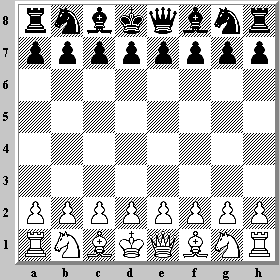

Start Position 534

Considering the two start positions objectively, there is no real reason why the Queen should start 'on her color'. The rule could be stated just as easily 'King on his color'. The start positions of the two pieces is an arbitrary decision that makes no real difference one way or the other. If the rules of chess had been codified as 'King on his color', chess opening theory would have developed exactly as it has over the last two centuries, and all of our chess books would have opening diagrams reflecting the switch in the positions of the Kings and Queens.

In chess960 the two start positions SP518 and SP534 are not equivalent. As I pointed out in A Database of Chess960 Start Positions,

SP534 is not a simple mirror image of SP518, the traditional start position. When castling O-O or O-O-O in SP534, the King and Rook end up on exactly the same squares as they do when castling in SP518: e.g. after castling O-O, the Rook ends on f1 and the King ends on g1.

It might not be as obvious as the case with the start positions of the King and Queen, but the rules of castling in chess also contain a big dose of arbitrariness. Suppose the castling rule in traditional chess were defined as follows:-

  • when castling O-O, the King ends on f1, the Rook on e1;
  • when castling O-O-O, the King ends on b1, the Rook on c1.

Other than the observation that it is a little easier to state the informal rule that we use to describe the castling move -- 'the King moves two squares toward the Rook and the Rook hops over the King' -- the new castling rule is just as logical as the traditional rule. The new rule could be stated informally as 'the King moves one square toward the Rook on the Kingside or three squares toward the Rook on the Queenside, and the Rook hops over the King'.

If you've thought about the castling rule in traditional chess ('two squares toward the Rook'), you probably realized that castling to the two sides does not produce identical positional considerations. Castling O-O-O has the advantage that the Rook ends up on a center file (the d-file), while castling O-O has the advantage that the King is located closer to the corner where it is a little safer. After castling O-O-O, a second move (Kc1-b1) is often played to move the King closer to the corner, while after castling O-O, a second move (Rf1-e1) is often played to bring the Rook to a center file. In either case, achieving the full advantages of castling -- safety the King and activate a Rook -- often requires an additional move. (*)

Looking the same way at the new castling rule ('one square toward the Rook on the Kingside or three squares on the Queenside'), the relative merits of the two types of castling have reversed. Castling O-O-O requires an additional move to bring the Rook to the center, while castling O-O requires an additional move to bring the King toward the corner.

Now let's say we define a variant where (a) we always start RNBQKBNR, but (b) in half the games we castle using the rule 'two squares toward the Rook', while in the other half we castle using the rule 'one square toward the Rook on the Kingside or three squares on the Queenside'. We have in fact defined a game where we play SP518 in half of the games and SP534 in the other half of the games. This is because our new castling rules have created a perfect mirror of SP534, with the King always starting on e1 instead of d1.

Looking at the other 958 start positions in chess960, it's easy to see that exactly half of the positions are mirrors of the other half, where the only real difference is the castling rule. We could just as easily have defined a game where (a) the King always starts on the Kingside, but (b) in half the games we respect traditional castling (O-O ends Kg1 and Rf1, O-O-O ends Kc1 and Rd1) while in the other half we use new castling (O-O ends Kf1 and Re1, O-O-O ends Kb1 and Rc1). This would result in exactly the same game as chess960, the sole difference being that the King always starts on the Kingside!

I'm not suggesting that anyone play using this half-and-half castling rule. I can imagine endless debates about which castling rule is actually in use for a specific game. What I'm suggesting is that chess960 is really chess480*2, where '*2' (meaning 'times two') denotes the two castling variants. Even if we were to restrict the number of start positions to two -- SP518 and SP534 -- we would have essentially doubled the number of opening variations available to us in traditional chess.

To repeat the point of my previous post, Chess960 Is an Evolution of Chess. It removes the arbitrariness of traditional chess rules, thereby increasing the complexity of the opening phase.

***

(*): Of course, the full range of positional considerations behind castling is more complicated than what I've stated. After castling O-O, the Rook might be better placed on a square other than e1, just as after castling O-O-O, the Rook might be better placed on a square other than d1. Similar considerations apply to the best square for the castled King. These complications don't change the direction of my argument; they just show how subtle chess (or chess960) can be.


26 September 2009

Chess960 Is an Evolution of Chess

Over the last few weeks I've investigated the evolution of two important rules in chess. The first rule governs the initial position:-

The second rule governs castling:-

I didn't pick these two rules at random. Together they constitute the sole difference between traditional chess (aka SP518: RNBQKBNR) and chess960. A frequent objection to chess960 is the emotional argument, 'It's not really chess!', which is only true if we consider chess to be exactly the game defined by FIDE's Laws of Chess (appropriately called 'FIDE Chess' by certain people).

The laws are found in FIDE's Handbook under section 'E. Miscellaneous': E.I.01A. Laws of Chess, where, contrary to the belief of the 'It's not really chess!' crowd, we also find in E.I.01B. Appendices the rules of chess960, which were added earlier this year. [Am I the only person who thinks it odd that FIDE classifies the laws of chess under 'miscellaneous'?]

In my lengthy quotes from Murray on the origins of the two rules, I included his summaries on other rules that have evolved through the centuries -- the moves of the pieces, the Pawn's initial move, Pawn promotion, en passant, stalemate, the bare King. These show that the similarities between traditional chess and chess960 are more significant than the differences.