17 March 2012

The Best Chess960 Weapon

A few years ago, when I first started playing chess960, I studied the openings of the best chess960 players I could locate in order to learn some tricks of the trade. One of the players I studied was a fellow nicknamed doodledandy, who won the first two chess960 championships on SchemingMind.com. I featured one of his games in an early post on my main blog, Pyramids and Dropouts.

In the nearly three intervening years since that post, I've played many of the same players who lost to doodledandy way back when. They are good players in their own right and I've come to gain even more respect for doodledandy's play. The position shown in the following diagram is a good example.

The player of the White pieces was the same opponent who beat me handily in a game I posted under the title Castling Misjudged. The start position was SP025 NQNBBRKR and the first few moves were 1.c4 c5 2.Nab3 b5 3.cxb5 Qxb5 4.Qf5, bringing us to the diagram. White's last move attacked the c-Pawn, which is not easily defended. The d-Pawn is pinned, while after 4...Bb6, White has 5.d4. How would you continue?
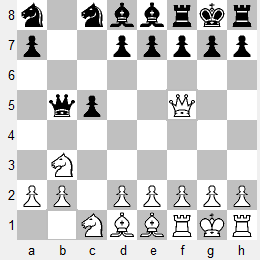

After 4.Qb1-f5

Black played the surprising Pawn sacrifice 4...e5 (!). Now after 5.Qxe5, the d-Pawn is no longer pinned, allowing 5...d6, which not only protects the c-Pawn, but also attacks the Queen and develops the light squared Bishop. The game continued 6.Qc3 Nab6 7.e3 Bf6 8.Qc2 c4 9.Nd4 Bxd4 10.exd4 Bc6 11.f3 Re8 12.Bf2 O-O, where Black is developing, attacking, or both, on every move. After the last move, 12...O-O, Black is far ahead in development while White's extra Pawn looks worthless. To see how Black converted his advantage, follow the game score, courtesy Scheming Mind.

[Event "Chess960: 2006 Chess960 Dropout Tournament, Round 5"]
[Site "SchemingMind.com"]
[Date "2007.05.08"]
[Round "-"]
[White "Tyler"]
[Black "doodledandy"]
[Result "0-1"]
[SetUp "1"]
[FEN "nqnbbrkr/pppppppp/8/8/8/8/PPPPPPPP/NQNBBRKR w KQkq - 0 1"]

1.c4 c5 2.Nab3 b5 3.cxb5 Qxb5 4.Qf5 e5 5.Qxe5 d6 6.Qc3 Nab6 7.e3 Bf6 8.Qc2 c4 9.Nd4 Bxd4 10.exd4 Bc6 11.f3 Re8 12.Bf2 O-O 13.d3 cxd3 14.Nxd3 Bb7 15.Be2 Ba6 16.Rd1 Nd5 17.Bf1 Qb7 18.Qd2 Re6 19.h4 h5 20.Rb1 Ncb6 21.b3 Rfe8 22.Rd1 Ne3 23.Bxe3 Rxe3 24.Kf2 Nd5 25.Qa5 R8e6 26.Rd2 g6 27.Nc1 Bxf1 28.Rxf1 Nf4 29.Rc2 Qe7 30.Qg5 Rf6 31.Kg1 Kg7 32.Kh2 Qe8 33.a3 Rf5 34.Qg3 Nd5 35.Kg1 Rf4 36.Rc4 a5 37.a4 Qe6 38.b4 axb4 39.Rxb4 Rg4 40.Qf2 Rxg2+ 41.Kxg2 Nxb4 42.Kg1 Rc3 43.d5 Qxd5 44.Ne2 Rc4 45.Rc1 Nd3 46.Rd1 Qb7 47.Qe3 Ne5 48.Nd4 Qb2 49.Kh1 Rxa4 50.Qd2 Ra2 51.Qxb2 Rxb2 52.Kg1 Kf6 53.f4 Ng4 54.Ra1 Ne3 55.Ra6 Rg2+ 56.Kh1 Rg4 57.Rxd6+ Ke7 58.Rb6 Rxh4+ 59.Kg1 Rxf4 60.Nc6+ Kd6 61.Ra6 Rf1+ 62.Kh2 g5 63.Nd8+ Kd5 0-1

It's obvious that doodledandy had excellent positional judgement. This must have been his best weapon on the way to winning two consecutive tournaments.

10 March 2012

The More the Better

In my most recent post, Chess960 Needs Fresh Eyes, I touched on the idea of
two-game matches where the opponents used the same start position, taking the White side in one game and the Black side in the other. While this seems like a natural way to conduct a chess960 tournament, for practical reasons it is better suited to correspondence play.

I was thinking about the extra time required to play two consecutive games with the same start position. After posting those remarks, I remembered the recent San Sebastian tournament, an event featuring traditional chess with a twist. As TWIC 896 (9 January 2012) explained it:-

Donostia Chess Festival: The format was unusual a knock-out tournament with some modifications, as the players who got eliminated played in a parallel group. And the main novelty was that, following David Bronstein's idea, the matches consist of two games of classical chess played simultaneously. So no one had the advantage of playing the first game with the white pieces. • [Wikipedia: San Sebastián: 'San Sebastián (Spanish) or Donostia (Basque) is a city and municipality located in the north of Spain']

What did the players think about this format with two simultaneous games? The official site, Donostia Chess Festival, carried a number of comments from top players in the event.

GM Shakhriyar Mamedyarov: I think this Basque system is very competitive. I like this format and that's why I'm here. The idea was created by David Bronstein and if I'm not mistaken he was playing against Mikhail Tal crazy matches on eight boards simultaneously. I don't know if this format can be popular in the future but in my opinion to organize this event is already a big success!

GM Sergey Fedorchuk: During the game I was confusing moves, score sheets. I was writing wrong moves, correcting them and of course it distracted me. At least I pushed clocks correctly. I was playing very fast at the beginning thinking that my time will finish very soon but in fact two hours are enough even for two games. I believe it's just new type of game just different one if we compare to "normal" chess. Some players can play better rapid chess; some of them play better blitz, so there will be some players who can play better with [this] format as well. Some poker players open many tables in computer screen. They play simultaneously everywhere and can control the situation.

GM Antoaneta Stefanova: I've never played the tournament like that before, so I expected to be more confused with all those actions -- playing, writing moves in different score sheets, pushing buttons on clocks. Loek Van Wely told me he had played the tournament on the six boards against the same opponent. So since we have only two here it can not be so difficult.

GM Loek Van Wely: It's also kind of tricky to play on two boards. I believe its better not to play fast here. You should not be [distracted] by your opponent who makes moves on the other board as well. Although, if there is an obvious move on the other board you can make the move quickly but in general it's better to keep on thinking about your position. The only situation when it's possible to switch all the time is when you have time trouble. In any case it's not so simple somehow to play here. [...] You look to one board then to another one and somehow you don't see clearly any more. I believe people will like this format and we are going to see more tournaments with Basque system. In my opinion it's a fairer format. There is a chance to play against the same opponent with both colors.

GM Andrei Volokitin (the eventual winner): Basque system is very interesting and not typical. It has right to exist. I like to play chess in general, so I feel comfortable to play so many games. The more the better!

Chess960 is already a giant step forward in the evolution of chess. Is the chess world ready for it to be combined with the Basque System of tournament play?

03 March 2012

Chess960 Needs Fresh Eyes

Last year, in Parallel Games and Parallel Games II, I looked at two-game matches where the opponents used the same start position, taking the White side in one game and the Black side in the other. While this seems like a natural way to conduct a chess960 tournament, for practical reasons it is better suited to correspondence play.

Since writing that post, I've had the opportunity to play a few such matches and now have some understanding of the techniques involved. You might assume that playing a two-game match with a random chess960 position is no different than playing a similar match with the traditional start position, but you would be wrong. In the traditional position, you don't care if your opponent opens 1.d4 or 1.e4 as White, or answers your 1.c4 with 1...c5, 1...e5, or any of the other choices. You've prepared for all eventualities and the initial moves are not about seeing which player has the better understanding of chess. That comes later in the game.

In chess960, on the other hand, already in the first moves you're comparing your initial plan as White with your opponent's plan in the other game. It's a contest to discover who has seen more possibilities in the given position.

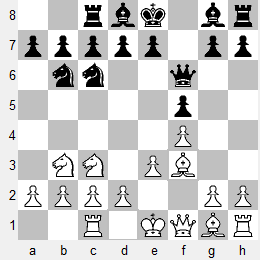
The match against my strongest opponent started from SP077 NNRBKQBR. A little analysis convinced me that an early f2-f4 (...f5 for Black) is necessary. On top of letting the Bishop out, it gives the Queen a developing square, thereby preparing to castle O-O. The f4 idea was used by both players in both games. An early position in the game where I had Black is shown below, after the moves 1.f4 f5 2.Nc3 Nc6 3.Nb3 Nb6 4.e3 Qf6 5.Bf3. Note that White's last move prepares O-O-O.

What to play next? I looked at a number of ideas. The move 5...e5, developing the dark squared Bishop and setting up tension in the center, suggests itself. I rejected this because after 6.fxe5 Nxe5 7.Bxb7 Rb8 8.Ba6, it involves a Pawn sacrifice. Black gets good counterplay, but I wasn't convinced that it was enough for the Pawn.

More straightforward is 5...Bf7, but I didn't want to commit the Bishop to a passive square while more active possibilities were still available. A similar idea is 5...e6. This might have been the best choice, but I decided against it because of 6.Bxc6 dxc6 7.e4, when White's pieces look more active than Black's.

That last line gave me another idea. If White can give up the Bishop pair so soon, why can't Black? That's how I hit on the idea of 5...Bxb3. After the natural response 6.axb3, White has the open a-file, but it doesn't bring any immediate benefit. In return, Black is confident that White won't castle O-O-O, when the a-file is useless.

After I played 5...Bxb3, my opponent must have reasoned the same way, because he answered 6.cxb3. After a further 6...e6 7.O-O-O Be7, I was happy with my game, and eventually got a small positional plus. I still think 6.axb3 was better, but that would have been a different game.

In the traditional start position, you never have the opportunity to exchange a Bishop for a Knight on its first developing move (except after, e.g. Na3/Nh3, which is decidedly unusual). It's hard to overcome that sort of traditional thinking and look at a chess960 position with fresh eyes, but that's exactly what some positions require.

25 February 2012

No Time for Shelter

It seems ages since I reported on the results for the SchemingMind 2009 Chess960 Dropout Tournament, in The Seeds of Victory?, and now I can report on the site's 2010 Chess960 Dropout Tournament. Unlike the 2009 event, which was my first time playing the knockout format used for the site championships, in the 2010 event I survived into the final round, eventually finishing tied for 2nd/3rd.

My play wasn't as good as the result might indicate. Two of my strongest opponents defaulted in positions that were entirely unclear and which could have gone either way. I would have been lucky to win both games and a loss in either would have meant certain elimination.

My only loss was against the eventual winner of the event, the same player who beat me in the 2009 event. I covered a position from that earlier game in another post, Symmetry Misjudged. He coasted to victory in the 2010 event using a classic tournament strategy, winning all of his games as White, while drawing his last four games as Black.

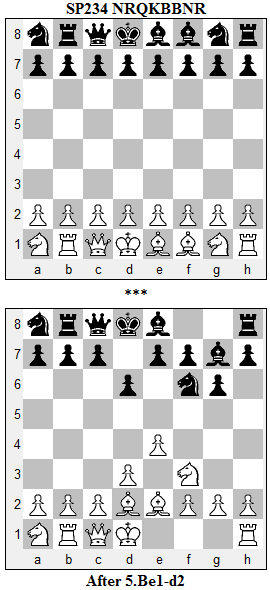
The position in the top diagram shows the start position, SP234 NRQKBBNR. Its most striking feature is probably the traditional formation of the BNR on the Kingside. I decided that castling O-O was the most likely plan for both players and expected my opponent to open with 1.d4. I was surprised when he played instead 1.d3, which might well have been the first time that a strong player started with a single step of a Pawn as the first move against me. I answered 1...Nf6, and we were off. The next few moves were 2.Nf3 g6 3.e4 d6 4.Be2 Bg7 5.Bd2, reaching the position in the bottom diagram.

Both players have used their first moves to pursue rapid development and White is already able to castle O-O. I wanted to continue 5...Bc6, but was concerned that the Bishop was somehow exposed on that square. I decided to play 5...c5, making a shelter for the Bishop, but wasn't certain if the loss of time would work against me. As I expected, White played 6.O-O, and I continued 6...Bc6.

Now tactics unfolded quickly with 7.e5 Nd7 8.exd6 exd6 9.Bg5+ Nf6 10.Re1, when Black has to react with 10...O-O, or lose the option to castle. White continued to play aggressively, hitting me with a combination a few moves later where I overlooked the key move. I eventually lost a Pawn, then another Pawn, and struggled on to the 47th move, when I resigned.

After the game, I couldn't find anything wrong with my play, except for the uncertain 5...c5. Was that the losing move? It doesn't look like one, but in chess960 you're never really certain how you stand in the opening.

18 February 2012

An Aborted Announcement

While poking through issues of TWIC from the mid-1990s, in preparation for a post on The Last, Lost Interzonal, I found an earlier mention of chess960 than the 19 June 1996 press conference described in Fischer Announces Fischerandom. From The Week in Chess 51, 1 October 1995:
'Bobby Fischer to present new chess rules' By Roberto Alvarez: Bobby Fischer will present worldwide his NEW chess rules in Merlo City (San Luis, Argentina) on November 13, 1995. Fischer has visited Argentina in 1959 (3rd/4th at Mar del Plata tournament [1959], Buenos Aires 1960, Buenos Aires 1970 and match Fischer-Petrosian, Buenos Aires 1971).

From November 14 to December 30, 1995 will take place a tournament or match between GM Lajos Portisch (HUN) and GM Eugene Torre (PHI) using these rules. This tournament will be transmitted around the world using INTERNET. Also on November 11 (nearly, to be confirmed) will take place in Merlo an strong international open tournament (normal rules).

What happened to that 1995 announcement? Besides Alvarez, GMs Portisch and Torre might be able to answer the question. Alvarez isn't mentioned in my 'Fischer Announces' post, but he is associated with the 1996 event in a related item on ChessVariants.com: Fischer Random Chess - News (see 'News from Argentina'). His document is still available on rec.games.chess. Whatever finally became of the November 1995 plans, another post on this blog, Brady on Fischer Random, places Fischer in Hungary at the end of 1995.

11 February 2012

Two and a Half Blogs

A large number of visits flagged on this blog's stats page alerted me to a new chess960 resource, Chess with no opening book, on a site, Metafilter.com, that was also new to me. It turned out that it's an introduction to chess960 covering the following points:-
  • The problem of opening theory in traditional chess
  • Rules specific to chess960
  • The strong similarity to traditional chess
  • The fairness of the 960 start positions
  • Blog ('two and a half') & Youtube resources
  • Online play sites

The blog resources, Chess960 Jungle (see the sidebar) and this one that you're reading now, were deemed worthy of a number of targeted links, which explains the transient jump in my stats. For one day, my visits were triple an average day, but returned to normal the next day. I imagine HarryO received even more visits on his blog, since he garnered the lion's share of links to blogs. Well done, Harry!

The Youtube resources included one channel that I hadn't seen before, with two annotated Nakamura - Aronian games, probably from Mainz 2009. The play sites also had a new resource, lichess.org, including both 'Play with a friend' and 'Play with the machine' options. I tried the play with a machine option at the lowest level and got a chess960 game with 'Crafty A.I.', which I won easily.

The comments were also worth reading. The first comment showed once again that chess960 is interesting not only for grandmasters looking for a respite from opening theory, but also for club players who have no inclination to study that theory.

I'm an apostate - I was pretty serious about chess for a while, but it was the opening book that actually sent me away from the game. When I was serious, I told people, "I'm not going to memorize the specific openings - I'm going to learn the theory and work from that." The response, "OK, kid, tell me how that works out for you," was unfortunately too accurate.

Another comment...

I don't think Chess 960 would be damaged if "by convention" some subset of the initial positions like SP941 were simply disallowed as "uneven".

...reminded me that I haven't looked at the CCRL stats (sidebar again) in a long time. SP941 is RKRBNQBN; is there some reason to exclude it? I'll try to revisit at least one of these new finds in a future post.

04 February 2012

Second Looks

Here are a few topics that I've already mentioned in past posts. Dennis Steele, the admin at ChessManiac.com, wrote to tell me,
Just wanted to let you know that ChessManiac.com now offers chess960 and vote chess. We also allow Chess960 Vote Chess games. That is a twist. Not sure if anyone else offers this or not.

The site is listed in the right column under 'Correspondence (Turnbased) Chess960' online play. The original announcement, including an audio clip of Fischer describing his invention, can be found at Chess960 now available online at ChessManiac.com. Another page, Chess Maniac Community Raises $8100 for upgrades, mentions that chess960 was added by popular demand. Vote chess, too.

***

Chessvibes.com just announced its annual Vote for the YB Novelty of the Year 2011. What's that got to do with chess960? Two years ago I used the 2009 NOTY contest as a discussion point in Fischer: 'The *Old* Chess Is Dead'. You can find the report on the 2010 contest on Chessvibes' Anand wins Yearbook Novelty award of 2010.

I'd like to piggyback on the 2011 NOTY to run my own contest. Guess on which move the winning 2011 novelty was played and win a one year subscription to this Chess960 FRC blog. Second place gets a two year subscription. Yes, it's an old joke, but so are chess opening novelties on move 23. To get the ball rolling, I vote that the winning novelty will occur on move 15. The six candidate games have already been shortlisted on the Chessvibes announcement, so no peeking!

***

Finally, two Schemingmind.com chess960 events finished recently: preliminary groups for Chess960 League - Season Five and 2010 Chess960 Dropout Tournament. I played in both, know them well, and will feature a game or two from each event in a future post.