25 April 2015
Chess960 1-2-3, April 2015
11 April 2015
Illegal for Chess, Legal for Chess960
Certain problems/studies that are illegal in chess might be legal in chess960, but I can't give any specific examples.
While writing that post I didn't have time to hunt for examples, but they aren't too hard to discover. In Chess glossary for Freshman Seminar: Chess and Mathematics, I found
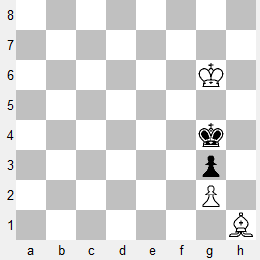
Legal position (n.): a position that can be reached from the initial array by game consisting entirely of legal moves, however bizarre. Conventionally every chess problem should have a legal position. Naturally then, an illegal position is a position that cannot be reached by a legal game. For instance, a position in which one side has more than 8 pawns, or has both White and Black Kings in check, is illegal (why?). So is any position with a White Bishop on a1 and White pawn on b2 (why?), such as the following mutual Zugzwang (q.v.), which Lewis Stiller discovered in the course of an exhaustive computer search: White Kg6, Bh1, Pg2; Black Kg4, Pg3.
The given position is shown in the following diagram.
Mutual Zugzwang

[FEN "8/8/6K1/8/6k1/6p1/6P1/7B w - - 0 1"]
The tablebase used in Shredder Computer Chess - Endgame Database accepts the position as valid and gives WTM 'Draw' and BTM 'Lose in 20'.
04 April 2015
CHESSIS2C960 Chess.com
I'm looking for chess analogies to explain chess960: 'Chess is to chess960 as ... is to ...' Any suggestions? Chess960 Analogies
It was the right forum to ask. Eliminating a handful of examples that I threw in myself, some worthy suggestions were:-
- as black & white TV is to color TV
- as V2 is to V3
- as raw spaghetti is to cooked spaghetti
- as blind obedience is to self reliance
- as Nascar racing is to F1
- as F1 is to Nascar racing
Midway through the discussion, I realized that a better formulation might have been 'Chess openings are to chess960 openings as ... is to ...'. Thanks to the racing analogies another angle occurred to me while I was preparing this post.
Chess *castling* is to chess960 castling as an automatic transmission is to a stick shift.
Why? Because in traditional chess the choice of 'where' to castle is usually obvious (and often conventional) although 'when' is sometimes tricky. In many chess960 openings one of the hardest early decisions is where and when to castle.
Which of the analogies do I like best? I'm not sure, but the one I understand the least is about spaghetti.
28 March 2015
CHESSIS2C960 Visually
Let's try filling in the blanks: 'Chess is to chess960 as ... is to ...'
Following the modern trend of reducing all communication to the bare minimum, I'll abbreviate that to CHESSIS2C960.
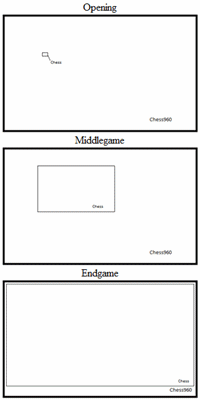
The image on the left compares chess to chess960 for the three major phases of the game. If squinting doesn't help, just know that the large boxes are labelled 'chess960', and the small, progressively larger boxes are labelled 'chess'.
In the opening, chess has somewhat more than 1/1000th the complexity of chess960. In the middlegame, I've shown it at about 1/7th the complexity. In the endgame they have nearly identical complexity. There are a few legal chess960 endgame positions that can't occur in chess, but they aren't worth worrying about (*).
As for the middlegame complexity, we don't know what the relative values are. There are many positions arising from chess960 that could arise only with great difficulty from the traditional start position. There are many never-before-seen strategies in chess960, but how could we quantify them? How would we even start to enumerate them?
Perhaps we should start by identifying some of the new strategies and hope that some pattern emerges. That's about as much as I can do with this blog.
(*) Certain problems/studies that are illegal in chess might be legal in chess960, but I can't give any specific examples.
21 March 2015
Know Your Competition
Anyone for a variation on chess? Is chess played out? This concern has been voiced periodically over the history of the game, and the challenges has never been more profound: over-refinement of opening-theory; perfection of endgame technique; super-abundance of draws at top-flight level; and (most recently) dominance of chess computers. To best ensure the future survival of the game, the great and the good have, over the years, proposed a number of variants to the rules of chess.
For example:
- Randomizing the starting position (Fischer)
- Adding extra pieces (Capablanca and Seirawan)
- Pawn-division (Regan)
- Redefining stalemate as victory (Short).
That is a good start, but the monologue then turns shrill.
Although not without academic interest, there is one problem which each of these chess simulants suffers from: it's just not as good as the real thing! We know it. And their inventors know it too. This is amply demonstrated by the lack of enthusiasm shown even by their originators. If you feel that your chess-variant is worthy of interest, then, by all means, start a web-site, develop a smart phone app, get sponsorship, organize a tournament, re-write endgame theory, publish a book of studies. But, if these are too much trouble for you, then, for heaven's sake, you might at least play the game yourself!
>>> Tinkering with the rules of chess is like adding a harmonica or a ukulele section to a classical orchestra: it's pointless. And sounds awful. <<<
This is all an introduction to an essay on Arimaa, which is not a topic for this blog. That last sentence about 'tinkering' leaves me baffled. It's structured like a quote, but I couldn't find the passage anywhere else. More interesting for this blog is the list of four variants. I needed help on the third and found it on Chessbase.com: Ken Regan's Tandem Pawn Chess by Kenneth Regan.
Properly speaking, chess960 isn't a variant, it's an evolution, since chess is a subset of chess960. Back to the orchestra analogy, let's try filling in the blanks: 'Chess is to chess960 as ... is to ...'
14 March 2015
The Double Kramnik Formation

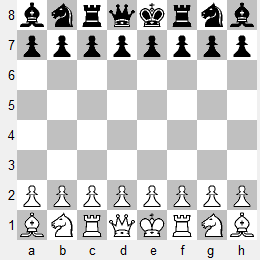
SP323 BNRQKRNB
How do the engines treat this position? I downloaded the corresponding file from the CCRL (see the link on the right sidebar) and found 178 CCRL games. I then loaded the file into SCID and used it to count the intiial moves. SCID doesn't know anything about chess960 -- it chokes when it encounters the first castling move -- but it works properly to that point. The following table shows the output from the SCID 'Tree Window'.
| Move | Frequency | Score | AvElo | Perf | AvYear | %Draws |
| 1: Nf3 | 52: 29.2% | 60.5% | 2622 | 2723 | 2010 | 13% |
| 2: b4 | 34: 19.1% | 61.7% | 2853 | 2907 | 2011 | 24% |
| 3: b3 | 31: 17.4% | 50.0% | 2659 | 2640 | 2010 | 29% |
| 4: Nc3 | 22: 12.3% | 77.2% | 2674 | 2891 | 2011 | 9% |
| 5: c4 | 17: 9.5% | 61.7% | 2712 | 2787 | 2010 | 6% |
| 6: g3 | 12: 6.7% | 41.6% | 2582 | 2529 | 2009 | 17% |
| 7: d4 | 5: 2.8% | 40.0% | 2010 | 0% | ||
| 8: e4 | 4: 2.2% | 37.5% | 2010 | 25% | ||
| 9: g4 | 1: 0.5% 1 | 00.0% | 2007 | 0% | ||
| TOTAL: | 178:100.0% | 58.9% | 2680 | 2745 | 2010 | 17% |
Here is the same for Black after White's most popular move, 1.Nf3.
| Move | Frequency | Score | AvElo | Perf | AvYear | %Draws |
| 1: Nf6 | 19: 36.5% | 60.5% | 2540 | 2472 | 2010 | 26% |
| 2: g6 | 17: 32.6% | 58.8% | 2680 | 2561 | 2010 | 0% |
| 3: c5 | 10: 19.2% | 60.0% | 2709 | 2604 | 2011 | 20% |
| 4: Nc6 | 3: 5.7% | 66.6% | 2012 | 0% | ||
| 5: b6 | 2: 3.8% | 50.0% | 2011 | 0% | ||
| 6: d5 | 1: 1.9% 1 | 00.0% | 2012 | 0% | ||
| TOTAL: | 52:100.0% | 60.5% | 2643 | 2542 | 2010 | 13% |
The most popular sequence for both sides, 1.Nf3 Nf6, follows basic opening principles. The Knight move (1) develops a piece, (2) prepares castling O-O, and (3) blocks the long diagonal in order to develop the corner Bishop without having it exchanged immediately. A look at the other popular first moves reveals other basic opening principles in action.
As long as I'm assigning random names to positions arising from the traditional setup, let's give GM Kasparov credit for the formation with the Knight and Bishop switched: 'RBN*****' or '*****NBR'. Why Kasparov? I introduced the 'double Kasparov formation' (aka the Kasparov position?) in two previous posts, Dog-Tired from Memorizing Openings and Switching Bishops and Knights.
07 March 2015
The Kramnik Formation
It is hard to explain but when in the initial position the Bishop stands on h8, the Knight is on g8, and the Rook on f8, the artistic beauty of chess disappears. By the way, I asked my colleagues about it and many of them share my feelings -- something is dubious and unaesthetic.
...and decided to call his example the 'Kramnik formation'. How many of the 960 start positions (SPs) use this formation? Taking the Queenside (a-side) formation 'BNR*****', there are three squares where the other Bishop can be placed, then four where the Queen can be placed, then three for the other Knight. The King and Rook drop into the last two squares with the King between the Rooks. Multiplying 3*4*3 gives 36, which must be the number of Kramnik formations on that side of the board.
Using the same logic on the Kingside (h-side) formation '*****RNB', there must also be 36 positions. This gives us 72 Kramnik positions, right? No, wrong, because two of the positions have the formation on both the Queenside and Kingside: SP323 BNRQKRNB and SP339 BNRKQRNB. I'll call these double Kramnik formations.
SP323 is the traditional start position (SP518 RNBQKBNR) with the Rooks and Bishops switched. SP339 is the twin of SP323, with the King and Queen switched. It's worth noting that in SP339, castling O-O-O is possible on the first move. It's also worth noting that both SPs fall into the category of positions with four corner Bishops.
SP323 is shown on the left. As for Kramnik's assertion that 'the artistic beauty of chess disappears', what can I say?
That 'beauty is in the eye of the beholder'?
That beauty is also found in the unfamiliar?

The beauty of chess is so much more than the all-too-familiar positions that arise from the traditional SP. Chess960 opens an entirely new, unexplored world of chess beauty.