20 April 2013

Games Between Skillful Players

The last time I looked at the LSS game collection (see the link to LSS in the sidebar) was in my post on Really Short Games, where I gave an example of a chess960 opening blunder ('??'). There are many more examples and while it might be useful to catalog the patterns involved, this is not the most interesting aspect of chess960.

Continuing with my copy of the LSS database, I identified games between players rated 2000 or more. Of the 7308 games on file, a little more than 100 games met this criteria. The reason is that until a year ago, LSS offered only one type of chess960 event, where players of all strengths are placed into the next event -- first come, first served -- until the available places are filled. Then the next event is opened. This often leads to rating mismatches with differences of 1000 points or more. The site now offers annual 'LSS Chess960 Championships', but the 2012 edition has only completed the preliminary stage, where there was just a single pairing of 2000+ players. We should see more games between top players as the semifinal and final stages complete.

All of the LSS events use the parallel game format, where opponents play two games using the same start position, one with White and one with Black. I've discussed this format in several posts, where the most recent was Opening Logic Sets the Course.

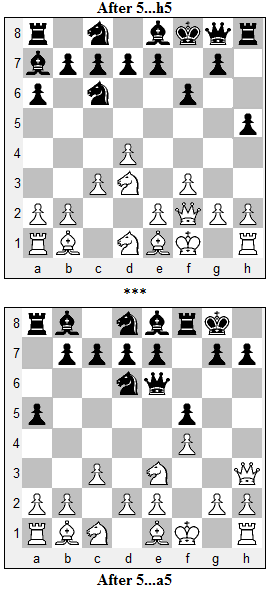
For this current post I chose a game played last year in an event named FO-2012-0-00316. One player was rated 2335, the other 2175, and they were assigned SP456 RBNNBKQR as the start position. The following diagram shows the position after five moves in both games.

In the top diagram, the initial moves were 1.f3 f6 2.Qf2 a6 3.c3 Ba7 4.d4 Nc6 5.Nd3 h5.

In the bottom diagram, the moves were 1.f4 Nd6 2.c3 f5 3.Qe3 Qe6 4.Qh3 O-O 5.Ne3 a5.

Both games show a curious symmetry of the f-Pawn. In the first game, f2-f3 and ...f7-f6 were played. In the second game, f2-f4 and ...f7-f5 were played. Can you tell from looking at the diagrams which player was higher rated?

13 April 2013

'I wish there were more opportunities to play'

American GM Hikaru Nakamura has figured in many posts on this blog, for example CCM9: Nakamura, Grischuk, and Rybka (for more, see 'Search This Blog' in the navigation bar on the right). I was pleased to see a comment in the April 2013 Chess Life (CL): Cover Story; 'The Resolute Grandmaster: Hikaru Nakamura’s slow progress towards the top' by Macauley Peterson (p.24).
Highlights from Nakamura at the London Chess Classic: In general, I try to surprise my opponents much more, as opposed to having a set repertoire of one or two openings. The more weapons you have -- the more chances to surprise your opponents and reach positions that you're more familiar with -- the better off you are. That's why, I would say, Carlsen has such great results. He's very good in pretty much every structure that's out there. He knows the concepts and the piece play a lot better than some of the other players.

With the computers now, you can't just be successful with one opening. You look at players like Karpov or Kasparov. Karpov for almost his whole career played the Caro-Kann, and some Frenches as well, and he did great. And with Garry, he played the Scheveningen and then the Najdorf for the better part of 20 years, whereas nowadays you really have to know more than that because with the computer you can analyze any opening and probably within one day you can have a very good understanding of it. So, because of that it's really changed the whole landscape of chess.

I really like Chess960 [also known as Fischer Random chess - MP]. I think it is the future of chess. For now classical chess is still very much alive, but at some point I think ... most people will be playing [960] ... The pieces are more random but still the skill factor is there, and I really enjoy it because it's really playing pure chess, there isn't the same preparation the way there is now ... I wish there were more opportunities to play it.

The same issue of CL (p.10) had 'Benko Remembers Fischer : Three compositions in honor of Fischer’s 70th birthday (born March 9, 1943)'. Two of the compositions used chess960 castling rules.

30 March 2013

Random Position, Random Results?

On my main blog I've been running a series on the three 'Black Is OK' books by GM Andras Adorjan. I wrote the most recent post, 'Black Is OK' - 12 Discussion Points, with chess960 in mind. Here are the first three of the 12 discussion points, adapted for chess960.
  1. I presume -- in the spirit of the presumption of innocence -- that [all 960 start positions are] equal.
  2. The logical outcome of [any start position] is a draw.
  3. If one of the players wins [a] game, his opponent has certainly made some mistake.

Not as convincing as the same statements for traditional chess (SP518 RNBQKBNR), are they? To be clear, saying that 'all 960 start positions are equal', doesn't mean equal to each other; it means equal for White and Black, i.e. neither color starts with a winning advantage in any start position (SP). At this point in my chess960 education, I presume this is true, but I am far from convinced and wouldn't be surprised if this presumption turned out to be false. In the ongoing series of games I presented in Proof of Concept with HarryO, my sparring partner admitted that he doesn't have the same confidence that I do. He is certainly not alone.

Getting back to traditional chess, the foundation of the 'Black Is OK' philosophy rests entirely on the second point. To quote the original statement in full:

Qualified players will mostly come up with the same reply as a great number of world champions or chess thinkers since Lasker: the logical outcome of the game is a draw.
If the 'qualified players' are right, as the accumulated experience suggests, then Black is OK; if they are not right, then there is a tree of related variations where all branches inevitably lead to a forced win for White, and Black is definitely *not* OK (ignoring the minute possibility that traditional chess is a forced win for Black, which is highly unlikely).

Since there aren't really any qualified players in chess960, and since the accumulated experience is skimpy at best, we just don't know if 'Black Is OK' across all SPs. All we have is our presumption of innocence, which is an act of faith. That brings me to the third point: a game is only lost because of a mistake. In chess960 it might indeed be lost because of a flaw in the start position. We will never know for sure, will we?

In his 'presumption of innocence' essay (see the '12 Discussion Points' post for a link), Adorjan touched on one metric that might be relevant. He mentioned that the ratio of White wins to Black wins in practice 'could be something like 55:45 in 100 games'. This corresponds to an observation I made in A Pawn Equals 200 Rating Points.

A difference of 40 rating points [value of first move as a fraction of a Pawn] gives the higher rated player a little less than a 0.56 chance of winning the game. This means a 56% expected score for White, and a 44% expected score for Black, which is close to the result derived from databases of historical master-level games.

Is this ratio related to the specific start position in SP518 or is it a function of the first move? Perhaps it is both. I'm afraid that, once again, we will never know for sure, will we!

23 March 2013

Commentating the Opening in London

Like most other die-hard chess fans, for the past week I've been following the Candidates tournament in London. I commented on the event in a post titled London Candidates - First Week on my World Chess Championship blog, but I've also been watching the action with chess960 in my thoughts. Today the seventh round, the last round of the event's first half, is being played.

While I was waiting for the games to start, I picked a round at random -- Round 5 - Commentary on Livestream -- and reviewed the video, which I had already watched live. Then I noted all of the comments on the openings which were on a higher level than straight analysis of the moves; let's call them meta-comments.

Ivanchuk - Carlsen: In every round Carlsen's game has been one of the commentators' favorites. In this game we see that they were already unfamiliar with the opening variation on the eighth move. (LT is IM Lawrence Trent, the anchor. NS is GM Nigel Short, guest commentator and former challenger for the World Championship title. The numbers show the time into the clip when the commentators switched to talk about that game.)

08:30
LT: 'This is all main line theory.'

21:00
LT: 'This is all main line.'
NS: 'I've completely forgotten everything here [...] This is the Karpov - Kasparov stuff'

30:00
LT: 'That [move] must be a novelty'
NS: 'I don't know. We need some Gruenfeld experts. I don't know this [move]'
LT: 'It's a rare one. It's certainly not one of the main ones. I'm not a Gruenfeld expert either.'
NS: 'We'll probably find on the database that there were vast numbers of games played, but I'm not very familiar with this at all.'
LT: 'No. We don't use engines here. We don't use databases. We just use our raw talent.'
NS: 'That's why we're struggling.'
LT: 'We get up to move eight in a Gruenfeld and that's about it.'

Kramnik - Aronian: No one ever seems to find much of interest in Kramnik's openings and no one ever seems interested in spending much time on them. He is on too high a level.

10:30
[They explain some features of the moves; no meta-comments.]

29:00
LT: 'It's dull o-clock'

Grischuk - Radjabov: Just like the Ivanchuk - Carlsen game, neither commentator is familiar with the specific line played.

22:30
NS: 'This [move] is quite trendy. God knows what the point of it is. [...] This [other move] is the old stuff and I'm an old-fashioned player. There's nothing wrong with it, but it's very old. That's my sort of chess.'
[After some moves]
LT: 'This has been seen a lot of times as well. [...] Grischuk has only spent a few minutes on this.'
NS: 'I'm sure he's got all of this prepared.'

Svidler - Gelfand: Here we see some real enthusiasm. White played an unexpected move that allowed the commentators' imaginations to roam.

14:00
LT: 'Look at this! That's more like it!'
NS: 'Is that a move? You can't do this in the Gruenfeld. That's illegal, isn't it?'
[They discuss the move.]
NS: 'I'm enjoying this.'

To summarize: At an early stage of three games the commentators were unfamiliar with the opening variation played. In one of those games they found it uninteresting. The fourth game they loved because it was unexplored territory.

The commentators are both titled players, one of whom was world class in his heyday. If they can't follow the early stages of the game, what hope is there for keen club players like the rest of us? Then consider the other 600 million players (?!; FIDE's number) who might only have played a few dozen games in their lives. The theory is too deep, the precedents are too wide, and the players' computer preparation is too complex. No one knows what is going on in the game except the two players themselves.

In that last game, GM Short said, 'I'm enjoying this'. At that moment he was on the same level of understanding as at least one of the players, as were the rest of us. This is not to say that everyone understood equally. The players, after all, are among the best in the world with a better understanding of chess than 99.999% of all chess players.

To return to chess960, this is exactly the attraction of Fischer's greatest invention. Everyone -- whether player or commentator or spectator -- is looking at the position for the first time ever, applying their own knowledge of chess to tackle a completely new chess position. Chess might not be a great spectator sport, but chess960 might well be.
16 March 2013

Really Short Games

In First Move Diversity in Chess960, I used a collection of games from The Lechenicher SchachServer (LSS; see the link under 'Correspondence Chess960' on the right sidebar). Since that post, the site has added games played in 2012:-
Database with all LSS Chess 960 tournaments finished up to and including December 2012. 7308 games in zipped PGN format.

After downloading the file and adding it to my database, I developed some queries to identify short games. Of the 7308 games, I found over 1000 that finished in ten moves or less. Many of these were games that had been abandoned by one of the players after only a few moves, but some were genuinely short games. One way to identify real games was where they contained the checkmate ('#') symbol. Consider the following start position (SP).


SP887 RQBKRNNB

One game with this SP lasted only three moves -- 1.Nf3 Nf6 2.Ne5 Ne4 3.Nxf7# 1-0 -- ending in a smothered mate. Many of the short checkmates were more examples of smothered mate, although I also found quite a few that were the result of a Queen and Bishop battery on a long diagonal checkmating the enemy King sitting on b8 or g8.

In the past, I've seen these short games used as 'proof' that chess960 is somehow deficient because it permits them. The same argument would say that traditional chess is deficient because it permits Fool's mate (1.f3 e5 2.g4 Qh4#).

Short mates are more a reflection of a player's skill than of a game's shortcomings. It is absolutely essential to look at threats created by the opponent's last move. In chess960, this often means threats created on the first move.

09 March 2013

Remembering Bobby

Today is the 70th anniversary of Bobby Fischer's birth. Here is a collection of chess960 posts where he played a central role.

The invention of chess960 might one day prove to be his greatest accomplishment.

02 March 2013

Carlsen and Chess960

Magnus Carlsen and chess960? As far as I know, the world no.1 has never shown any interest in Fischer's invention. The purpose of that headline was to introduce a portion of GM Bachar Kouatly's editorial in the March 2013 issue of Europe Echecs:-
The characteristic of a genius is to innovate and to take the opposing view against established dogma. Carlsen remakes chess today the same way as Fischer who wanted to avoid forced passage through the openings ['le passage forcé par les ouvertures']. The invention by the American genius of Fischer Random Chess or 960 was destined to measure the intrinsic strength of a player without reciting the opening by heart. His attempt to transform the game of chess by a renaissance was too brutal for a world that doesn't like change.

Carlsen succeeded the tour de force by playing at chess960 ['échecs 960'(!)] with our old rules. In effect, it is extremely rare to see him take the advantage in the opening, contrary to Kasparov who nearly always led the debate in this phase of the game. To the contrary, Carlsen tries to obtain a playable, even slightly inferior position in the first 15 to 20 moves, which goes against all of today's players who like to play with the initiative from the beginning.

He accepts to kowtow ['courber l'échine', literally: 'bend the spine'] in order to begin the real combat in the middlegame, and frequently to terminate it in endgames exhausting to all his opponents. Through his phenomenal understanding of the game he manages to abandon what we believe to be fundamental in a chess game.

[I left in a couple of GM Kouatly's original phrases because I'm not sure about my translation (in case there is any doubt, I'm not a professional translator) and mentioned 'échecs 960' because I couldn't remember encountering the phrase before.]

There is considerable food for thought in the brief passage from EE. I should point out that, unlike many mainstream chess resources, Europe Echecs is not anti-chess960. I referenced a few of their articles in one of my posts about the 2011 St.Louis event, Kings and Queens on Chess960. The statement that chess960 is 'too brutal for a world that doesn't like change' remains to be seen. It's still too early in any transition to make categorical statements like this.

As for the comparison between Fischer's idea and Carlsen's style, it comes down to the observation that geniuses know when and how to break the rules that the rest of us are struggling to assimilate. Kouatly seems to be saying that Carlsen relies on slightly inferior moves to unbalance his opponents. This would be a good topic to explore on my main blog, where I'm building a collection of Carlsen's games; the most recent post was Carlsen TMER PGN.

I've already addressed the idea of using inferior moves to escape the burden of opening theory; see, for example, Shall We Play Amar's Opening? While it has certain attractions for diehard adherents of traditional chess, it is far less rich in ideas than the universe of alternatives offered by chess960. The proof of this is the notion that it takes 'the first 15 to 20 moves' for Carlsen to find an interesting position. In chess960, this happens already on White's first move.

Although it would be a great boost for chess960 if a player of Carlsen's stature would openly support it, I have no illusions that this will happen soon. Professional players need to 'follow the money' and today there is no money in chess960. The transition from traditional chess will happen not from the top-down, but from the bottom-up. As club players realize that too much effort is required to tackle the enormous body of opening theory, which is a necessary prerequisite to finding new approaches in that theory, they will be attracted to the simplicity, elegance, and challenge of chess without opening books. As this happens, the money will start to trickle in and the professionals will follow.