17 January 2015

FICS / ICC / Lichess, Comments on Chess960

After ChessCube, Comments on Chess960, let's take a look at comments about chess960 on FICS. First, here are the FICS rules on how to play (first written in 1996!):-

FICS doesn't have a forum and I couldn't find much discussion on other forums. The recurring theme seems to be how problematic it is to find a game there. For example:-

As for the last two servers listed after ICS under my 'Crossboard (Live) Chess960' links, I've already discussed them on this blog. Here is the final post for each server; follow the link to find earlier posts:-

In my next post I'll start looking at servers listed under 'Correspondence (Turnbased) Chess960'.

10 January 2015

ChessCube, Comments on Chess960

While working on Lichess, Second Look, I thought it might be a good idea to look at comments about chess960 from each of the ten online play sites listed on the right. That would give me some insight into practical issues involving the implementation of chess960. First on the list is ChessCube.com, where I found two good comments about when the clocks should be started.

Chess960 clock change (Feb 2011):-

At the moment the clock timer only starts once White has made his first move. White gets too much advantage! White is free to think for as long as they like while Black cannot predict what White will play with any degree of confidence and thus cannot properly prepare a reply during the time the clock is still. Once White has moved, Black's time is then the first to suffer!

The situation is made worse because White automatically get's one free tempo simply because they are White. Statistically speaking, this tends to put Black on the defensive from the game start. If White's time counts down immediately, this tends to balance out Black's chances to attack and play aggressively because at least there is some compensation to Black for being a tempo down.

Chess960 clock change (Aug 2013):-

White's countdown clock should start immediately on White's first turn. Black is already at a disadvantage and so when it comes to their first turn, all of the thinking they were doing on White's first turn might well come to nothing because White plays a different first move.

They almost sound as if they had been written by the same person. Whoever the author is, I agree with the reasons given.

While I was working on ChessCube, I deleted its label, which had also been listed on the right. When I set it up, I thought I would be playing frequently on the site, but it hasn't worked out the way I expected.

03 January 2015

Lichess, Third Look

After Lichess, First Look and Lichess, Second Look, is there any more to say? Yes, there is. That 'First Look' post only introduced the site's chess960 play against an engine, while 'Second Look' was a review of all my links to online play sites.

The site appears to be managed from ornicar/lila · GitHub, which bills itself as 'Best chess web application, ever'. Wikipedia, on its GitHub page, tells us,

GitHub is a web-based Git repository hosting service, which offers all of the distributed revision control and source code management (SCM) functionality of Git as well as adding its own features. Unlike Git, which is strictly a command-line tool, GitHub provides a web-based graphical interface and desktop as well as mobile integration.

The ornicar/lila page adds,

It's a free online chess game focused on realtime and ease of use. It has a search engine, computer analysis, tournaments, forums, teams, puzzles, a weird monitoring console, and a world map. The UI is available in 80 languages thanks to the community.

Since my interest in the site is mainly for chess960, I searched both the web and the Lichess forum for material relevant to Fischer's greatest invention. One forum post from the past month, Forum > General Chess Discussion > Chess 960, asked, 'How popular is this variant here?', and led me to the site's search page.

There I learned that of the 50.000.000+ games recorded on the site, almost 600.000 are chess960. As a percentage that might seem small, but it's hardly discouraging; chess960 adoption is still in its very early days. I also learned that 32 games have been played where the average rating of the two players was more than 2400. That could be a good starting point for a future post on this blog.

Another starting point might be the on the site's GitHub page.

If you want to add a live chess section to your website, you are welcome to embed lichess. It's very easy. [...] Just embed lichess using an iframe.

I'm looking at those tabs at the top of every page on this blog -- 'Home' ... 'Chess960 1-2-3' -- and telling myself, 'Let's give it a try!'

27 December 2014

Lichess, Second Look

I ended the previous post, Lichess, First Look, with the question 'where should it be placed in the list of chess960 servers shown in the sidebar of this blog?'. The main page, en.lichess.org, which is also the 'Play' page, lists both 'Real time' and 'Correspondence' play. Since I have fewer 'Real time' links than I have 'Correspondence' links, I listed it under my Crossboard (Live) links.

While I was working on those links, first documented in Chess960 Online Play Sites (March 2011), I checked all links to ensure they were still active. One site had disappeared (Brainking.de) and one site had changed its main address (LSS), so I made those corrections.

As for Lichess itself, everything I look at tells me that it's highly unusual. I'll need a 'Third Look' before I make any conclusions.

20 December 2014

Lichess, First Look

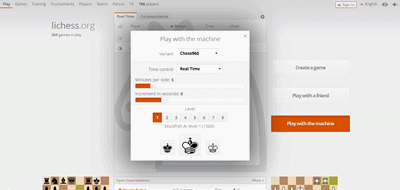
An online play resource I haven't covered yet is Lichess.org. HarryO mentioned it in a comment to Foraging the 'News Groups' (August 2013), and it always pops up on searches for specific chess960 positions like the all important BBQNNRKR. It also offers a chess960 'Play with the machine [Stockfish]' service.


Lichess.org : Play with the machine

What else does it offer? And where should it be placed in the list of chess960 servers shown in the sidebar of this blog? A longer look is needed.

13 December 2014

Design the Chess960 World Championship

Earlier this year I posted a series on my World Championship blog -- The Road to the World Championship: Part I, Part II, and Part III -- along with an opinion on my main blog, The Winning Formula, 'Has FIDE finally found the winning formula?'. The posts describe the qualification process for the FIDE World Championship.

Let's suppose we're tasked with designing a World Championship for chess960 using the same four-stage structure as the FIDE qualification cycle for traditional chess:-

Continental Championships -> World Cup -> Candidates Tournament -> Title Match

This structure uses four different types of event -- Swiss system, Knockout, Round robin, and Match -- corresponding to the four qualifying stages. For each equivalent stage of the chess960 championship,

  • How are start positions (SPs) chosen?
  • When are SPs announced to the players?
  • How many games are played with each SP?
  • What time controls are used?
  • How do tiebreaks work?
  • Is SP518 in use?

Lots of questions. Any opinions?

06 December 2014

The Initial Positional Considerations

In my previous post, Breaking the Symmetry, I reported on the 2012 SchemingMind Chess960 Dropout Tournament. In this post I'll report on the 2013 event. In fact, SchemingMind conducted two 2013 chess960 dropout tournaments. The first was an experimental event using the 60 day countdown time control that I discussed in my initial post about The Lechenicher SchachServer (LSS). The second was a traditional event using the same time control (30 days per game plus 1 day per move) seen in the previous SchemingMind dropout tournaments. Because I had switched to LSS to try their more relaxed countdown control, I decided to skip both SchemingMind events.

Since the first 2013 SchemingMind tournament finished recently and the second is in the last round, I'll report on the first event: 2013 Chess960 Dropout Tournament (Schemingmind.com). A key game took place in the fifth of the six rounds, between the eventual runner-up and the eventual winner, playing White and Black respectively. The chess960 wheel of fortune gave the players SP718 RKQNNBBR, shown in the top diagram.

The initial positional considerations in every chess960 game are nearly always the same:-

  • To which side will I castle?
  • How will I deploy the minor pieces?
  • Where will the Queen go?

In SP718, castling O-O-O appears to be the obvious choice, but the other considerations are not so straighforward. Let's see what the two players did.
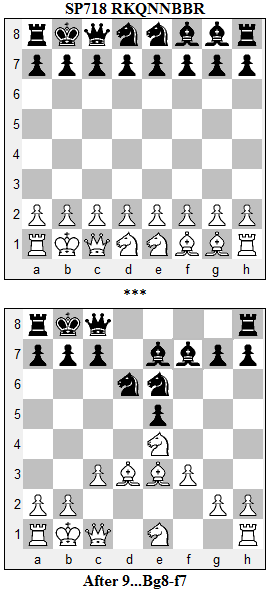
The game started 1.d4 d5 2.Nc3 f6 3.e4 dxe4 4.Nxe4 Nd6 5.f3 e5 6.dxe5 fxe5 7.Bd3 Be7 8.c3 Ne6 9.Be3 Bf7, reaching the position shown in the bottom diagram. Both players have developed the minor pieces in different arrangements. Black has completed their development, while White still has to move the Knight off e1. Its only move is Nc2, which apparently did not appeal to White for his next move, since he played 10.g3. Besides making space for the Knight on g2, the move keeps the enemy Knight off f4, and prepares a Kingside expansion with h2-h4.

Now Black had to tackle the questions concerning castling and the Queen's development. The obvious choice is a Queen move followed by ...O-O-O, but Black found another possibility: 10...a5!. This move says that Black will leave the King in place, will deploy the Rook via the a-file, and will use the a-Pawn to harrass the White King. This plan must have sent White scrambling to find a good counterplan, but he eventually decided to continue on his chosen course. A few moves later Black sacrificed a Pawn to get attacking chances against the White King, and finally won the game. The full game score is...

[Event "Chess960: 2013 Chess960 Dropout Tournament, Round 5"]
[Site "SchemingMind.com"]
[Date "2014.04.18"]
[Round "-"]
[White "pjl1015"]
[Black "Ezedoke"]
[Result "0-1"]
[Variant "fischerandom"]
[SetUp "1"]
[FEN "rkqnnbbr/pppppppp/8/8/8/8/PPPPPPPP/RKQNNBBR w KQkq - 0 1"]

1.d4 d5 2.Nc3 f6 3.e4 dxe4 4.Nxe4 Nd6 5.f3 e5 6.dxe5 fxe5 7.Bd3 Be7 8.c3 Ne6 9.Be3 Bf7 10.g3 a5 11.h4 a4 12.Qc2 g6 13.Qe2 Rf8 14.Nc2 Nxe4 15.Bxe4 Nc5 16.Bxc5 Bxc5 17.Qb5 Bb6 18.Qxe5 Ra5 19.Qe7 Bc5 20.Qg5 Qe6 21.a3 Qb6 22.Qd2 Rb5 23.Nb4 Bb3 24.Nc2 Bc4 25.Nb4 Be3 26.Qc2 Re5 27.Qxa4 Rxe4 28.fxe4 Qe6 29.Re1 c5 30.Qd1 Bf2 31.Nd3 Bxd3+ 32.Qxd3 Bxe1 33.O-O-O c4 34.Qd4 Bxg3 0-1

... courtesy of SchemingMind.