Showing posts with label Experiments. Show all posts

28 September 2024

A Flawed Chess960 Study

A chess study is a composed position which illustrates some unexpected theme. It is usually a position which could arise naturally from a game between two skilled players. This distinguishes it from a chess problem, which is based on a composed position that is extremely unlikely to arise in a real game. An academic study is something completely different.

When was the last time you saw a research paper based on a study of chess960? There must have been others, but this is the first one I can remember seeing. Titled Machine Learning Algorithms to Predict Chess960 Result and Develop Opening Themes (arxiv.org; 'submitted on 29 Oct 2023'), it lists its authors as:-

Shreyan Deo, DPS Vasant Kunj, Delhi, India • Nishchal Dwivedi, Department of Basic Science and Humanities, SVKM’s NMIMS Mukesh Patel School of Technology Management & Engineering, Mumbai, India

The 'Abstract' offers a useful overview. In its entirety it says,

This work focuses on the analysis of Chess 960, also known as Fischer Random Chess, a variant of traditional chess where the starting positions of the pieces are randomized. The study aims to predict the game outcome using machine learning techniques and develop an opening theme for each starting position.

The first part of the analysis utilizes machine learning models to predict the game result based on certain moves in each position. The methodology involves segregating raw data from PGN files [NB: CCRL was the source] into usable formats and creating datasets comprising approximately 500 games for each starting position. Three machine learning algorithms -- KNN Clustering, Random Forest, and Gradient Boosted Trees -- have been used to predict the game outcome.

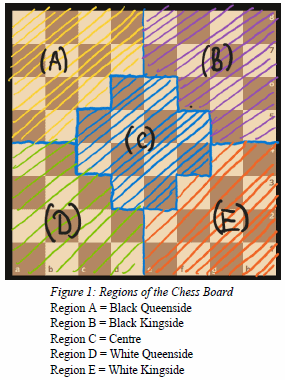
To establish an opening theme, the board is divided into five regions: center, white kingside, white queenside, black kingside, and black queenside. The data from games played by top engines in all 960 positions is used to track the movement of pieces in the opening. By analysing the change in the number of pieces in each region at specific moves, the report predicts the region towards which the game is developing. These models provide valuable insights into predicting game outcomes and understanding the opening theme in Chess 960.

Keywords: Chess 960 [Chess960], Fischer Random Chess, machine learning, game outcome prediction, opening theme, KNN Clustering, Neural Networks, Gradient Boosted Trees.

Note: Trying to see just by looking at the snapshot of an evolved game how accurately we can predict who will win

The 16-page paper is interesting for many reasons. I extracted the section headers to create a table of contents:-

1. Introduction

2. Methodology
2.1. Segregation of Data
2.2. Visualising Chess Positons as Numbers
2.3. Predicting the Outcome
2.4. Developing an Opening Theme

2. Modelling [should be '3.'?]
3.1. KNN Clustering
3.2. Random Forest
3.3. Gradient Boosted Trees

4. Result
4.1. Outcome Prediction
4.2. Theme Analysis

5. Discussion
5.1. Discussing the Accuracy of the Predictions
5.1.1. Comparing the Different Data Sets
5.1.2. Comparing the Different Machine Learning Models
5.1.3. Disparity in the Accuracies of Certain Starting Positions
5.1.4. Possible Reasons for Low Accuracy Rate
5.2. Discussing the Theme Analysis and Its Importance

6. Conclusion

7. Future Developments & Limitations

8. References [eight total]

9. Appendix

The section '9. Appendix' starts,

This section traces the opening theme of each individual starting position. The heading provided is in the form X_Y, where X represents the region in which White pieces tend to develop, and Y represents the region in which Black pieces develop.

This is very useful in individually finding out how each specific starting position should be played. For example, the position BBNNQRKR should be played by the players such that White attacks the Black Queenside whereas Black attacks the White Kingside.

Why choose SP032 BBNNQRKR as an example? Because it's the study's first position in the first group of positions, all of which are under the header 'Black Q Side_White K Side'. A useful diagram ('Figure 1: Regions of the Chess Board') from the study helps to explain how it sees the different sections of the board.
Unfortunately, the explanation ('should be played by the players such that...') of BBNNQRKR is dubious:-

  • 'White attacks the Black Queenside'
  • 'Black attacks the White Kingside'

The position BBNNQRKR clearly shows that the two Bishops ('BB') on the Queenside are attacking the castling pieces ('RKR') bunched together on the Kingside. That indicates how both sides will proceed. How should White attack the Black Queenside? With the Knights ('NN')?

At this point it's worth remembering that at the start of each game both players have identical piece placements. The difference is that one side moves first and thereby has a natural initiative.

The traditional start position (SP518 RNBQKBNR), is grouped under 'Black Q Side_Centre', meaning:-

  • 'White attacks the Black Queenside' [as in the previous example]
  • 'Black attacks the center'

Here it's worth remembering that White has a choice of first moves (1.e4, 1.d4, etc.) with different strategies for developing the pieces. The other 959 start positions also offer a choice of strategies. I can't remember playing many (correspondence) chess960 games where White has a first move that is clearly better (NB: 'SP864 BBQRKRNN' & 'SP868 QBBRKRNN' are not clear). Is it possible to group the subsequent developments of different first moves for one start position under a single header, e.g. 'White attacks... _ Black attacks...' ?

The rest of the paper is equally unconvincing, although there are large portions that I didn't understand. One key illustration ('Figure 3') is incomprehensible because the column headers are clipped to be identical.

An important discussion starts with '5.1. Discussing the Accuracy of the Predictions'. It says,

The results of the machine learning models were quite surprising yet also logical. All the predictions were only [around] 40% accurate, which is only slightly better than randomly guessing an outcome and getting it right, the probability of which is 33.33% (as there are only 3 outcomes possible).

Another section, '5.1.4. Possible Reasons for Low Accuracy Rate', offers several 'possible reasons', but ignores the most obvious. The methodology of the study might well be seriously flawed.

30 December 2023

Sayonara?

My chess960 blogging started on my main blog and lasted for about nine months...

...It continued uninterrupted on this current blog for a little more than six years, when I decided it was time for a pause...

...The pause lasted a year and a half...

  • 2017-01-21: 'Everyone I Know Plays Chess960' • 'After an 18-month absence from chess960 blogging, I'm going to return to the subject with a couple of posts every month.'

...Now I'm going back into hibernation, although I won't rule out an occasional post if I have something to say about a subject. Bye for now!

23 December 2023

A Chess Christmas Carol

Chess of Christmas Past, Present, and Future

Chess of Christmas Past: People read books and study so-called opening 'theory', trying to find new moves to spring on unprepared, unsuspecting opponents.

Chess of Christmas Present: People run powerful chess engines and memorize computer analysis, trying to find new moves to spring on unprepared, unsuspecting opponents.

Chess of Christmas Future: People play chess960 (or whatever they prefer to call it).

***

Have a Merry Chess960 Christmas! And please drive carefully...
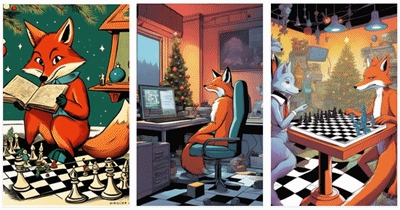
[Images: AI Comic Factory]

26 August 2023

Chess018 and the CCRL

In last week's post, Chess018 Is a Thing (August 2023), I suggested an idea for a follow-up post:-
One more idea that could be easily tested is to look at the chess018 start positions (SPs) on CCRL. Which SP is statistically best? Which is worst? What are the most popular first moves for each SP? Sounds like another post is taking form.

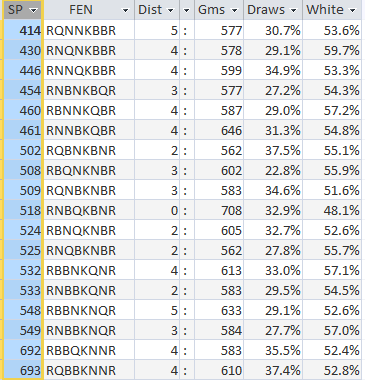
The following chart lists the 18 SPs in the chess018 family. The first three columns are from my own database of SPs. The last three columns are from the CCRL (see the sidebar for a link).

The column 'Dist' ('Distance') is a metric I whipped up when I first started investigating chess960. It was explained in the following posts:-

Some day I hope to find a use for 'Dist', e.g. a correlation with some other observation. Today is not that day.

The CCRL numbers for chess018 should be compared to the same numbers across all 960 SPs. At first glance, nothing unusual appears. Somewhat curious is the one SP where the score for White is less than 50% -- the traditional start position. I imagine it has something to do with the engines not using a book.

19 August 2023

Chess018 Is a Thing

This month's Chess Life (August 2023) had a three page article relevant to the world of chess960. Titled 'Chess18 : Streamers descend on a giant log cabin to try their hands at an interesting variant' by GM Larry Kaufman, it started,
Recently I had the opportunity to participate, at least for a bit, in a fun chess event at the Timber Moose Lodge in Timber Lakes, Utah, along with some of the most popular chess streamers around. It wasn't a world championship, but it was the first master-level chess18 tournament, and it was watched by chess fans around the globe.

Chess18 is a subset of chess960, or as it more popularly known, "Fischer Random" chess. It uses the 18 positions of chess960 where the Kings and Rooks begin on their normal squares -- the upshot is that no special castling rules are needed.

Later in the article, GM Kaufman admitted,

I have long liked the concept of Chess18, so in 2020 I organized a four-game Chess18 Rapid match between the Komodo chess engine and 2018 Reykjavik Open Chess960 champ GM Alex Lenderman, with Komodo giving knight odds.

This isn't the first time that 'chess018' (as I'll call it for the purpose of searching on this blog) has been discussed here. More than ten years ago I posted 'Bizarre Castling Rules'? (July 2013), which quoted someone else saying,

This variant, which I have dubbed Chess18, has a randomized opening setup just like its "predecessors." The difference is that the Rooks and the King start on the same squares that they do now so that castling remains exactly the same as it is now -- problem solved!

Ten years on I can say with some authority that the 'bizarre castling rules' add an extra dimension to the opening strategy in a game of chess960. Instead of automatically castling O-O as in the majority of games using the traditional start position (SP518 RNBQKBNR), the players have to consider which of the three castling options is best -- O-O, O-O-O, or neither -- for themselves and for the opponent in the given start position. This consideration affects the choice of development for the other pieces.

Before that 'bizarre rules' post, I wrote Not Everyone Likes Chess960 (December 2011), where I noted,

There is nothing to stop any circle of players -- be they GMs or club players -- from restricting their chess960 activity to a handful of positions. This is, after all, what traditional chess does in restricting its focus to SP518. The rest of the world should not be obliged to follow their narrow choice.

That thought is still a guiding light for me. 'Let a thousand flowers bloom' becomes 'Let 960 flowers bloom'.

***

A few other points came to mind while I was writing this post. One of the obvious, although unspoken, advantages of chess018 is that chess engines don't have to be altered to play it. Of course, in 2023 any engine that doesn't understand chess960 castling rules is a contender for the chess engine graveyard.

Re 'automatically castling O-O as in the majority of games using SP518', I'm not sure whether I've already posted on this. How do the other 'chess018' positions compare to SP518?

Re Kaufman's aside -- 'chess960, or as it more popularly known, "Fischer Random" chess' -- I've assumed for a few years now that this was indeed the current trend. Last month, while I was researching material for a post, I searched on both 'chess960' and 'fischer random' plus a keyword/phrase using several different search terms. I had more hits on 'chess960' than on the alternative. This is only anecdotal evidence and should be tested more rigorously. But how?

Re 'chess018', I'm going to try to stick to 'chessnnn' to name subsets of chess960. The leading zero in '018' is a bit geeky, but so what?

Re '18 positions of chess960', did the organizers allow SP518? Some people use 'chess959' to describe the full 960 positions less SP518. It's not a bad convention. Some more conventions: 'chess001' for the SP518 crowd (the chances of that catching on are exactly zero); 'chess002' for SP518 and SP534 only (the King and Queen switched), and 'chess000' for people who hate chess.

One more idea that could be easily tested is to look at the chess018 start positions (SPs) on CCRL. Which SP is statistically best? Which is worst? What are the most popular first moves for each SP? Sounds like another post is taking form.

24 June 2023

Chess960 in the Cloud

In a recent post, When Chess960 Reduces to Chess (May 2023), I wrote,
The point where castling is no longer an option is exactly where chess960 starts to look and feel like chess starting from the traditional position (SP518 RNBQKBNR). This is the point where a chess service like Chessify becomes fully viable.

A few weeks before writing that post, I had the opportunity to use Chessify on live chess960 positions. I was traveling for two weeks without any of the software tools I normally use for correspondence chess960. Before leaving home, I loaded six games into Chessify by using their 'Import' function to enter the current FEN position for each of the games. Most of the games had already reached the point where castling was no longer an option, but there were a couple of exceptions. A week into my trip I finally had some time to look at the games.

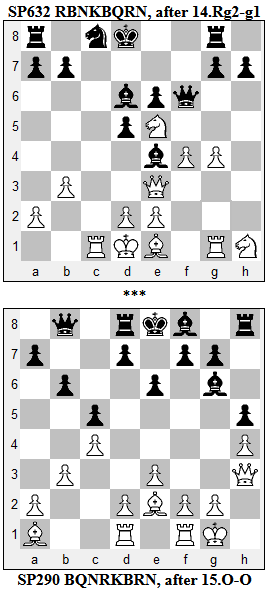
In the diagram's top position White has lost the castling privilege, while Black can still castle to both sides. I was playing Black. Stockfish NNUE on Chessify told me that 14...g5 was by far the best move, leading to a slight advantage for White. I vaguely remembered from my previous analysis that Black had an advantage in the position and decided that it must have something to do with castling. Since ...O-O-O isn't happening any time soon, the correct line must involve ...O-O. The move 14...O-O is a blunder because of 15.Nd7, which suggests 14...Nb6 to protect d7. Using Stockfish to continue the analysis and manipulating the FEN to simulate ...O-O, I decided that 14...Nb6 must be the right move and played it.

When I returned home, I looked at my previous analysis and discovered that 14...g5 was indeed the right move, leading to a significant advantage for Black. With 14...Nb6, I had spoiled my position and gone from a probable win to a struggle for a draw.

In the bottom position White has just castled, while Black can still castle ...O-O-O. I was again playing Black. Still using Stockfish NNUE, I decided that 15...O-O-O was premature and played 15...f6 instead. Back home I was happy with this move and after 16.f4, continued 16...O-O-O.

A few moves later I started to see weirdness from Chessify's Stockfish. I always calculate multiple variations (MPV in chess jargon) and reached a position where around depth 25, a key move disappeared from White's candidate moves and another move appeared twice. With the help of Chessify support (top notch in my opinion) I discovered that the FEN for the position was wrong. It indicated that both White and Black could still castle to the side where they had already castled. I corrected the FEN and the Stockfish analysis appeared normal. I decided that there was a bug in Stockfish triggered by faulty FEN.

In my four other games nothing unusual happened. While traveling I made a move or two in each game and when I returned home confirmed that my play was correct. My conclusions from this exercise? 1) Playing using only cloud tools is feasible; and 2) Playing chess960 with an engine that doesn't understand chess960 castling is possible, but risky. Always double check the chess960 FEN...

20 May 2023

When Chess960 Reduces to Chess

Let's talk turkey. Once in a while I like to document my recent experience playing chess960 online. Earlier this year I posted The Fascinating World of Chess960 (January 2023), where I wrote,
Last month's post was also about switching to a different online service for playing chess960. [...] I continued playing on LSS until last year. I was playing chess960 in a couple of multi-stage events, where success in one stage promotes a player to the next stage. I decided to skip the next stages, essentially taking a year off from serious play. [...] I switched to Chess.com in May 2022, playing one or (maximum) two games of correspondence chess at a time.

A month later I wrote a post about a Chess.com service, Chess.com Reviews a Chess960 Opening (February 2023). Since then I've stopped playing Chess.com for reasons that I won't discuss in this post. I went back to LSS, partly with the intention of evaluating Chessify for chess960.

This is the first time I've mentioned Chessify on this chess960 blog, although I've discussed the service several times on my main blog. In Chessify Resources (March 2023), I wrote,

The main problem with chess960 in a traditional chess environment stems from the castling rules. Since chess960 games tend to become extremely tactical after a few moves have been played, there is nevertheless some value in trying to confirm the tactics with a traditional, non-chess960 engine. [...] I'll continue using Chessify to look at chess960 positions.

There are three phases of a chess960 opening (often overlapping with the early middle game):-

  • Both sides can castle.
  • One side loses the castling privilege.
  • The other side loses the castling privilege.

I say 'loses the castling privilege', because it can arise when castling, when the King moves, or when both Rooks move. The point where castling is no longer an option is exactly where chess960 starts to look and feel like chess starting from the traditional position (SP518 RNBQKBNR). This is the point where a chess service like Chessify becomes fully viable.

25 February 2023

Chess.com Reviews a Chess960 Opening

In last week's post, Chess.com Pinpoints a Tactical Error (February 2023; see the post for a copy of the game's PGN), I used 'Chess.com's Game Review Tools' to find out where I had made the first mistake in losing a chess960 game. This week I'll use the same tools to extract comments on the opening moves.

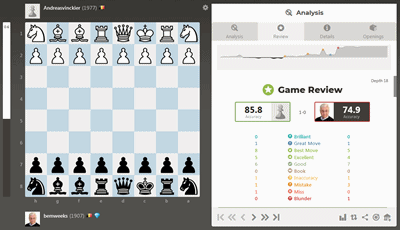
The following diagram shows the start of the same game featured in the 'Tactical Error' post. There's more I can say about the look and feel of the 'Analysis' tool itself, but I'll save that for a series I'm doing on my main blog. The most recent post in that series was Chess.com's Game Review Tools PGN (February 2023).

Shown on the left is the start position for the game, 'SP350 NRKQRBBN'. On the right is a summary of the overall quality of the players' moves ('Brilliant', 'Great Move', ..., 'Blunder'). For example, the tool considers that both players made one 'Great Move'.


AV vs. bemweeks | Analysis (chess.com)

The following table shows the tool's comments on the first 12 moves of the game (24 ply deep). I stopped the analysis when I reached the move where I committed the 'Tactical Error'.

Move Short
Comment
Long
Comment
Eval  
1.e4 is excellent This prepares the bishop for development. This threatens to reveal an attack on a pawn. +0.13
1...e5 is good This prepares your bishop for development. +0.30
2.f4 is excellent This exposes an attack, threatening a pawn. +0.27
2...Nb6 is excellent Your piece jumps in to protect a pawn! +0.41
3.fxe5 is best Right on target. +0.41
3...f6 is an inaccuracy You are threatening to attack a trapped rook. +1.09
4.Nb3 is a mistake This loses a pawn. +0.05
4...fxe5 is best That wins a free pawn! +0.05
5.Ng3 is excellent One of the best moves. -0.02
5...Qf6 is best You activate your queen by moving it off of its starting square. -0.02
6.Be3 is good This moves the bishop to a better location, allowing it to control more squares. -0.30
6...O-O-O is good Your rooks can see each other now, allowing them to provide mutual defense. +0.02
7.d3 is best That's what I would have recommended. +0.02
7...d5 is best You are threatening to kick a bishop. +0.02
8.Qd2 is an inaccuracy This ignores a better way to develop a queen off its starting square. -0.47
8...Qc6 is good You are threatening to kick a bishop. -0.10
9.Bg5 is good This wins a tempo by threatening a rook and forcing it to move away. -0.38
9...Be7 is a mistake You are threatening to win material. +0.56
10.Bxe7 is best After all captures, this is an equal trade. +0.56
10...Rxe7 is best You trade off equal material. +0.56
11.Nf5 is good This attacks a rook, winning a tempo when it moves away. This threatens to fork pieces. +0.27
11...Red7 is good You have now doubled your rooks, allowing them to team up to create threats. +0.62
12.exd5 is best This exposes an attack, threatening a pawn. +0.62
12...Qxd5 is a mistake You overlooked a better way to recapture a piece. +1.63

There's much more I could say about the comments, but it would not be useful at this point. Here are a few comments that jumped off the screen at me.

  • 8...Qc6; 'You are threatening to kick a Bishop.' • The move defends against a nasty x-ray threat.

  • 9.Bg5; 'This wins a tempo by threatening a Rook and forcing it to move away.' • The move doesn't win a tempo, but it might lose a tempo by forcing the Rook to a better square.

  • 9...Be7; 'Is a mistake. You are threatening to win material.' • It's a mistake to win material? Something does not compute here.

And so on. The long comments are generally lame and show little understanding of chess960 opening objectives. What happened in the fight for the center?

The most valuable part of the exercise is to see the change in evaluation from one move to the next. It reaffirms the severity of my mistake on the 12th move.

18 February 2023

Chess.com Pinpoints a Tactical Error

In last month's post, The Fascinating World of Chess960 (January 2023), I discussed a shift in focus for my own chess960 games. In a nutshell, to play chess960 I switched from a site allowing engines to a site forbidding them. I finished the post saying,
That's the background for a series of posts that I plan to write for my games on Chess.com. There are several aspects to be covered, e.g. Game review tools

I introduced those tools on my main blog in Chess.com's Game Review Tools (February 2023), using an example chess960 game. I'll use the same game in this current post. After four wins, it was the first game I lost on Chess.com starting June 2022, when I adopted the no-engine approach.

The 'Game Review Tools' post used numbers to identify the different screen shots and I'll follow the same numbering scheme in this current post. There are three different review tools that I numbered '02', '03a', and '05a'. The '02' tool shows the moves of the game and the times used for each move. It also provides (1) an entry into the '03a' and '03b' tools, and (2) a PGN download of the moves of the game, without variations or comments.

At this point, I don't see much difference between the '03a' and '05a' tools. The differences seem mainly cosmetic, so I'll continue with the '05a' tool. It's accessed via a feature called 'Saved Analysis'. In the game I was outplayed tactically and didn't know where I had gone wrong.

I had Black in a game starting 'SP350 NRKQRBBN'. I was pleased with my position after the first few moves and thought that I had equalized, maybe even gained a slight advantage. Then suddenly I had an inferior game. Why?

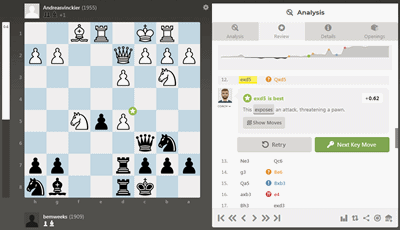
The '03a' and '05a' tools offer commentary on each move played in the game. I won't discuss the early comments in this post, because I'm not yet convinced they are helpful. The critical position is shown in the following screenshot, Black to move.


AV vs. bemweeks | Analysis - Chess.com • After 12.e4-d5(xP)

White has just captured a Pawn on d5 with 12.exd5, and Black has four possible recaptures. The move 12...Rxd5 is a '??' blunder, allowing the family fork 13.Ne7+. That leaves three other moves. Since White's last move also discovered an attack on the e5-Pawn, I played 12...Qxd5, protecting that Pawn. That was a mistake, which the tool flags with the remark '(?) Qxd5 is a mistake'.

What's better? The tool suggests 12...Nxd5. Now if 13.Rxe5, Black has 13...Qf6, when White is in trouble. I didn't see that possibility during the game and never recovered. Following is the PGN as provided by the '02' tool.

[Event "Let\\'s Play! - Chess960"]
[Site "Chess.com"]
[Date "2022.07.05"]
[Round "?"]
[White "Andreasvinckier"]
[Black "bemweeks"]
[Result "1-0"]
[Variant "Chess960"]
[SetUp "1"]
[FEN "nrkqrbbn/pppppppp/8/8/8/8/PPPPPPPP/NRKQRBBN w EBeb - 0 1"]
[WhiteElo "1977"]
[BlackElo "1907"]
[TimeControl "1/86400"]
[EndDate "2022.07.23"]
[Termination "Andreasvinckier won by resignation"]
[initialSetup "nrkqrbbn/pppppppp/8/8/8/8/PPPPPPPP/NRKQRBBN w EBeb - 0 1"]

1. e4 e5 2. f4 Nb6 3. fxe5 f6 4. Nb3 fxe5 5. Ng3 Qf6 6. Be3 O-O-O 7. d3 d5 8. Qd2 Qc6 9. Bg5 Be7 10. Bxe7 Rxe7 11. Nf5 Red7 12. exd5 Qxd5 13. Ne3 Qc6 14. g3 Be6 15. Qa5 Bxb3 16. axb3 e4 17. Bh3 exd3 18. O-O-O dxc2 19. Bxd7+ Rxd7 20. Rxd7 Qxd7 21. Qxa7 Nf7 22. Qa5 Nd6 23. Nd5 1-0

The Chess.com tools offer several different PGN downloads. I'll discuss those in another post on my main blog.

21 January 2023

The Fascinating World of Chess960

Last month's post, Christmas Eve (December 2022), wasn't just about creating a new category for Posts with label MW's games (that's me). It was also about switching to a different online service for playing chess960.

I recorded my first game of chess960 in a post on my main blog, titled Chess960? I'm Hooked! (September 2008). The PGN embedded there says the game was played on SchemingMind.com (SM), a site for correspondence chess that is particularly strong in its support of chess variants. I continued playing there until 2016.

A few years after getting hooked, I started playing on another correspondence site, The Lechenicher SchachServer (December 2012; LSS), for reasons explained in that post. I continued playing on both SM and LSS until 2016, when I ran into a problem on SM and decided to leave. To make a long story short, SM has a no-engine policy, but makes little effort to enforce it. LSS allows engines for most of its events and I preferred the clarity of LSS.

I continued playing on LSS until last year. I was playing chess960 in a couple of multi-stage events, where success in one stage promotes a player to the next stage. As the two events were winding down, the site announced the next stages. Unfortunately for me, the start of both events coincided with a pair of two-week vacations that I had been planning for some time. Since LSS events allow only two weeks of vacation on a fixed number of days for a game (no increments), I was faced with an immediate time deficit in all new games. I decided to skip the next stages, essentially taking a year off from serious play.

As my active games gradually came to a conclusion, in my free time I started using an engine to analyze my old correspondence games from the pre-engine, pre-chess960 era. I was amazed that my moves were generally approved by modern engines. I could often recollect the reasoning and emotions behind my moves and realized that using an engine had turned me from a chess player into an engine operator. After 14 years of playing chess960, I hadn't gained much insight into its subtleties, because I was essentially playing what the engine instructed me to play, often without understanding why.

I decided to switch to a site that didn't allow engine use. SM was out because it doesn't enforce its policy. Then I remembered Chess.com, which has a good reputation for vigorously enforcing its no-engine policy, even if it leads to controversial decisions. I had played a few games of chess960 there in 2009-2010 and more recently in 2019, an experience documented in Playing the FWFRCC (June 2019).

I switched to Chess.com in May 2022, playing one or (maximum) two games of correspondence chess at a time. What a difference! Where my last years with LSS involved struggling against players with far more powerful engines than I was using, at Chess.com I was using my own head to play real chess against other players doing the same. After all, that's what had attracted me when I first started playing chess so many years ago.

So far I've played about a dozen games on Chess.com, never once tempted to use an engine. I also know full well that if I do use an engine and am caught, I will lose the premium membership that CEO Erik gave me when I was writing a review of the site for About.com in mid-2008.

That's the background for a series of posts that I plan to write for my games on Chess.com. There are several aspects to be covered:-

  • Insights from my games
  • The correspondence play interface
  • Game review tools
  • The site's custom anti-cheating measures
  • And more...?

I'll wander through these topics in future posts, some of them on my main blog. Thanks to both SchemingMind and LSS for the terrific support of chess960 throughout the years. May they continue to introduce keen chess players to the fascinating world of chess960.

27 August 2022

TCEC DFRC1

In a perfect world, this post would be a followup to the previous post 2022 FWFRCC Kickoff (August 2022; 'FIDE World Fischer Random Chess Championship'). That event will undoubtedly dominate the blog for the next few months, but first I have to tackle an outstanding topic before it becomes old news.

This post is more of a followup to last month's TCEC C960 FRC5 (July 2022), because it's also about the TCEC. It's in reference to a post on my main blog, Stockfish Wins TCEC DFRC1, Leads CCC18 Rapid Final (August 2022). As a summary of DFRC1, I wrote,

In DFRC1 ('Double Fischer Random Chess: (960*960) possible starting positions'), Stockfish and LCZero finished tied for 1st/2nd places with 16.0/22, 1.5 points ahead of KomodoDragon, which was 2.0 points ahead of Stoofvlees. In the 50 game final match, Stockfish beat LCZero 29.5-20.5 (+18-9=23). For more discussion of the event, see the next post on my chess960 blog.

I know, this isn't the 'next post' on this blog; it's the 'next+1 post'. The unexpected news about the FWFRCC took priority. To understand what the TCEC accomplished -- and it's without question a noteworthy accomplishment -- let's quote some TCEC !definitions [Warning! : Serious chess engine jargon ahead...]:-

!dfrc • Double Fischer Random Chess: The same as Fischer Random Chess [FRC; C960], except the White and Black starting positions do not necessarily mirror each other. Double FRC has 921,600 (960*960) possible starting positions. [Also has links to files for DFRC 'Openings' and 'Evals'.]

!dfrctest • Initial test of !DFRC at TCEC. To check a) engines handling of DFRC - see !bugs, b) some DFRC start positions, c) cutechess handling of DFRC, d) GUI handling of DFRC. Time control: 7 minutes + 1 second/move. Duration 1 week

!dfrc1 • 1.SF (on SB 196) 2.Lc0 (SB 192.5) 3. KD. 26 participants (FRC5 + Bagatur), Swiss format, games from starting positions, 11 rounds, and 30min+3s TC. Estimated duration: 12 days.

!bookdfrc • Selected 1600 opening positions for the DFRC event, and for the DFRC testing. These are the positions for which KD, Eth, Berserk and SF (the latter through dbcn) agree that white has about a 50% chance for a win. The selection was then further pruned using careful SF analysis.

!unbust • Took positions where starting position abs(eval) >= 2.00, 17739 DFRC positions. Played Stockfish 202206020749 200k vs Stockfish 100k and 8071 were still 'busted'. Played those 1M vs 100k and 1172 were left 'busted'. Played those 10M vs 100k and 83 were left 'busted'. Finally, those 100M vs 100k and 10 are still 'busted'. These will be used in Bagatur vs Stockfish bonus.

!chess324 • A subset of DFRC where the Kings and the Rooks are at the usual starting position. Since castling is standard, this allows all engines to play.

For more about that last definition, see Chess324 (talkchess.com; lkaufman, aka Larry Kaufman of Komodo++ fame). The dean of chess engines explained, 'The Kings and Rooks are placed on their normal positions. All the other pieces for White and Black are placed randomly, with no symmetry requirement, the only restriction being that for each side the Bishops must be on opposite colored squares.'

Chessbase weighed in on a related topic with Double Shuffle Chess: a fun variant against Fritz Online (chessbase.com; Albert Silver). In this variant the Kings aren't required to be between the Rooks and there is no castling. No thanks, I'll pass. Maybe the TCEC or the CCC will give it a try.

After that little detour, let's get back to the TCEC. For archive info (crosstables, PGN, etc.) about the DFRC1 events, see:-

Since I'm already following the TCEC, I'll keep an eye on their DFRC events. My first impression is that it's more for chess engine enthusiasts than for chess960 enthusiasts, but I was no fan of chess960 when it first appeared on my radar either.

29 January 2022

TCEC FRC4 Unbalanced Books

In last week's post, TCEC C960 FRC4 (January 2022), I mentioned the use of 'unbalanced books'. Wanting to know more about them, I downloaded the PGN files for the last two stages of FRC4, where they were used, and analysed them. For the 48 games in the 'Final League' (i.e. semifinal) and the 50 games in the final match, there were 32 different start positions (SPs), distributed as follows:-
2 : 18 positions
4 : 11
6 : 3

The first column shows the number of times a position was used in a game. In other words, 18 SPs were used twice, and so on. Since each SP was played twice, each engine in turn taking White, this is the minimum. I once attempted to calculate how much each of the 960 SPs were scrambled relative to the traditional start position. The results were summarized in A Chess960 Almanac (October 2011).

Is there a correlation between 'unbalanced books' and the degree of scrambling? A preliminary analysis was inconclusive, but 32 different SPs is too small a sample to decide one way or the other. I hope we'll eventually get enough data to say for sure.

27 July 2019

Random Resources

A new video from Chess.com's IM Daniel Rensch explains the basics:-

Chess.com has also released a short puzzle test:-

That's a great idea, but it could be split into at least two puzzle series: 1) Do you know the castling rules?, and 2) Tactical devices that never arise from the traditional start position. Both of those ideas are easily expanded. Also worth a look is:-

  • Chess960 Dice (indiegogo.com; 'Chess based on talent not memory!')

HarryO of Chess960 Jungle, points out:-

Harry says, 'You announce "The NO LOOK 1.e4!" with your hands raised in the air'. One of the comments points to another sequence in the video where GM Nakamura plays 'The NO LOOK 1.c4!':-

From the 1978 Karpov Gambit in the Open Variation of the Spanish Game to "I didn't even look at the board." Thank you, Bobby Fischer!

I can't tell if 'Thank you, Bobby Fischer!' is sincere or sarcastic.

25 May 2019

A Difficult SP Revisited

These days the posts on this blog are overwhelmingly news oriented, but once in a while I like to look at a real chess960 position. A few months ago, in A Stockfish Experiment (February 2019), I wrote,
At first glance, there doesn't seem to be a high correlation between the Sesse results and the CCRL results. The first position where there is agreement between the two sources is [SP868] QBBRKRNN. I once discussed this position in 'A Difficult SP for Black' (April 2013). By coincidence, I'm currently playing the position in a pair of correspondence games and hope to have more to say about it in the future.

The two games have finished, so the future is today. For easy reference, here's a link to the original post: A Difficult SP for Black. Already on the first move, White threatens a smothered mate on the third move. In that post I noted,

Black has two methods of meeting the difficult challenge posed by 1.Ng3.

Those two methods were:-
1...Nf6 2.Nf5 Rg8, and
1...g6.

Both of the latest games used different methods of defense, as shown in the diagrams below. The top diagram is my game as White. The game started with the first line above, but instead of 2...Rg8, Black played 2...Nh5, guarding the sensitive square g7. This looks like a natural move, so why didn't I consider it six years ago? I looked at my notes from that game and recalled that the move appeared only infrequently on the CCRL database, which is a record of engine-vs-engine games. Even today on the CCRL, after hundreds more games have been added for SP868, the move 2...Nh5 has not been tried very much. Why not? Either there is a tactical refutation or the engines have a built-in bias against moving a Knight to the a-or-h files. I couldn't find a tactical refutation.

The game continued 3.b3 f6 4.d4 c6 5.Nf3 d5 6.c4 Bxf5 7.Bxf5 g6 8.Bc2 Nf7, after which I castled 9.O-O. I had the initiative for most of the game, but it turned out to be insufficient. The game eventually ended in a draw after about 60 moves, with an unavoidable tablebase position on the horizon.

The bottom diagram is my game as Black. Here I was attracted by the idea of sacrificing a Pawn with 1...Ng6. The move had been played three times on CCRL with a score of +0-3=0, all wins by Stockfish as Black. A Pawn sacrifice is also the idea behind 1...g6, but is either sacrifice really playable? I spent a few hours analyzing the various continuations after 1...Ng6, and concluded that it was no worse than the alternatives. The game continued 2.Nh5 f6 (diagram) 3.c4 d5 4.f4 Nh6 5.f5 Nh4 6.Nxg7+ Kf7 7.Ne6 Ng4 8.Rf3 Bxe6 9.fxe6+ Kxe6. This might be the first game I have played where my King was on its third rank before the 10th move. Even more curiously, it turned out to be safe there. I eventually equalized and the game was drawn on the 55th move.

That makes two games, two draws, and two more ways to handle 'A Difficult SP for Black'. The two new methods are:-
1...Nf6 2.Nf5 Nh5, and
1...Ng6.

Good thing the SP is more complicated than it looks. Even one chess960 position lost from the first move would mean trouble for Fischer's greatest invention.

16 February 2019

A Stockfish Experiment

Last year, in the aftermath of the Carlsen - Nakamura chess960 match, Chess.com published an article, What's The Most Unbalanced Chess960 Position?. The essence of the piece was:-
Recently, the Norwegian "supercomputer" Sesse analyzed all 960 variations using Stockfish 9. At a depth of 39-40 ply for each position, which took about two to three hours each, its findings were published.

I downloaded the referenced spreadsheet and compared it with the data currently displayed on the CCRL (see link in the right sidebar). The results are shown below.

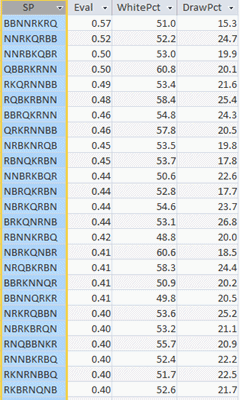
The first column shows the start position, followed by the Sesse evaluation in centipawns, followed by the CCRL overall percentage score for White and the precentage of draws. For example, the top row says that BBNNRKRQ was evaluated by Sesse at 0.57 (a little more than a half-Pawn), with a CCRL result of 51.0% in White's favor and 15.3% of games ending in a draw.

The chart gives the top-25 positions flagged by Sesse, down to a cutoff of 0.40. I could have added the numeric ID for each start position and will do so if I ever come back to the data.

At first glance, there doesn't seem to be a high correlation between the Sesse results and the CCRL results. The first position where there is agreement between the two sources is QBBRKRNN. I once discussed this position in A Difficult SP for Black (April 2013). By coincidence, I'm currently playing the position in a pair of correspondence games and hope to have more to say about it in the future.

As for the Sesse results, they confirm that engines just don't evaluate chess960 start positions particularly well. Long term positional considerations are not the engines' strong point.

24 June 2017

A Concrete Publishing Proposal

My previous post, 'The Essence and the Rules of Chess' was a call for action by GM Andrey Deviatkin to raise the popularity of chess960 [aka 'Fischer chess']. It ended,
There've been no serious progress with chess960 popularity for quite a long time. But even if the change might be invisible, the potential energy of Fischer chess has been growing. And the appearance of just one rich enthusiast or serious sponsoring company can become the last straw and cause the real breakthrough like the domino effect. The situation can change very quickly and drastically.

When I first saw the GM's Facebook post, I jumped in with a comment on what I think is the number one problem facing widespread adoption of chess960. (To protect the innocent, I've changed the names of the commenters to their initials.)

MW: To make real progress with chess960, someone has to solve the publishing problem. It renders obsolete every opening book ever published as well as many middlegame books. Only endgame manuals survive (and you know what many players think about studying endgames). What sort of books will the chess publishing sector produce? They are the natural enemies of chess960.

The phrase 'natural enemies of chess960' might be strong, but I'm not sure it's wrong.

PL: Databases would also be largely obsolete.

PL is the Peter Long of Peter Long on Chess, who writes extensively on the web. When people talk about chess databases, they often mean Chessbase.

SN: We aren't suggesting migrating from chess to chess960. What is being proposed is gradual diversification.

PL: I believe the solution here requires drastic action!

The series of comments ended with several concrete proposals.

AD: Firstly, in my opinion, the number of opening theory manuals is already excessive, to say the least. Secondly, I don't believe that chess960 will just kill the theoretical topics and not bring about any of new ones. Why so if it's in fact a much richer game? I can easily imagine books and videos on 'How to handle starting positions with bishops in the corners', 'Queen in the corner', 'To castle or not to castle', 'Flank-based development of the rooks', 'Preventing a bishop from being locked' etc etc.

MW: While I agree that there are too many books on openings, people write them, people publish them, and people buy them. I believe they are the most popular genre in chess literature today. Chess960 has been known for almost 21 years -- a full generation -- and there is almost no literature: zilch. One problem is that it defies classification; you can't start analyzing position no.1 and continue through no.960, because you learn nothing useful from the exercise. The furthest I have seen anyone get is around no.250, about 25% of the total start positions. • Here's a challenge for you. Taking your example 'Queen in the corner', develop an outline for a 150 page book.

I didn't get an answer to that challenge, but I didn't expect to get one. It's a tough problem that can't be answered in 25 words or less. If it were easy, someone would have already published such a book. I gave my challenge some further thought. A Queen in the corner can be developed in three ways:-

  • Along its file.
  • Along its diagonal.
  • Along the back rank.

'Along its file' breaks down to three further cases. Let's say the Queen is on a1. To develop along the file requires pushing the a-Pawn. It can be pushed to a3, to a4, or beyond. The choice depends on (a) whether Bishops are sitting on f8, g8, or h8; and (b) whether White intends to castle O-O-O.

'Along its diagonal' has two main cases: whether a Bishop is sitting on h8 or not.

'Along the back rank' depends on what pieces are sitting to the immediate right of the Queen and whether White intends to castle O-O-O.

Any further subclassification requires looking at how the other pieces are arranged at the start of the game and becomes an analysis of specific start positions. Since that is neither feasible nor useful, a better next step would be to gather game examples of the types of Queen development (from both a1 and h1) and show how the games evolved for both the White and the Black players.

Since the problems of development are most important in the first 10-15 moves of a chess960 game, an analysis of specific examples needs only to be carried out until the middlegame is reached. What I'm thinking of here is a sort of move-by-move analysis showing how the specific features of the position translated into a choice of plans and of moves within those plans. And let's not forget that some examples will inevitably involve bad plans and bad moves. To fill 150 pages in a book (that's an average size for the opening books I have at hand) would take something like 40-50 examples.

Note that one-eighth of the 960 start positions (SPs) have a Queen on a1 and the same number have a Queen on h1. That makes 240 SPs to be considered. I know that some people would prefer to exclude all of these positions from being chosen as an initial SP, because they are so foreign to the traditional start position (SP518 RNBQKBNR), but I'm not one of those people.

A few years ago I worked out A Framework for Chess960 Opening Theory (April 2009). A 'Queen in the corner' is one of the 19 discrete examples in the framework; I labeled it 'Q:a/h'.

27 June 2015

Whispering a Fond Adieu!

They say, 'a watched pot never boils'. It seems the chess960 pot is in a constant simmer, but its boiling point remains as elusive as ever. My first blog post on the subject was Shall We Play Fischerandom Chess? (August 2008), and this post will be my last, at least for the foreseeable future. It's time to turn my attention elsewhere.


Google image search on 'chess960'

Heartfelt thanks to the many visitors to this blog for taking an interest in chess960. Special thanks to the two serial commentators -- GeneM and HarryO (in alphabetical order) -- who kept me honest because I knew each new blog post would get at least two hits.

A few months ago I received an email from GeneM, aka Gene Milener, aka the author of 'Play Stronger Chess by Examining Chess960'. He wrote,

In January 2006 I published a book about chess960. This year I will publish another chess book. Even though this new book is not about chess960, I am adding a section in its appendix to discuss or update the state of chess960 now that a decade has passed. Inasmuch as you have become the preeminent voice about chess960, I wondered whether you might be interested in contributing an essay for your own attributed subsection -- on your thoughts about the current state of chess960?

I first thought of this appendix chapter as an 'Epilogue' about chess960, but that sounded too final, like chess960 did not make it and died. I rather think that changes on this scale take time as measured by generations. So instead the chapter will be presented as something like the 'Current State of Chess960 in 2015'.

For years in your blog you have put spotlight and microscope on a broad variety of specific topics within the chess960 realm. Having read your chess960 blog every weekend now for years, I am curious to see what your assessment will be when you step back to consider how the overall picture has evolved, where it stands in 2015, and where it might be headed a generation or two from now.

My essay can be found at Fischer Chess in the Year 2015. I also told Gene,

If I were writing this for the web, I would link to my post debunking certain myths: Top 10 Myths About Chess960. I consider it my top contribution to understanding chess960.

When Gene's book eventually hits the web, I'll mention it on my main blog 'Chess for All Ages' (see the link in the right navigation bar), the same place where I'll post any new reports related to chess960. I agree with Gene that the acceptance of chess960 will 'take time as measured by generations' and I will continue to play for as long as there are opponents interested in Fischer's greatest invention.

Bye for now! - Mark

08 November 2014

SP864 BBQRKRNN - Other Opinions

In my previous post, SP864 BBQRKRNN - Two Trials, I discussed a particularly difficult start position (SP), which seems to present Black with an immediate problem. Although the 'Two Trials' showed that Black has defensive chances, the test was not particularly convincing.


SP864 BBQRKRNN 1.Ng3

On Chess.com I found a post, Do you find chess960 challenging or fun?, with a challenge that sums up the position perfectly. I'm leaving it in CAPS, because it deserves to be shouted.

SaharanKnight: I CHALLENGE ANYONE TO SHOW ME AN OPENING POSITION WHERE EITHER SIDE HAS AN ADVANTAGE OTHER THAN TEMPO!

True chess960 fans have a deep rooted belief that none of the 960 start positions are unfair. After some discussion back-and-forth, SaharanKnight came up with a new line.

  • 1...d5 2.c4 Qg4 3.Nf5 O-O-O (or perhaps 3...d4; 3...Qxg2 is bad because of 4.Nf3)

Given the premature Queen development, I'm not convinced that the line is sound, but it deserves to be tested. He also came up the same line that was tested in 'Two Trials'.

  • 1...Nf6 2.Nf5 Rg8

This led to a discussion about castling.

SK: At this point, White shouldn't claim credit for spoiling castle since Black may still castle with the other Rook.

MW: Castling O-O-O is suicide in this SP. Black will have to move two Pawns to develop the Bishops. Meanwhile White will castle O-O and launch a Pawn attack on the other flank. Once the White Pawns open a few lines, the Black King will be a sitting duck for White's pieces.

There's no reason to take my word for it, so the O-O-O idea deserves a test. I'll leave that for someone else to do. After the Chess.com discussion I contacted GM Andrey Deviatkin, seen on this blog earlier this year in More from Moscow 2014, where he was one of the participants. I gave him the position and asked him, 'White opens 1.Ng3, threatening 2.Nf5. What would you play if you were Black?' He came back with two lines.

  • Most likely I'd play 1...g6, and if 2.b4 then 2...f6. Maybe it's not as bad as it seems, for example, 3.c4 b6 4.Nf3 c5.

  • I'd also consider 1...Nf6 2.Nf5 Rg8 and then castling Queenside. 1...Nh6 is another option but I don't like it.

When I explained my doubts about the second line and castling O-O-O, he replied,

I agree about the long side castling, that's why I'd probably prefer 1...g6 and 2...f6. But I have a feeling that Black's position after g6, f6 is better than it seems at first glance, although White is of course more comfortable. But isn't the same true for some Taimanov, Rauzer, Hedgehog, Pirc and so on?

I'm sure there are no "already lost" initial setups because both armies are present at full, in absolute symmetry and far from each other. Many people would argue that some initial positions are already "lost", but I think it's just because of their habit.

I liked the point about the armies being 'in absolute symmetry and far from each other', but wasn't convinced about the comparison to traditional chess.

I'm not so sure about the Taimanov, Rauzer, Hedgehog argument. Those are choices that Black has in traditional chess. A confirmed 1.e4 e5 player might not be comfortable playing a Taimanov and isn't forced to do that. In BBQRKRNN 1.Ng3, Black is defending against a powerful threat already on the first move and is forced to make some concession -- losing the castle O-O option or playing a cramped game with a lag in development. White, on the other hand, hasn't given up anything. What is Black's compensation?

The GM replied,

First, I have some suspicion that the black knight developed to f7 might feel a little more comfortable than the g3-knight (restricted by the g6-pawn), and maybe this will provide Black some compensation for the crampedness? I mean, maybe we don't know Fischer chess openings laws too well yet to judge if something is really awkward or only seems so? Even Berlin was considered awkward till Kramnik analysed it through and played vs Kasparov.

Second, if we talk of normal chess, a confirmed e5-player might face King's gambit, Evans, Scotch gambit and so on -- which were considered dangerous for decades. (Let alone that Fischer chess is exactly about knowing how to play every type of positions).

I think that only practice (and definitely with time limits no shorter than 25 minites per game) can provide real answers if any positions should really be excluded or not, and my opinion so far is that it won't be necessary, maybe except for the classical position.

After some more back-and-forth on traditional openings, I had to admit, 'It's a big mystery why the Sicilian works as well as it does. The Hedgehog systems are another mystery.'

I've spent three posts discussing BBQRKRNN. When all has been said, there remains only one way to find the truth: to play the position objectively from both sides. Chess has its mysteries and they are many, but chess960 promises many more.

01 November 2014

SP864 BBQRKRNN - Two Trials

Continuing with Another Difficult SP for Black, the problem position is shown in the following diagram. How does Black defend against the move 2.Nf5, with the nasty threat of 3.Nxg7 checkmate?


The first trial with this position is recorded on HarryO's Chess960 Jungle blog in Non-Random Chess960 Trial Game 9: SP864. I had White, HarryO Black. He defended the mate threat in the most direct way -- giving up the castles O-O option. After the initial moves, 1.Ng3 Nf6 2.Nf5 Rg8 3.Nf3 Ng6 4.O-O, we reached the position shown in the top diagram below. Harry played his next move, 4...b6, and commented,

Preparing to attack the g2 square and hopefully open access to the h3 square as well. Black is reluctant to play anything other than rock solid moves that try not to induce a second weakness into Black's army.

The next sequence in the game was 4...b6 5.c4 d5 6.cxd5 Bxd5 7.b4 c5 8.bxc5 Nf4. After 8...Nf4, Black wrote,

I'm struggling to see the light for Black. This is really tough. It will only be a few more moves and I will be beyond my skill level to save the game.

Indeed, over the next few moves Black sacrificed a Pawn to escape the pressure, leaving him in a disadvantageous endgame that we abandoned as a probable win for White. Here we discussed other attempts to save Black after White's first move. I suggested,

As for improvements, your move 1...g6 is worth a try. I also think 4...e6, forcing the Knight back immediately, is better than the move you played. The last word has yet to be said for this SP.

HarryO agreed that, after 4...e6, even though 'the f6 square is weakened', we had to show that the start position could be saved.

We rolled the position back to White's fourth move and switched sides, so I had the Black pieces. The trial can again be found on HarryO's blog, this time in Non-Random Chess960 Trial Game 9: SP864 after 4)...e6. The game continued 4...e6 5.Ng3 c5 6.c4 d5 7.cxd5 Nxd5 8.b3 b6 9.Rfe1 f6 10.e3 Nde7. After 10...Nde7, Black commented,

Threatening ...Bxf3, when the weak square on f3 will give Black plenty of counterplay.

We played another move pair, 11.Qc4 Bxf3, and I gave a conditional move move: 'if 12.gxf3 f5', with the comment

Secures the e4-square against use by the White pieces.

The position is shown above in the bottom diagram. White wrote,

If I trace back what happened, when you played 10...Nde7 at that moment the question of lost start positions in chess960 was over in my mind. There are none. [Fischer] was simply a genius who saw this much sooner than anyone that has walked the planet since chess was invented. [...] I am totally shocked, amazed, in disbelief, inspired, confused, intrigued and simply glad to have witnessed the sight of the position that is now on the board.

We had saved a most 'Difficult SP for Black'. Around the end of our first game, HarryO suggested that we 'post the position 4...e6 on Chess.com and see what responses we get'. I agreed the idea was worth pursuing and was happy to find a suitable post, Do you find chess960 challenging or fun? A few comments into the thread, SaharanKnight had posted the challenge,

I CHALLENGE ANYONE TO SHOW ME AN OPENING POSITION WHERE EITHER SIDE HAS AN ADVANTAGE OTHER THAN TEMPO!

That statement sums up perfectly the all-too-obvious challenge posed by SP864 BBQRKRNN 1.Ng3. I'll look at the ensuing exchange in my next post.

25 October 2014

Another Difficult SP for Black

The post from a few weeks ago, A Half-Tempo Advantage, reminded me that I had one game left from last year's Proof of Concept with HarryO. After examining A Difficult SP for Black (SP868 QBBRKRNN), we looked at its cousin (SP864 BBQRKRNN) which is largely the same position except that a Queen and a Bishop are switched at the start.


SP864 BBQRKRNN 1.Ng3

White's first move is again 1.Ng3, threatening 2.Nf5. To defend against the attack on g7, Black must make a positional concession already on the first move. To see how HarryO and I handled it -- I had Black -- you can find our moves on HarryO's blog as comments to Non-Random Chess960 Trial Game 9: SP864 after 4)...e6.

I also flagged the position on a couple of chess960 forums. I'll discuss the feedback in my next post.