Showing posts with label Theory. Show all posts

28 September 2024

A Flawed Chess960 Study

A chess study is a composed position which illustrates some unexpected theme. It is usually a position which could arise naturally from a game between two skilled players. This distinguishes it from a chess problem, which is based on a composed position that is extremely unlikely to arise in a real game. An academic study is something completely different.

When was the last time you saw a research paper based on a study of chess960? There must have been others, but this is the first one I can remember seeing. Titled Machine Learning Algorithms to Predict Chess960 Result and Develop Opening Themes (arxiv.org; 'submitted on 29 Oct 2023'), it lists its authors as:-

Shreyan Deo, DPS Vasant Kunj, Delhi, India • Nishchal Dwivedi, Department of Basic Science and Humanities, SVKM’s NMIMS Mukesh Patel School of Technology Management & Engineering, Mumbai, India

The 'Abstract' offers a useful overview. In its entirety it says,

This work focuses on the analysis of Chess 960, also known as Fischer Random Chess, a variant of traditional chess where the starting positions of the pieces are randomized. The study aims to predict the game outcome using machine learning techniques and develop an opening theme for each starting position.

The first part of the analysis utilizes machine learning models to predict the game result based on certain moves in each position. The methodology involves segregating raw data from PGN files [NB: CCRL was the source] into usable formats and creating datasets comprising approximately 500 games for each starting position. Three machine learning algorithms -- KNN Clustering, Random Forest, and Gradient Boosted Trees -- have been used to predict the game outcome.

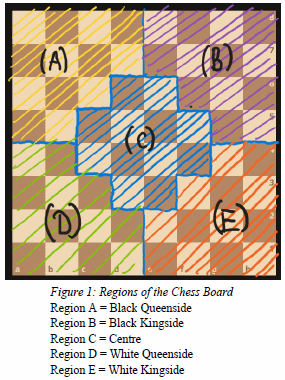
To establish an opening theme, the board is divided into five regions: center, white kingside, white queenside, black kingside, and black queenside. The data from games played by top engines in all 960 positions is used to track the movement of pieces in the opening. By analysing the change in the number of pieces in each region at specific moves, the report predicts the region towards which the game is developing. These models provide valuable insights into predicting game outcomes and understanding the opening theme in Chess 960.

Keywords: Chess 960 [Chess960], Fischer Random Chess, machine learning, game outcome prediction, opening theme, KNN Clustering, Neural Networks, Gradient Boosted Trees.

Note: Trying to see just by looking at the snapshot of an evolved game how accurately we can predict who will win

The 16-page paper is interesting for many reasons. I extracted the section headers to create a table of contents:-

1. Introduction

2. Methodology
2.1. Segregation of Data
2.2. Visualising Chess Positons as Numbers
2.3. Predicting the Outcome
2.4. Developing an Opening Theme

2. Modelling [should be '3.'?]
3.1. KNN Clustering
3.2. Random Forest
3.3. Gradient Boosted Trees

4. Result
4.1. Outcome Prediction
4.2. Theme Analysis

5. Discussion
5.1. Discussing the Accuracy of the Predictions
5.1.1. Comparing the Different Data Sets
5.1.2. Comparing the Different Machine Learning Models
5.1.3. Disparity in the Accuracies of Certain Starting Positions
5.1.4. Possible Reasons for Low Accuracy Rate
5.2. Discussing the Theme Analysis and Its Importance

6. Conclusion

7. Future Developments & Limitations

8. References [eight total]

9. Appendix

The section '9. Appendix' starts,

This section traces the opening theme of each individual starting position. The heading provided is in the form X_Y, where X represents the region in which White pieces tend to develop, and Y represents the region in which Black pieces develop.

This is very useful in individually finding out how each specific starting position should be played. For example, the position BBNNQRKR should be played by the players such that White attacks the Black Queenside whereas Black attacks the White Kingside.

Why choose SP032 BBNNQRKR as an example? Because it's the study's first position in the first group of positions, all of which are under the header 'Black Q Side_White K Side'. A useful diagram ('Figure 1: Regions of the Chess Board') from the study helps to explain how it sees the different sections of the board.
Unfortunately, the explanation ('should be played by the players such that...') of BBNNQRKR is dubious:-

  • 'White attacks the Black Queenside'
  • 'Black attacks the White Kingside'

The position BBNNQRKR clearly shows that the two Bishops ('BB') on the Queenside are attacking the castling pieces ('RKR') bunched together on the Kingside. That indicates how both sides will proceed. How should White attack the Black Queenside? With the Knights ('NN')?

At this point it's worth remembering that at the start of each game both players have identical piece placements. The difference is that one side moves first and thereby has a natural initiative.

The traditional start position (SP518 RNBQKBNR), is grouped under 'Black Q Side_Centre', meaning:-

  • 'White attacks the Black Queenside' [as in the previous example]
  • 'Black attacks the center'

Here it's worth remembering that White has a choice of first moves (1.e4, 1.d4, etc.) with different strategies for developing the pieces. The other 959 start positions also offer a choice of strategies. I can't remember playing many (correspondence) chess960 games where White has a first move that is clearly better (NB: 'SP864 BBQRKRNN' & 'SP868 QBBRKRNN' are not clear). Is it possible to group the subsequent developments of different first moves for one start position under a single header, e.g. 'White attacks... _ Black attacks...' ?

The rest of the paper is equally unconvincing, although there are large portions that I didn't understand. One key illustration ('Figure 3') is incomprehensible because the column headers are clipped to be identical.

An important discussion starts with '5.1. Discussing the Accuracy of the Predictions'. It says,

The results of the machine learning models were quite surprising yet also logical. All the predictions were only [around] 40% accurate, which is only slightly better than randomly guessing an outcome and getting it right, the probability of which is 33.33% (as there are only 3 outcomes possible).

Another section, '5.1.4. Possible Reasons for Low Accuracy Rate', offers several 'possible reasons', but ignores the most obvious. The methodology of the study might well be seriously flawed.

30 March 2024

Chessbase and Its 180 on 960

The previous post, Freestyle Goats Might Return (February 2024), ended on a highly optimistic note:-
We can look forward to much top-level chess960.

In the intervening month we've had a couple of equally optimistic follow-ups from Chessbase:-

The news was confirmed by a (former?) Carlsen confidant, now writing for Chess.com:-

Chessbase.com has come a long way in the six years since the site posted an article that I panned in Purported Problems with Chess960 (April 2018). My post started,

That title is taken from a recent article by Frederic Friedel of Chessbase: The problem with Chess960 (chessbase.com; February 2018). Let's cut to the chase. The problem with chess960 is that there is no problem with chess960.

So why did Chessbase make a 180-degree turn? Maybe it's a case of:-

If you can't beat them, join them!

I suspect it's more a case of:-

Money talks and nobody walks!

Whatever the reason, the world's leading chess database company has also started running articles on chess960 opening theory:-

I don't agree with all five 'Opening Tips'. For example, the first of the five is

Introduce the queen into the game early

That's much too categorical for me. I once wrote a post about a game of mine titled Activating the Corner Queen (September 2013). I reached the conclusion, 'Black was always in command and eventually won. The early activation of Black's Queen was the deciding factor.'

I could give plenty of counter-examples where a Queen came out too early and was harrassed by the opponent's minor pieces, just like beginners are warned against after the traditional start position. A more nuanced tip would be something like, 'The decision when and where to develop the Queen is even more consequential than similar decisions for the other pieces'. Chess960base, anyone?

22 July 2023

TCEC FRD

A year ago on this blog I had a pair of related posts...

...where 'FRC' stands for 'Fischer Random Chess'. Last month on my main blog I had a pair of follow-up posts...

...'FRC' is, of course, another name for chess960, where the start positions for the two players are mirrored. 'DFRC' is 'Double FRC', where the two players have different start positions.

In that post 'Stockfish Wins TCEC DFRC2', I noted that future TCEC FRC/DFRC events will use a format they call 'FRD', meaning 'Fischer Random Double'. For an explanation of FRD, see that post. Don't be surprised if this current post is the last mention of FRD on this blog.

25 February 2023

Chess.com Reviews a Chess960 Opening

In last week's post, Chess.com Pinpoints a Tactical Error (February 2023; see the post for a copy of the game's PGN), I used 'Chess.com's Game Review Tools' to find out where I had made the first mistake in losing a chess960 game. This week I'll use the same tools to extract comments on the opening moves.

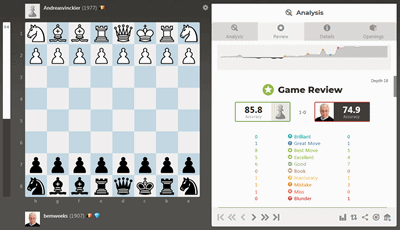
The following diagram shows the start of the same game featured in the 'Tactical Error' post. There's more I can say about the look and feel of the 'Analysis' tool itself, but I'll save that for a series I'm doing on my main blog. The most recent post in that series was Chess.com's Game Review Tools PGN (February 2023).

Shown on the left is the start position for the game, 'SP350 NRKQRBBN'. On the right is a summary of the overall quality of the players' moves ('Brilliant', 'Great Move', ..., 'Blunder'). For example, the tool considers that both players made one 'Great Move'.


AV vs. bemweeks | Analysis (chess.com)

The following table shows the tool's comments on the first 12 moves of the game (24 ply deep). I stopped the analysis when I reached the move where I committed the 'Tactical Error'.

Move Short
Comment
Long
Comment
Eval  
1.e4 is excellent This prepares the bishop for development. This threatens to reveal an attack on a pawn. +0.13
1...e5 is good This prepares your bishop for development. +0.30
2.f4 is excellent This exposes an attack, threatening a pawn. +0.27
2...Nb6 is excellent Your piece jumps in to protect a pawn! +0.41
3.fxe5 is best Right on target. +0.41
3...f6 is an inaccuracy You are threatening to attack a trapped rook. +1.09
4.Nb3 is a mistake This loses a pawn. +0.05
4...fxe5 is best That wins a free pawn! +0.05
5.Ng3 is excellent One of the best moves. -0.02
5...Qf6 is best You activate your queen by moving it off of its starting square. -0.02
6.Be3 is good This moves the bishop to a better location, allowing it to control more squares. -0.30
6...O-O-O is good Your rooks can see each other now, allowing them to provide mutual defense. +0.02
7.d3 is best That's what I would have recommended. +0.02
7...d5 is best You are threatening to kick a bishop. +0.02
8.Qd2 is an inaccuracy This ignores a better way to develop a queen off its starting square. -0.47
8...Qc6 is good You are threatening to kick a bishop. -0.10
9.Bg5 is good This wins a tempo by threatening a rook and forcing it to move away. -0.38
9...Be7 is a mistake You are threatening to win material. +0.56
10.Bxe7 is best After all captures, this is an equal trade. +0.56
10...Rxe7 is best You trade off equal material. +0.56
11.Nf5 is good This attacks a rook, winning a tempo when it moves away. This threatens to fork pieces. +0.27
11...Red7 is good You have now doubled your rooks, allowing them to team up to create threats. +0.62
12.exd5 is best This exposes an attack, threatening a pawn. +0.62
12...Qxd5 is a mistake You overlooked a better way to recapture a piece. +1.63

There's much more I could say about the comments, but it would not be useful at this point. Here are a few comments that jumped off the screen at me.

  • 8...Qc6; 'You are threatening to kick a Bishop.' • The move defends against a nasty x-ray threat.

  • 9.Bg5; 'This wins a tempo by threatening a Rook and forcing it to move away.' • The move doesn't win a tempo, but it might lose a tempo by forcing the Rook to a better square.

  • 9...Be7; 'Is a mistake. You are threatening to win material.' • It's a mistake to win material? Something does not compute here.

And so on. The long comments are generally lame and show little understanding of chess960 opening objectives. What happened in the fight for the center?

The most valuable part of the exercise is to see the change in evaluation from one move to the next. It reaffirms the severity of my mistake on the 12th move.

30 July 2022

TCEC C960 FRC5

Earlier this month on my main blog, I posted Stockfish Wins TCEC Swiss 3 and CCC17 Blitz (July 2022). After 'TCEC Swiss 3':-
The site then launched FRC5, which is currently in the four engine 'Final League' stage (KomodoDragon is missing).

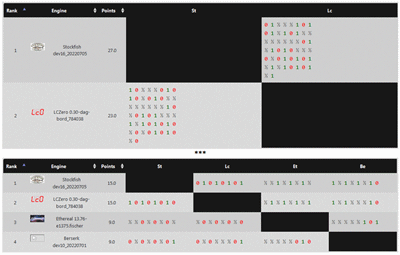
The 'Final League' served as a qualification event for the two engine 'Final Match'. The following chart shows the crosstables for both of the 'Final' events, which have completed.


Top: Final Match
Bottom: Final League

In the 'Final League', Stockfish and LCZero finished in a tie for 1st and 2nd to qualify for the 'Final Match'. That result came about after they tied their individual mini-match +4-4=0 and crushed the two last-placed engines in their other mini-matches. In the 'Final Match' Stockfish beat LCZero +17-13=20.

As for the remark, 'KomodoDragon is missing', the other member of the current engine triumvirate was eliminated at the semifinal stage. Through a specific combination of first and second place finishes in the groups of the preliminary stage, all three engines played in the same four-engine semifinal group. LCZero finished a half point ahead of Stockfish, which was a full point ahead of KomodoDragon, thereby eliminating KomodoDragon. For more about the specifics of the competition, see:-

An important section of the rules is worth highlighting:-

4. Openings books
a. All matchups until the Semileagues stage will be played from a randomly generated FRC aka Chess960 start position.
b. For the Semileagues, the Final League and the Final a shallow book will be used.

What does 'shallow book' mean? I couldn't find an explanation on the TCEC Wiki, but the site's !commands inform,

!mob • MOB - Minimalistic Openings Book made by Kan. The idea is to leave lots of choice to the engines and be as shallow as possible while providing an optimum of variety.

I imagine that definition was developed for the traditional start position SP518 and has been reused for chess960. My post on the previous event, TCEC C960 FRC4 (January 2022), looked at TCEC practices for chess960 opening books. To adapt a phrase from that post,

The researcher behind the 'shallow' analysis should make available his full analysis showing which positions were eliminated for which reasons.

That FRC4 post also referenced a couple of my own 'Iceberg' posts (November 2021) analyzing engine runtime data from TCEC FRC3. Add FRC5 to the backlog of events for this sort of analysis.

29 January 2022

TCEC FRC4 Unbalanced Books

In last week's post, TCEC C960 FRC4 (January 2022), I mentioned the use of 'unbalanced books'. Wanting to know more about them, I downloaded the PGN files for the last two stages of FRC4, where they were used, and analysed them. For the 48 games in the 'Final League' (i.e. semifinal) and the 50 games in the final match, there were 32 different start positions (SPs), distributed as follows:-
2 : 18 positions
4 : 11
6 : 3

The first column shows the number of times a position was used in a game. In other words, 18 SPs were used twice, and so on. Since each SP was played twice, each engine in turn taking White, this is the minimum. I once attempted to calculate how much each of the 960 SPs were scrambled relative to the traditional start position. The results were summarized in A Chess960 Almanac (October 2011).

Is there a correlation between 'unbalanced books' and the degree of scrambling? A preliminary analysis was inconclusive, but 32 different SPs is too small a sample to decide one way or the other. I hope we'll eventually get enough data to say for sure.

22 January 2022

TCEC C960 FRC4

In a recent post on my main blog, Stockfish Wins Both TCEC FRC4 and CCC16 Bullet Events (January 2022), I made three observations related to chess960:-
(1) 'Stockfish and LCZero tied for 1st/2nd in the [TCEC] FRC4 'Final League', a point ahead of KomodoDragon. Stockfish beat LCZero +13-9=28 in the Final.'

(2) 'A [TCEC] note mentioned, "!bookfrc • Final League and the Final will use unbalanced books [...] On the edge between draw and white win." For more info, see TCEC FRC 4, under 'FRC Book Generation'.'

(3) 'After FRC4, the site ran an event called 'S22 - DFRC Sanity Check'. What's DFRC? "!dfrc • Double Fischer random chess: The same as Fischer random chess, except the White and Black starting positions do not mirror each other. Double FRC has 921,600 (960*960) possible starting positions."'

The 'more info' reference in (2) was for TCEC FRC 4 - TCEC wiki (wiki.chessdom.org), where the nuts and bolts of the tournament are explained. I covered the previous event in TCEC C960 FRC3 (March 2021).

One welcome difference between FRC3 and FRC4 was the increased number of competitors in the 'First phase', comprised of four leagues. In FRC3, there were four engines in each league; in FRC4, six engines were planned, although only 23 engines started the event. After FRC3, I analyzed engine runtime data for the first time in a pair of posts:-

  • An Engine Iceberg (November 2021) • 'TCEC FRC3 was a 50 game match won by KomodoDragon over Stockfish on a final score of +2-1=47.'
  • The Engine Iceberg Looms Larger (ditto) • 'Final match of the CCC C960 Blitz Championship (October 2021).'

It might be useful to repeat the exercise for FRC4, although I should be clear on objectives for the exercise. What can be learned by looking at only a small, random subset of the 960 possible start positions?

The TCEC wiki page discusses 'unbalanced books'. It's an interesting concept, but perhaps too heavy on the human manipulation: 'following work is done by hand'; 'then (by hand and eye) I choose'; '[sequences] that don't look crazy to me'; 'eliminated lines that looked too drawish or too busted'; 'some looked too artificial, some looked a bit too similar to others'.

Traditional A/B engines have never been particularly good at evaluating the long term consequences of opening decisions. A comprehensive analysis extends well beyond their search horizons. Maybe the AI NNUE engines are better at this, but that hasn't been studied anywhere (that I know of).

A red flag goes up when I see a phrase like 'lines that looked ... too busted'. In the years of writing about and playing chess960, I haven't seen any start positions that were 'too busted'. To the contrary, Black always has resources to counteract White's various initiatives. Perhaps the researcher behind the analysis (Bastiaan) should make available his full analysis showing which positions were eliminated for which reasons.

Another phrase caught my attention: 'not a single position favours Black in my analysis'. This is what one would expect to see in a position between opponents having exactly the same resources, except one gets to move first. Otherwise we would talk about 'first move disadvantage' or 'zugzwang in the start position'.

As for DFRC (FRC squared? chess921.6K?), this is a new area for analysis. It's another example of Gene Milener's idea that I covered in Chess960 Phase Zero (November 2018). A first action might be to examine runtime data from the DFRC games.

25 December 2021

The CCRL Is Unreliable (Not!)

I currently have 21 posts in the category Showing posts with label CCRL. One of those posts lists six early posts from my main blog making a total of 26 posts (21-1+6) for that label. Only one of those posts was written in the five years since I restarted this chess960 blog, indicating that the CCRL (see the right navigation bar for a link) has declined in importance for me. In recent years I rarely consulted it for opening advice.

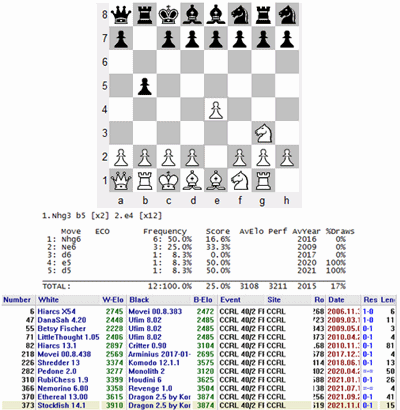
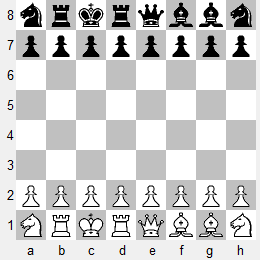
This month I started a new eight-game (four different start positions) event and decided to take another look at the CCRL data. One of the games, SP777 QRKBBNRN, is pictured below.


SP777 QRKBBNRN

For the game where I had white, I chose 1.Nhg3 as the first move, and the game continued...

1.Nhg3 [x89] b5 [x2] 2.e4 [x12]

...reaching the position in the diagram. The numbers in brackets ('[]') are the number of games in the CCRL file for SP777, out of 378 games total. After Black's first move, only two CCRL games remained, but the number increased after White's second move, thanks to a simple transposition of White's first and second moves.

The first block of text in the image, statistics calculated by SCID, shows Black's moves after 2.e4. The numbers are terrible for White -- in the 12 games, White scored only 25%. When I first saw the stats, I told myself, 'This line is unplayable!', but couldn't see any other reason why it shouldn't be played. It's the most logical move in the position.

The second block of text shows some basic info about the 12 games, listed in chronological order. The last two columns are the most interesting. The WLD scores total +2-8=2 (25%), but the last column shows the 'Length' (number of moves) for each game. Of the 12 games, only four lasted longer than 15 moves.

The first game, Hiarcs - Movei (played 2006), ended '1-0' after Black's 6th move, when the opponent's are still developing their forces. The last game, Stockfish - Dragon (played this year), ended after White's 15th move with the comment 'Black wins by adjudication', although the position is at best unclear.

My conclusion? The CCRL statistics are completely misleading and can't be relied on. My own SP777 game hasn't yet reached the 10th move, so I can't say anything else, because it's still in progress.

***

Later: Re 'Of the 12 games, only four lasted longer than 15 moves', after I wrote the post, I realized I had made a serious error. SCID doesn't know anything about chess960. When it encounters an illegal move, it stops processing the game. For chess960 games, most castling moves look like errors, so SCID stops. Thus the low move counts.

For the first three games in my list, the real plycounts were 99, 511, and 122, where the number of 'moves' in the game (more accurately called 'move pairs', i.e. a move for White plus a move for Black) would be half that. This reminded me of an equally serious error I made on my main blog in the first few months of chess960 blogging, when I miscalculated CCRL statistics:-

My conclusion now? (1) I'm the one that's unreliable, not the CCRL; (2) I shouldn't blog on Christmas day, the date of this post; (3) I should be careful when I find a simple answer to a complicated question.

Re the original observation, 'The numbers are terrible for White -- in the 12 games, White scored only 25%', I'll have to look at it again. The game that provoked the analysis has reached the 17th move, so it is still too early to comment.

27 November 2021

The Engine Iceberg Looms Larger

Last week's post, An Engine Iceberg (November 2021), looked at runtime data from 'TCEC C960 FRC3', which I covered on this blog in March 2021. I wrote,
Since the data covers only the first move of 25 SPs (50 games) out of the full set of 960 SPs, it's obviously just scratching the surface. Suppose we had data for the first few moves of all 960 SPs from many different engines played over a long period of time. What might we learn from this?

For this current post I repeated the exercise on the final match of the CCC C960 Blitz Championship (October 2021). I wrote,

In the final match Stockfish beat Dragon +10-1=589. Yes, more than 98% of the final games were drawn.

I loaded the PGN for all 600 games into my database and ran a preliminary analysis. There were two small surprises.

The first surprise was that the data for individual moves was not the same for both the TCEC and the CCC. Here are examples for the first move of the first game in both events.

TCEC: 1. e4 {d=36, sd=36, mt=147236, tl=1657764, s=81363821, n=11979602252, pv=e4 Nb6 Nb3 e5 g3 g6 Ne3 c6 f4 exf4 gxf4 f5 exf5 gxf5 Bf2 Qf6 c3 Nd5 Bc2 Nxe3 Qg1 Ne6 Bxe3 Bc7 O-O-O O-O-O Nd4 Bf7 Rf1 Bh5 Rde1 Nxd4 Bxd4 Qf7 b3 Be2 Rf2 Bg4 Kb2 Rxe1 Qxe1 Rg8 Qf1 Bb6 Bxb6, tb=0, h=99.9, ph=0.0, wv=0.26, R50=50, Rd=-11, Rr=-1000, mb=+0+0+0+0+0,}

CCC: 1. d4 {+0.45/32 9.6s, ev=0.45, d=32, pd=g6, mt=00:00:09, tl=00:04:55, s=148396 kN/s, n=1415409674, pv=d4 g6 e3 d5 g4 c6 c4 dxc4 f4 g5 fxg5 Na6 Nf2 e5 Bxc4 Nb4 Na3 exd4 Qf3 Be7 exd4 Qxd4 O-O O-O Bb3 Ne6 h4 Qg7 Be3 Nd5 Ne4 Nxe3 Qxe3 h6 Nc4 hxg5 Ncd6, tb=0, R50=50, wv=0.45}

Fortunately, the important 'wv' and 'pv' fields are available for both events. Any other fields I decide to use might require some sort of conversion.

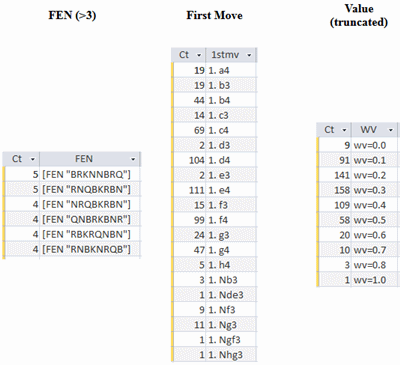
The second surprise was that the CCC start positions (SPs) were not repeated for a second game, colors switched, between the engines. Instead, a new SP was assigned to each game. The left table in the following chart shows that some SPs were nevertheless repeated up to five times.

In addition to the six SPs shown in the table, 24 SPs were repeated three times and 90 were repeated twice. I assume that the SPs are chosen randomly for both the TCEC and the CCC, perhaps with the exception of SP518 RNBQKBNR, but I know from past investigations that several bad algorithms are in use elsewhere; see Start by Placing the Bishops (September 2017) for examples.

The center table in the chart shows the number of times a certain first move was chosen across all 600 games. For example, the initial moves 1.a4 and 1.b3 were both chosen 19 times. Just as in SP518, advancing a center Pawn two squares (1.c4, 1.d4, ...) is the most popular opening strategy. Although any single SP has a maximum of four initial Knight moves, sometimes only two or three moves, all eight moves are possible across the 960 SPs.

There are a number of questions for further exploration. When is the advance of an edge Pawn -- 19 x 1.a4 or 5 x 1.h4 -- desirable? I suspect these are position where the Queen starts in the corner behind the Pawn. Why the large difference between the counts on the two edge Pawns? Perhaps this is because of castling O-O/O-O-O considerations. Also worth noting is that O-O/O-O-O was never chosen for the first move.

The rightmost table in the chart gives a rough distribution of initial 'wv' values, i.e. what value did the engine calculate for its first move? These are truncated values, e.g. the CCC 'wv=0.45' shown above is counted in the table as 'wv=0.4'. I could have used roundoff and a bar chart to display the counts more accurately, but I ran out of time.

One big question presents itself here. Why are there so many 'wv' greater than 0.5, but so few decisive results during the match? I also need to determine if Stockfish and Dragon calculate values in the same statistical range. I doubt that they do.

The three tables in that chart lead to many questions and few answers. I'll take this up again some other time.

20 November 2021

An Engine Iceberg

In the previous post, CCC C960 Blitz Championship (October 2021), I wrote,
Given that engines' evaluations for every move are available in the event's PGN game scores, perhaps there is something to be learned about the 960 different start positions. That investigation would make a good follow-up post.

Make that two good follow-up posts. The first post was on my main blog, Evaluating the Evaluations (November 2021), where I concluded,

Now that I have a tool for rapidly evaluating the engine evaluations, what can I do with it? The first task will be to put it to work on the 960 start positions used in chess960.

The second post is this one. I had already downloaded a few PGN files from recent engine vs. engine events, so the first question was which one to use. I decided to continue with the games from an event that I covered earlier this year in another post on this blog, TCEC C960 FRC3 (March 2021). At that time I noted,

Except for an occasional CCRL game, I can't remember ever looking at an engine vs. engine chess960 game. Is there anything to be learned from such an exercise, or is the play of the engines beyond comprehension?

TCEC FRC3 was a 50 game match won by KomodoDragon over Stockfish on a final score of +2-1=47. The seven mandatory tags in the PGN header for the first game look like this:-

[Event "TCEC Season 20 - FRC3 Final"]
[Site "https://tcec-chess.com"]
[Date "2021.03.14"]
[Round "1.1"]
[White "KomodoDragon 2671.00"]
[Black "Stockfish 20210226"]
[Result "1/2-1/2"]

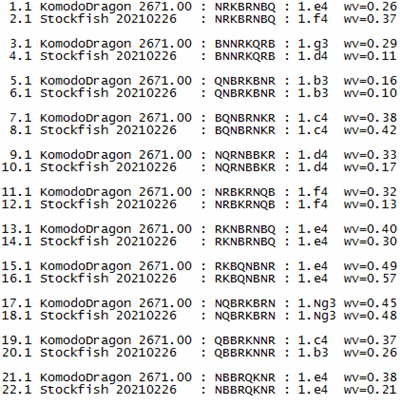
I loaded the file into my database, added the concept of SP, and produced the following chart. It covers the first 22 games of the match. Each start position (SP) was played twice, where KomodoDragon always had White in odd-numbered games. In a match between humans, this pattern would risk giving an advantage to one of the players, but in games between engines, it's harmless.

The last two columns show the first move, as chosen by White, and the value ('wv') calculated by the engine for that move. I could have also shown the principal variation ('pv') calculated by White, but that wouldn't add much to an initial understanding of the data. The same data is available from the PGN file for all moves by both sides in a game.

Since the data covers only the first move of 25 SPs (50 games) out of the full set of 960 SPs, it's obviously just scratching the surface. Suppose we had data for the first few moves of all 960 SPs from many different engines played over a long period of time. What might we learn from this? I would want an answer to that question before spending too much effort collecting more data.

24 July 2021

Don't Neglect the Corner Queen

A few years ago I wrote a post Activating the Corner Queen (September 2013; SP180 NBBRNKRQ), where I concluded,
Black was always in command and eventually won. The early activation of Black's Queen was the deciding factor.

I was reminded of that post in a pair of games that I recently played at the same time and that both ended disastrously for my opponents. I was White in both games.

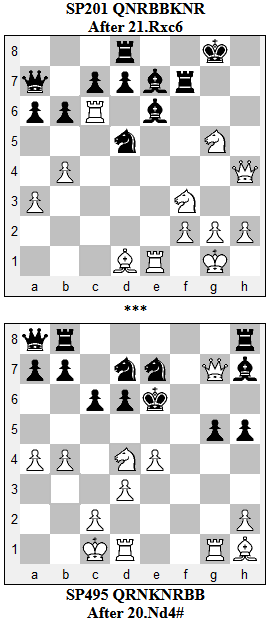
The position at the top is from a game that started with SP201 QNRBBKNR. Black played the inconsistent sequence 9...Qa7, followed immediately by 10...b6. This left the Black Queen out of play just as much as in the start position. I played 5.b4 and 6.Qb2, followed later by 17.Qd2, where the Queen joined an attack building against the Black King. The diagrammed position, where Black resigned, shows all White pieces participating in the attack.

The position at the bottom is from a game that started with SP495 QRNKNRBB. Black's Queen never moved and Black made no effort to develop it by moving either of the Pawns that blocked it. I played 1.b4, activating the Queen on the first move. Although the Queen didn't jump into the game until 19.Qg7, setting up a killer mating net, it participated in the tactics throughout.

In the traditional start position (SP518 RNBQKBNR), the Queen is well placed to enter the game as circumstances dictate -- via either of two diagonals, up the file (often to the second rank), or occasionally sliding along the back rank. When the Queen starts in the corner, it is badly placed and requires special attention.

In both diagrammed games, White was virtually playing with an extra Queen, a significant advantage for any player. It can't have been pleasant for either of the opponents.

23 January 2021

So Explains So vs. Carlsen

In last month's post Wesley So's Strategies (December 2020), I located a pair of Chessable courses -- one of them pricey, the other free -- and finished saying,
I can't argue with 'Free', so I started the [Chessable] course and hope to have more to say in a followup post.

I hadn't accessed Chessable since writing that post, but had no trouble finding the course again. After signing in, I received the following screen.

Using that as a start point, I accessed the course, repeated the first chapter '1. Introduction' to get my bearings, and started on '2. Wesley So vs. Magnus Carlsen'. That second chapter is an hour-long video presented by GM Wesley So, where he discusses the third game from his FWFRCC final match with GM Carlsen (see my previous post for more about the match).

The third game of the match used SP729 RKNBBQNR as the start position. Before making his first move, So offered a preliminary analysis:-

Looks at first to be a very peculiar position, because the White King is far inside the Queenside and there are no less than five pieces blocking his way if he ever wants to castle Kingside to g1. So he has to move five pieces away from the back rank before he is able to castle [O-O].

The King feels a little bit vulnerable being so far away from the Queen. All the squares in front of the White King are protected for the time being. However he doesn't feel as safe as in other starting positions because the White Queen is so far away.

Other than that the other pieces are pretty much in regular starting positions, the difference being with the Bishops in the center so it's not clear exactly which direction they should go.

I split that analysis into three paragraphs, because they serve as a useful checklist for a generic analysis of any start position:-

  • Consider the castling options
  • Weigh the King's safety
  • Note the position of the other pieces

The focus on the start distance between the King and the Queen was a new consideration for me, but the rest was familiar ground. One imprecision I noted was: 'All the squares in front of the White King are protected'. If we count the King as a protector, this is true of every start position. If we don't count the King, the g-Pawn in SP729 is not protected. After his introduction, So said,

I played the move 1.e2-e4, which in my view is the best move in the position.

He then went on to explain why he thought it was best, also considering other reasonable first moves. In the first half of the video, GM So discussed the first dozen moves of the game (out of 60 played), providing some astute observations on the evolution of the play. Although I didn't watch the second half, I assume that it was equally instructive, given (1) that a chess960 game eventually comes to resemble any game stemming from SP518 RNBQKBNR, the traditional start position; and (2) So's status as one of the best SP518 players in the world.

A forum discussion is attached to the course. One comment, titled 'So lazy', said,

Come on, this is sooo lazy. It's just the most basic explanation of rules and some not Fischer Random only tactics, nothing about strategy or any good principles.

Anyone agreeing with that comment is advised to stick with SP518. First learn the basics of traditional chess, after which GM So's commentary should make more sense. Since winning the '2019 FWFRCC', crushing GM Carlsen in the final match, he is considered the no.1 chess960 player in the world. This video shows why. I am one step closer to shelling out the bucks for the full, pricier course.

17 October 2020

Chess960 Opening Meta-theory

After the videos featured in last month's post, 2020 Champions Showdown Live (September 2020), another video is worth special attention.


Openings in Fischer Random?! | Chess Openings Explained - NM Caleb Denby (59:58) • 'Streamed live on 14 Sep 2020'

The description said,

National Master Caleb Denby looks [at] the biggest opening successes and disasters from 2020 Champions Showdown -- Chess 9LX, a Fischer Random Chess (also known as Chess960) event. Learn to identify weaknesses in the opening position.

Thirty seconds into the clip, NM Denby (current FIDE standard rating 2110) explains,

There are two main opening topics that I'm going to focus on tonight, that are accentuated in chess960. First, you'll oftentimes find a lot of very early pressure or attacks on a specific weak point in the position. Players will identify a starting weakness in the initial position that they're given and will base their opening play around it.

Topic number two that I want to focus on is the idea of being left with one bad piece. This is something that often happens in chess960. Players are able to develop almost all of their pieces, but then there seems to be one piece that gets left behind. That can be detrimental to the entire chess position.

That first topic should be automatic for the initial assessment of any chess960 start position (SP). The second topic seems obvious enough, although I don't remember having explored it in any previous posts on this blog. I thought immediately of the traditional start position (SP518 RNBQKBNR with its weakness on f2/f7) and of something GM Karpov once wrote -- and I'm paraphrasing -- 'In every opening (most openings?), Black has to accept a weakness in the development of one of his pieces'.

In the first half of the video, Denby looks at three games from the 2020 Champions Showdown, two of them using the same SP. His examples show how vigilant both players must be during the first few moves. Three links in the video's description (right-click the embedded video for its Youtube address) point to the games on Lichess.org. Around 32:00 into the clip, Denby continues,

I want to switch gears now and go from these wonderful chess960 games to looking at some regular chess openings and how these ideas manifest from the real initial position in chess.

Did he say '*real* initial position'? The examples are from well-known SP518 opening variations and at this point I lost interest.

The first comment to the video was from HarryO of the Chess960 Jungle blog (see the link in the right sidebar): 'As far as I know this could be the first ever lecture on chess960 openings. Thanks.' HarryO ought to know! The first reply to his comment was: 'Lets hope it's the last. Chess960 was introduced to bring skill not preparation back to the games. Sadly chess has degenerated into a memory test.' I can't agree with that sentiment. Chess960 opening theory is meta-theory : how to tackle the analysis of a new, previously unseen SP. There is no memorization required and any analysis of a specific position is to discover that meta-theory.

On top of the sudden switch from chess960 to SP518, there were a few other aspects of the video that were mildly annoying. The first was the Youtube announcement that 'Live chat replay is not available for this video.' I've seen it on other videos, so why is it missing here? The second was Denby's frequent knuckle cracking. These are minor complaints and I have to agree with HarryO's overall assessment: 'Thanks!' I hope it is the first of many such videos, if not by NM Denby, then by other competent players.

27 June 2020

No Quitting Here!

In last week's post, Chess960 on Playchess.com, I responded to a quote from IM Sagar Shah with:-
Sagar Shah says, 'That's the thing in chess960. If you're not careful you can quickly run into a lost position.'

Since I'm something of a specialist for running into lost chess960 positions, I should document some of my most painful experiences. But which games should I choose? There are so many of them.

If I had any common sense I would stop this chess960 blog here and now. It's been five years to the day since I signalled my first attempt to quit in Whispering a Fond Adieu! (June 2015; 'Bye for now! - Mark'). I managed to stay away for 18 months, then came roaring back with 'Everyone I Know Plays Chess960' (January 2017). The title of that post was a quote from GM Peter Svidler where the complete thought was, 'Everyone I know plays chess960 with great pleasure.' Copy that!

Yes, chess960 continues to be a great pleasure for me. I started playing on correspondence servers in 2008 -- Chess960? I'm Hooked! (September 2008) -- and am still hooked. According to my records, I played 92 games on Schemingmind, most recently in 2016. I played another 136 games on LSS, where I currently have a half-dozen games underway.

With more than 200 games under my belt, I have plenty of examples to choose from -- wins, losses, and draws -- most of which were analyzed fairly deeply while they were being played. All of the LSS games were played with the help of an engine, so I'll start with those. After 12 years of playing chess960, I still don't understand much about its opening theory, making it a logical area to focus on.

So here's the plan: I'll continue to post twice a month. One post will be to keep up with any news; one post will be to learn something about opening theory. Maybe I'll eventually discover how to avoid running into a lost position.

30 May 2020

Seirawan, Nimzovich, and Chess960

In the previous post, Commentating Chess960, I listed two teams of chess960 commentators who handled responsibilities for high level events last year:-
  • Yasser Seirawan, Jennifer Shahade, and Maurice Ashley (in St.Louis)
  • Yasser Seirawan, Daniel Rensch, and Sopiko Guramishvili (in Norway)

The common member of both teams was GM Yasser Seirawan. He is the strongest of the five players, having twice reached the candidate stage of a World Championship cycle: 1985 Candidates Tournament and 1988-90 Candidates Matches. In his prime he was one of the ten best players in the world.

I discussed game two of the Norway event, the FWFRCC final, in the 'Commentating' post. In the video for game three, at around 17:20 into the clip, there was a brief discussion of 'Bad Bishops':-

YS: As Evgenij Ermenkov said, 'How could a Bishop ever be bad?'
DR: I thought Nimzovich said that -- your favorite, Nimzovich.
YS: No, no, he's not my favorite. [Everyone laughing]
DR: Would Nimzovich have been a good Fischer Random player? [Pause; YS thinks] Why don't you write a blog about that on Chess.com? Coming your way soon!
YS: Coming your way soon!

A few years ago, in Three Chess960 Developments to Watch (October 2017), I mused,

I've often thought that Nimzovich would have been a brilliant chess960 player, given his penchant for unusual openings and deep strategical concepts.

I started snooping around Chess.com, hoping to find a blog post by GM Seirawan on Nimzovich and chess960, but came up empty-handed. I found plenty of material by lesser lights explaining why Nimzovich wasn't Seirawan's favorite player, but that's a more suitable subject for my main blog than it is here.

I also took another look at Nimzovich's book 'My System'. Excluding a chapter titled 'The Isolated Queen's Pawn and Its Descendants' (IQP), all 15 chapters of the first two parts are just as relevant to chess960 as they are to chess starting from the traditional initial position. The IQP chapter might also be relevant, although my own experience is that the structure -- which can occur on the d- or e-file -- appears far less frequently in chess960. How many other classic chess textbooks are so relevant to chess960?

18 April 2020

Spectating Chess960

After the previous post on Problem Pieces (March 2020), I went back to the same video for Day 1 of the 2019 Champions Showdown Live (October 2019), and continued watching. I was hoping to find more nuggets of general advice similar to 'Problem Pieces', but the commentators were instead focused on the tactics specific to the game they were following.

The format of round one (Day 1) through round three (Day 3) was two rapid games followed by two blitz games, all games in each round having the same start position (SP). Even though I've been playing chess960 since 2008, I was impressed by how entertaining the Showdown games were. There was no explanation of the subtleties of the Najdorf Variation through move 15, no referring to a database of previous games to discover where the first original move was played. There were just some of the top chess players on the planet slugging it out from the first move in positions that have never been explored.

After watching Day 1, I skipped ahead to Day 4 where a different format was used. One SP was selected for four blitz games, followed by another SP for four more games, making eight games total for the day.

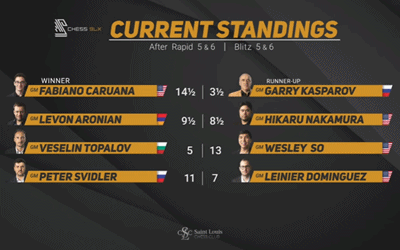
The results of the four matches for the first three rounds are shown in the following chart. The rapid games counted for two points, while the blitz games counted for one point. That meant each round had been worth a total of six points. The eight blitz games in Day 4 would be worth eight more points.

The chart shows that two of the matches were effectively decided, one was close to decided, and the fourth was a real tussle. GM Nakamura had come back from a 5-1 drubbing on the first day to trail GM Aronian by a single point. The commentators naturally focused on the Aronian - Nakamura match. The Caruana - Kasparov match had been the focus of attention in the previous rounds.

Day 4 started with a curiosity. The first start position (SP784 BBRQKNRN) was the twin of the position on Day 3 (SP175 NRNKQRBB). This meant that the initial piece development for SP784 repeated the considerations for SP175. The SPs would differentiate at the time of castling. • NB: After choosing the Day 4 position, TD Tony Rich called it 'SP779'. He was using the Chessgames.com Random Position Generator, which does not follow the standard numbering.

Before writing this post I hoped to gain additional insight into chess960 opening strategy, aka meta-theory. Instead I gained an appreciation for chess960 as a spectator. In Commentating the Opening in London (March 2013), I surmised,

This is exactly the attraction of Fischer's greatest invention. Everyone -- whether player or commentator or spectator -- is looking at the position for the first time ever, applying their own knowledge of chess to tackle a completely new chess position. Chess might not be a great spectator sport, but chess960 might well be.

Looks I got it right that time.

28 March 2020

Epaulette Mate

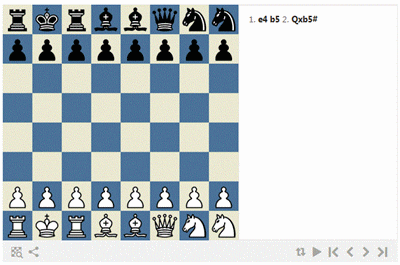
Here's an interesting idea found on Chess.com in a forum thread titled Chess960 Fool's Mate Variation. In the following diagram it's checkmate after 1.e4 b5 2.Qxb5# .


SP921 RKRBBQNN

The thread eventually determines that there are two such RKR***** positions (plus two more *****RKR mirrors). Why two? The Queen must be on the f-file and a Bishop must be on the d-file, because a Knight on that file can block the Queen check. That leaves three squares still to be occupied. The other Bishop must be on the e- or g-file, leaving the last two squares for the Knights.

The thread doesn't discuss the related positions *RKR**Q* and **RKR**Q. In fact, these can't lead to the same mate, because the two Bishops must be next to the Rooks, which places them on the same color square.

All 960 start positions are subject to some sequence of moves -- similar to a 'helpmate' problem -- that leads to the shortest mate for that position. Which positions require the most moves?

21 March 2020

Problem Pieces

A few months ago, in 2019 Champions Showdown Live (October 2019), after linking to a number of videos from the 2019 Champions Showdown, St. Louis, I closed with a question:-
How am I ever going to find the time to watch all of this?

Today I decided to use this post to start the viewing, but first I stopped in to watch round four of the 2020 Candidates Tournament; Yekaterinburg (Russia). I hadn't been able to see the first three rounds and the fourth day was a rest day. Traditional chess is alive and well! The four games were so interesting that I spent most of my free time following the action. After three draws and another draw looming, I finally switched over to the video for a round from St. Louis:-

Streamed live on Sep 2, 2019; 2019 Champions Showdown | Chess 9LX: Day 1

Since chess is primarily a competitive activity, watching a game is more exciting when you don't know the outcome, but it's still interesting. The commentators -- Yasser Seirawan, Jennifer Shahade, and Maurice Ashley -- did a thoroughly professional job explaining the ebb and flow of the games. The chess960 opening is the most challenging phase to explain, so I paid particular attention to the experts during the early moves.


SP366 NRKRQBBN

The diagram shows the start position for the first two rounds, i.e. eight games. At 18:50 into the video GM Seirawan said,

When you look at a chess960 position for the first time, you identify which pieces are problem pieces. I would identify Nh1 and Bg1. Which Pawn is the most vulnerable? Most likely the a2 & a7 Pawns [since they] are the only ones that aren't protected. Those will be the Pawns that the players first begin to attack.

I would have identified Na1 and Nh1 as the problem pieces. In fact, any piece starting in the corner, except a Rook, presents a problem. As for the Bg1, it is set to attack Pa7, making it more of an asset than a problem. But I won't quibble with the GM; his methodology is what counts.

P.S. Can we call SP366 the Leap Year position?

25 January 2020

From van Zuylen to Benko

In the previous post, An Alternative to a 'Boring, Mind-Draining Process', I discussed an article from the January 2020 Chess Life. The same article had a short sidebar titled 'What is Fischer Random Chess?', which started,
Fischer Random Chess was publicized by the 11th World Champion, Bobby Fischer, in Buenos Aires in 1996. The foundation of Fischer Random chess had been laid two centuries earlier by Philip Julius van Zuylen van Nijevelt as a means of combating expanding opening theory, requiring players to rely on creativity rather than rote memorization and repetition.

We've seen van Zuylen once before in this blog -- More Arguments Against Chess960 (April 2010) -- where Dutch writer Tim Krabbé placed van Zuylen's idea on an equal footing with Fischer's idea. In fact, the two ideas have as much in common as an acorn has to an oak tree. Van Zuylen shuffled the pieces on the rank behind the Pawns, not even taking care to place the Bishops on different colored squares. It's an interesting idea, but it's not particularly difficult to imagine. Fischer invented a castling scheme that was comprehensive enough to make the rules governing the traditional start position (SP518 RNBQKBNR) a subset of his own invention. The intellectual leap between the simple shuffling and the complex castling was a real feat of imagination.

For more about van Zuylen, see Philip Julius van Zuylen van Nijevelt (wikipedia.org). That page includes a link to van Zuylen's book, written in French, where the shuffling idea was introduced. I haven't had time to study the book, but another page, La Superiorite Aux Echecs: The first chess book of endgame theory by van Zuylen van Nyevelt (chess.com/blog/introuble2), makes it clear that shuffle chess represents only a miniscule portion of its total content.

Jumping from the 18th century to the 20th century, the November 1978 Chess Life (CL; p.609) had a pair of articles on shuffle chess. The introduction to the first article, showing the opposing pieces in a strategic huddle, is pictured below.


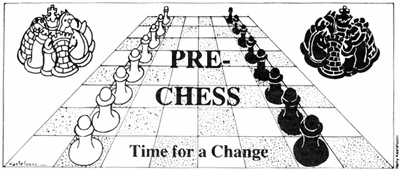
'Pre-chess : Time for a Change' by GM Pal Benko
(Drawing: Nelly Kastelucci)

GM Benko wrote,

About ten years ago someone told me of another idea, which he said had come originally from Soviet grandmaster David Bronstein, certainly one of the most original thinkers in chess The idea is to begin with the sixteen pawns set up as usual, but with no pieces on the board. White's first move is to set any one of his pieces on any square along his first rank. Black then places any of his pieces anywhere on his own first rank.

Play alternates, each player placing another piece on his first rank. No piece or pawn may be moved until all the pieces of both sides are in place. To keep the game as close as possible to orthodox chess, Bishops must be placed on opposite-color squares and castling is permitted only if the King is on "K1" and at least one Rook is on a corner square.

That's certainly more sophisticated than van Zuylen's acorn, although still far from Fischer's oak tree. The rest of Benko's article was about a four game 'pre-chess' match with GM Arthur Bisguier. It was followed immediately by the second CL article, titled 'Pre-chess : For the Thinking Player' by GM Bisguier, who won the match. The two GMs' thoughts on their version of shuffle chess foreshadowed the thinking about chess960 more than two decades later.

23 March 2019

More About Queens in the Corner

On my previous post, More about the Lichess Event, fellow chess960 blogger HarryO (see the sidebar for a link to his blog) commented,
What do you think of Magnus's style where if Queens are in the corner he will often play the edge pawn on the first move?

He was referring to the three hour video embedded in that post. I located two early instances of the corner Queen in the video:-

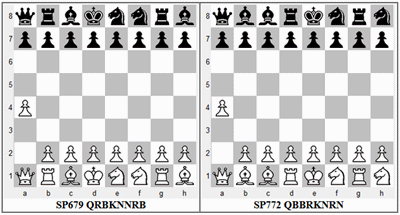
19:45 SP679 QRBKNNRB
26:45 SP772 QBBRKNRN

The following diagram shows the two positions plus GM Carlsen's first move as White.

The Queen in the corner is one of the knottiest problems to solve in chess960. I once focused on it in a post about A Concrete Publishing Proposal (June 2017) where I outlined the three ways the Queen can be developed.

There's another angle to the problem in that the rapid development of the Queen in many chess960 start positions leads to double-edged play. When one player develops the Queen while the other neglects its development, the first player often gets the initiative with a corresponding advantage. This challenges a basic principle of opening play that applies to the traditional position. I once ended a post, Make the Obvious Moves First (September 2012), with the observation,

Take, for example, 'Do not bring your Queen out too early'. I have played at least one game where early development of the Queen to the center was an excellent strategy.

Carlsen has taken the idea even further. There is no subtle maneuvering to slide the Queen along its back rank and jump out on a center file somewhere. He just pushes the Pawn in front of the Queen, then looks at what his opponent is doing before taking further action. Is this another example of 'Make the Obvious Moves First'?