19 February 2022

Quantity Chess

Ever since I started playing chess many moons ago, the year 2021 was the first year that I didn't play a single game using the traditional start position (SP518 RBNQKBNR). I didn't plan it like that; it just happened.

Every once in a while I encounter a reminder about why I no longer enjoy playing SP518. A few days ago it arrived in the February 2022 issue of Chess Life, in a book review titled 'Strong Coffee : GM Gawain Jones stirs the pot with his Coffeehouse Repertoire' by IM John Watson. The review started,

Of late we are seeing numerous opening repertoire books and electronic products by strong players. Most of these recommend variations within a particular White or Black opening, for example, a Caro-Kann Defense repertoire or a tome on "Beating the Sicilian." That’s difficult enough, but a few brave authors have taken on the more ambitious task of presenting a complete repertoire for White from the very first move, or a repertoire for Black versus all of White’s first moves.

You can imagine that with the increasing depth of established theory, such an undertaking has become an extremely daunting one. In his recent Coffeehouse Repertoire books, GM Gawain Jones presents a deep repertoire with 1.e4, and it takes two volumes and 1000 pages to complete the chore.

A thousand pages! Sounds like a lot, but what do I know? The review continued,

These are pages of the dense analytical detail that Quality Chess books are known for, with limited verbal explanation. That might seem excessive, but in fact, Jones can be commended for his efficiency. Quality Chess has already published two even lengthier multi-volume works devoted to repertoires with 1. e4. GM Parimarjan Negi’s brilliant and original five-volume series clocks in at 2280 pages (so far: he hasn’t even written about 1. e4 e5 yet!). And GM John Shaw’s three-volume Playing 1.e4 series consumes 1472 pages.

Finally, I should mention that GM Justin Tan’s recent book 1.e4! The Chess Bible (out from Thinkers Publishing in 2021) takes up the same challenge; so far, his first volume takes up 462 pages, to be followed by two more of presumably similar length. Such books are not for the faint of heart.

Let's summarize that:-

  • GM Gawain Jones; 1000 pages
  • GM Parimarjan Negi; 2280 pages, 'so far: he hasn’t even written about 1.e4 e5 yet'
  • GM John Shaw; 1472 pages
  • GM Justin Tan; 462 pages, 'to be followed by two more [volumes] of presumably similar length'

That totals more than 6000 pages ... just 1.e4. I have copies of ECO -- Chess Informant's 'Encyclopedia of Chess Openings' -- that I bought in the 1970s and that I still use occasionally as an easy reference. Here are page counts and year of publication for ECO's five volumes of the first edition:-

  • A: 1979, 476 pages
  • B: 1975, 398
  • C: 1974, 348
  • D: 1976, 404
  • E: 1978, 464

That makes less than 2200 pages covering all of White's first moves, starting with ECO A00's 1.h4? and 1.g4? (the '?'s were GM Bent Larsen's evaluation at the time). ECO volumes B and C covered all the 1.e4 responses.

Back to Jones, Negi et al, at whom are these books aimed? IM Watson suggests,

I should make clear that the two volumes of 1. e4 Coffeehouse Repertoire are ideally suited for experienced players or truly dedicated students. Many lower players will find the theoretical demands burdensome, and there’s very little verbal handholding of the "Why am I playing this move?" variety.

No verbal explanations? Sounds like pure engine analysis. As I write this, and as you read it, dozens (hundreds? thousands?) of super strong chess engines are crunching the data on the suggestions made by the four authors, attempting to render their conclusions obsolete and thereby gain a single point (1.0) in a game against their operator's unsuspecting adversary.

This way to the egress! It's clearly marked 'chess960'...

***

NB: None of this is meant to denigrate the efforts of Watson, Jones, Negi et al. John Watson is one of the best chess writers / book reviewers active today. The GMs are just trying to make a buck catering to a niche market while applying their expertise. That's the way it is for SP518 in 2022.

29 January 2022

TCEC FRC4 Unbalanced Books

In last week's post, TCEC C960 FRC4 (January 2022), I mentioned the use of 'unbalanced books'. Wanting to know more about them, I downloaded the PGN files for the last two stages of FRC4, where they were used, and analysed them. For the 48 games in the 'Final League' (i.e. semifinal) and the 50 games in the final match, there were 32 different start positions (SPs), distributed as follows:-
2 : 18 positions
4 : 11
6 : 3

The first column shows the number of times a position was used in a game. In other words, 18 SPs were used twice, and so on. Since each SP was played twice, each engine in turn taking White, this is the minimum. I once attempted to calculate how much each of the 960 SPs were scrambled relative to the traditional start position. The results were summarized in A Chess960 Almanac (October 2011).

Is there a correlation between 'unbalanced books' and the degree of scrambling? A preliminary analysis was inconclusive, but 32 different SPs is too small a sample to decide one way or the other. I hope we'll eventually get enough data to say for sure.

22 January 2022

TCEC C960 FRC4

In a recent post on my main blog, Stockfish Wins Both TCEC FRC4 and CCC16 Bullet Events (January 2022), I made three observations related to chess960:-
(1) 'Stockfish and LCZero tied for 1st/2nd in the [TCEC] FRC4 'Final League', a point ahead of KomodoDragon. Stockfish beat LCZero +13-9=28 in the Final.'

(2) 'A [TCEC] note mentioned, "!bookfrc • Final League and the Final will use unbalanced books [...] On the edge between draw and white win." For more info, see TCEC FRC 4, under 'FRC Book Generation'.'

(3) 'After FRC4, the site ran an event called 'S22 - DFRC Sanity Check'. What's DFRC? "!dfrc • Double Fischer random chess: The same as Fischer random chess, except the White and Black starting positions do not mirror each other. Double FRC has 921,600 (960*960) possible starting positions."'

The 'more info' reference in (2) was for TCEC FRC 4 - TCEC wiki (wiki.chessdom.org), where the nuts and bolts of the tournament are explained. I covered the previous event in TCEC C960 FRC3 (March 2021).

One welcome difference between FRC3 and FRC4 was the increased number of competitors in the 'First phase', comprised of four leagues. In FRC3, there were four engines in each league; in FRC4, six engines were planned, although only 23 engines started the event. After FRC3, I analyzed engine runtime data for the first time in a pair of posts:-

  • An Engine Iceberg (November 2021) • 'TCEC FRC3 was a 50 game match won by KomodoDragon over Stockfish on a final score of +2-1=47.'
  • The Engine Iceberg Looms Larger (ditto) • 'Final match of the CCC C960 Blitz Championship (October 2021).'

It might be useful to repeat the exercise for FRC4, although I should be clear on objectives for the exercise. What can be learned by looking at only a small, random subset of the 960 possible start positions?

The TCEC wiki page discusses 'unbalanced books'. It's an interesting concept, but perhaps too heavy on the human manipulation: 'following work is done by hand'; 'then (by hand and eye) I choose'; '[sequences] that don't look crazy to me'; 'eliminated lines that looked too drawish or too busted'; 'some looked too artificial, some looked a bit too similar to others'.

Traditional A/B engines have never been particularly good at evaluating the long term consequences of opening decisions. A comprehensive analysis extends well beyond their search horizons. Maybe the AI NNUE engines are better at this, but that hasn't been studied anywhere (that I know of).

A red flag goes up when I see a phrase like 'lines that looked ... too busted'. In the years of writing about and playing chess960, I haven't seen any start positions that were 'too busted'. To the contrary, Black always has resources to counteract White's various initiatives. Perhaps the researcher behind the analysis (Bastiaan) should make available his full analysis showing which positions were eliminated for which reasons.

Another phrase caught my attention: 'not a single position favours Black in my analysis'. This is what one would expect to see in a position between opponents having exactly the same resources, except one gets to move first. Otherwise we would talk about 'first move disadvantage' or 'zugzwang in the start position'.

As for DFRC (FRC squared? chess921.6K?), this is a new area for analysis. It's another example of Gene Milener's idea that I covered in Chess960 Phase Zero (November 2018). A first action might be to examine runtime data from the DFRC games.

25 December 2021

The CCRL Is Unreliable (Not!)

I currently have 21 posts in the category Showing posts with label CCRL. One of those posts lists six early posts from my main blog making a total of 26 posts (21-1+6) for that label. Only one of those posts was written in the five years since I restarted this chess960 blog, indicating that the CCRL (see the right navigation bar for a link) has declined in importance for me. In recent years I rarely consulted it for opening advice.

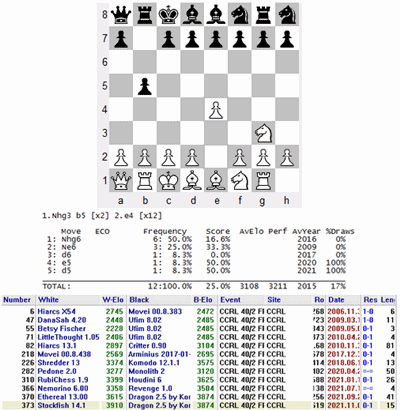
This month I started a new eight-game (four different start positions) event and decided to take another look at the CCRL data. One of the games, SP777 QRKBBNRN, is pictured below.


SP777 QRKBBNRN

For the game where I had white, I chose 1.Nhg3 as the first move, and the game continued...

1.Nhg3 [x89] b5 [x2] 2.e4 [x12]

...reaching the position in the diagram. The numbers in brackets ('[]') are the number of games in the CCRL file for SP777, out of 378 games total. After Black's first move, only two CCRL games remained, but the number increased after White's second move, thanks to a simple transposition of White's first and second moves.

The first block of text in the image, statistics calculated by SCID, shows Black's moves after 2.e4. The numbers are terrible for White -- in the 12 games, White scored only 25%. When I first saw the stats, I told myself, 'This line is unplayable!', but couldn't see any other reason why it shouldn't be played. It's the most logical move in the position.

The second block of text shows some basic info about the 12 games, listed in chronological order. The last two columns are the most interesting. The WLD scores total +2-8=2 (25%), but the last column shows the 'Length' (number of moves) for each game. Of the 12 games, only four lasted longer than 15 moves.

The first game, Hiarcs - Movei (played 2006), ended '1-0' after Black's 6th move, when the opponent's are still developing their forces. The last game, Stockfish - Dragon (played this year), ended after White's 15th move with the comment 'Black wins by adjudication', although the position is at best unclear.

My conclusion? The CCRL statistics are completely misleading and can't be relied on. My own SP777 game hasn't yet reached the 10th move, so I can't say anything else, because it's still in progress.

***

Later: Re 'Of the 12 games, only four lasted longer than 15 moves', after I wrote the post, I realized I had made a serious error. SCID doesn't know anything about chess960. When it encounters an illegal move, it stops processing the game. For chess960 games, most castling moves look like errors, so SCID stops. Thus the low move counts.

For the first three games in my list, the real plycounts were 99, 511, and 122, where the number of 'moves' in the game (more accurately called 'move pairs', i.e. a move for White plus a move for Black) would be half that. This reminded me of an equally serious error I made on my main blog in the first few months of chess960 blogging, when I miscalculated CCRL statistics:-

My conclusion now? (1) I'm the one that's unreliable, not the CCRL; (2) I shouldn't blog on Christmas day, the date of this post; (3) I should be careful when I find a simple answer to a complicated question.

Re the original observation, 'The numbers are terrible for White -- in the 12 games, White scored only 25%', I'll have to look at it again. The game that provoked the analysis has reached the 17th move, so it is still too early to comment.

18 December 2021

Chess940 in 'Chess Life'

Chess960 finally makes the cover (sort of) of a major chess magazine and what happens? They spell it wrong!

I knew this was going to happen. It was just a question of time. Not everyone is comfortable with Roman numerals, and of those who are, not everyone knows what 'L' stands for.
I already flagged one example in 2020 Champions Showdown, Lichess (September 2020), from the well-respected Leonard Barden of The Guardian. If the dean of chess journalism can blunder like this, anyone can.

What am I talking about? The built-in confusion between 9LX and 9XL, of course. The image above is from the table of contents (TOC) of the December 2021 Chess Life (CL). The small print says,

[Page 36] COVER STORY • MY AMERICAN TOUR • GM Maxime Vachier-Lagrave [MVL] on his victory at the 2021 Sinquefield Cup and his tie for second place at the 9XL Showdown.

That text was repeated in the introduction to the ten page article, making it a double blunder. To make matters worse, '9XL' sounds like a fast food menu item -- 'I'll have one no.9, Xtra Large, hold the mayo.'

I suppose I should stop waving my arms around and just be happy that chess960, aka FRC, aka 9LX, etc. etc., featured in two full pages of the MVL article. Earlier this year I covered the '9XL Showdown' event in two posts:-

There was one encouraging development in the MVL article. In that second post, 'Live', I noted,

Just as they did for past events, the 9LX organizers used a non-standard numbering system to identify the start positions (SPs).

This was fixed in the MVL article, where he discussed three of his chess960 games, vs. GMs Mamedyarov, Caruana, and Nakamura. MVL wrote,

At the Showdown, the players were given 15 minutes before the rounds to analyze the new starting positions with each other. I often looked at variations with Levon Aronian and Fabiano Caruana. To be completely honest, this kind of preparation is often just blindly groping around, but sometimes you find one or two ideas that work.

The Frenchman, currently rated world no.12, once posted a piece on his blog My Chess960 Debut (mvlchess.com), which was at the 2018 Champions Showdown at St.Louis. I covered the event on this blog in Champions Showdown, St.Louis (September 2018). In his blog post, MVL observed,

The idea of "confining" players, without computer access, one hour before the games, was very interesting. In this friendly atmosphere, allowing the players to get acquainted with the position and analyse together, generally by pairs, was worthwhile. [...] Analysis of a brand new position was clearly adding some spice to our daily routine. First of all, by depriving us of the morning prep burden... But also because we rediscovered the pure analytic work, as it was done by the Ancients, before the computer era!

It's been alomost two years since I last mentioned a CL article on this blog; see An Alternative to a 'Boring, Mind-Draining Process' (January 2020). Let's hope the next opportunity won't take another two years.

27 November 2021

The Engine Iceberg Looms Larger

Last week's post, An Engine Iceberg (November 2021), looked at runtime data from 'TCEC C960 FRC3', which I covered on this blog in March 2021. I wrote,
Since the data covers only the first move of 25 SPs (50 games) out of the full set of 960 SPs, it's obviously just scratching the surface. Suppose we had data for the first few moves of all 960 SPs from many different engines played over a long period of time. What might we learn from this?

For this current post I repeated the exercise on the final match of the CCC C960 Blitz Championship (October 2021). I wrote,

In the final match Stockfish beat Dragon +10-1=589. Yes, more than 98% of the final games were drawn.

I loaded the PGN for all 600 games into my database and ran a preliminary analysis. There were two small surprises.

The first surprise was that the data for individual moves was not the same for both the TCEC and the CCC. Here are examples for the first move of the first game in both events.

TCEC: 1. e4 {d=36, sd=36, mt=147236, tl=1657764, s=81363821, n=11979602252, pv=e4 Nb6 Nb3 e5 g3 g6 Ne3 c6 f4 exf4 gxf4 f5 exf5 gxf5 Bf2 Qf6 c3 Nd5 Bc2 Nxe3 Qg1 Ne6 Bxe3 Bc7 O-O-O O-O-O Nd4 Bf7 Rf1 Bh5 Rde1 Nxd4 Bxd4 Qf7 b3 Be2 Rf2 Bg4 Kb2 Rxe1 Qxe1 Rg8 Qf1 Bb6 Bxb6, tb=0, h=99.9, ph=0.0, wv=0.26, R50=50, Rd=-11, Rr=-1000, mb=+0+0+0+0+0,}

CCC: 1. d4 {+0.45/32 9.6s, ev=0.45, d=32, pd=g6, mt=00:00:09, tl=00:04:55, s=148396 kN/s, n=1415409674, pv=d4 g6 e3 d5 g4 c6 c4 dxc4 f4 g5 fxg5 Na6 Nf2 e5 Bxc4 Nb4 Na3 exd4 Qf3 Be7 exd4 Qxd4 O-O O-O Bb3 Ne6 h4 Qg7 Be3 Nd5 Ne4 Nxe3 Qxe3 h6 Nc4 hxg5 Ncd6, tb=0, R50=50, wv=0.45}

Fortunately, the important 'wv' and 'pv' fields are available for both events. Any other fields I decide to use might require some sort of conversion.

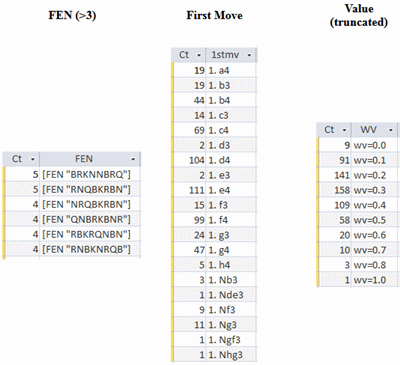
The second surprise was that the CCC start positions (SPs) were not repeated for a second game, colors switched, between the engines. Instead, a new SP was assigned to each game. The left table in the following chart shows that some SPs were nevertheless repeated up to five times.

In addition to the six SPs shown in the table, 24 SPs were repeated three times and 90 were repeated twice. I assume that the SPs are chosen randomly for both the TCEC and the CCC, perhaps with the exception of SP518 RNBQKBNR, but I know from past investigations that several bad algorithms are in use elsewhere; see Start by Placing the Bishops (September 2017) for examples.

The center table in the chart shows the number of times a certain first move was chosen across all 600 games. For example, the initial moves 1.a4 and 1.b3 were both chosen 19 times. Just as in SP518, advancing a center Pawn two squares (1.c4, 1.d4, ...) is the most popular opening strategy. Although any single SP has a maximum of four initial Knight moves, sometimes only two or three moves, all eight moves are possible across the 960 SPs.

There are a number of questions for further exploration. When is the advance of an edge Pawn -- 19 x 1.a4 or 5 x 1.h4 -- desirable? I suspect these are position where the Queen starts in the corner behind the Pawn. Why the large difference between the counts on the two edge Pawns? Perhaps this is because of castling O-O/O-O-O considerations. Also worth noting is that O-O/O-O-O was never chosen for the first move.

The rightmost table in the chart gives a rough distribution of initial 'wv' values, i.e. what value did the engine calculate for its first move? These are truncated values, e.g. the CCC 'wv=0.45' shown above is counted in the table as 'wv=0.4'. I could have used roundoff and a bar chart to display the counts more accurately, but I ran out of time.

One big question presents itself here. Why are there so many 'wv' greater than 0.5, but so few decisive results during the match? I also need to determine if Stockfish and Dragon calculate values in the same statistical range. I doubt that they do.

The three tables in that chart lead to many questions and few answers. I'll take this up again some other time.

20 November 2021

An Engine Iceberg

In the previous post, CCC C960 Blitz Championship (October 2021), I wrote,
Given that engines' evaluations for every move are available in the event's PGN game scores, perhaps there is something to be learned about the 960 different start positions. That investigation would make a good follow-up post.

Make that two good follow-up posts. The first post was on my main blog, Evaluating the Evaluations (November 2021), where I concluded,

Now that I have a tool for rapidly evaluating the engine evaluations, what can I do with it? The first task will be to put it to work on the 960 start positions used in chess960.

The second post is this one. I had already downloaded a few PGN files from recent engine vs. engine events, so the first question was which one to use. I decided to continue with the games from an event that I covered earlier this year in another post on this blog, TCEC C960 FRC3 (March 2021). At that time I noted,

Except for an occasional CCRL game, I can't remember ever looking at an engine vs. engine chess960 game. Is there anything to be learned from such an exercise, or is the play of the engines beyond comprehension?

TCEC FRC3 was a 50 game match won by KomodoDragon over Stockfish on a final score of +2-1=47. The seven mandatory tags in the PGN header for the first game look like this:-

[Event "TCEC Season 20 - FRC3 Final"]
[Site "https://tcec-chess.com"]
[Date "2021.03.14"]
[Round "1.1"]
[White "KomodoDragon 2671.00"]
[Black "Stockfish 20210226"]
[Result "1/2-1/2"]

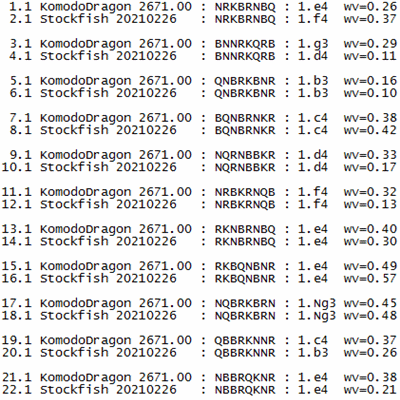
I loaded the file into my database, added the concept of SP, and produced the following chart. It covers the first 22 games of the match. Each start position (SP) was played twice, where KomodoDragon always had White in odd-numbered games. In a match between humans, this pattern would risk giving an advantage to one of the players, but in games between engines, it's harmless.

The last two columns show the first move, as chosen by White, and the value ('wv') calculated by the engine for that move. I could have also shown the principal variation ('pv') calculated by White, but that wouldn't add much to an initial understanding of the data. The same data is available from the PGN file for all moves by both sides in a game.

Since the data covers only the first move of 25 SPs (50 games) out of the full set of 960 SPs, it's obviously just scratching the surface. Suppose we had data for the first few moves of all 960 SPs from many different engines played over a long period of time. What might we learn from this? I would want an answer to that question before spending too much effort collecting more data.