23 February 2019

Carlsen Wins Lichess Chess960 Titled Arena

While I was working on last week's post, A Stockfish Experiment, I noted an announcement for an upcoming tournament, Bonus Titled Arena: Chess960! (lichess.org):-
Due to the recent gain in popularity of the Chess960 (or Fischer Random) variant, we're hosting a bonus Titled Arena: Chess960 Edition! The Titled Arena has become among the world's strongest Bullet tournaments, and we're proud to now also offer a high quality Chess960 tournament to our players.

Many of you have also requested a longer time control during these titled events, so we're trying 2 minutes + 1 second increment this time. Moreover, to ensure that each player will get enough games with this longer time control, we're increasing the tournament duration from the usual 2 hours to 3!

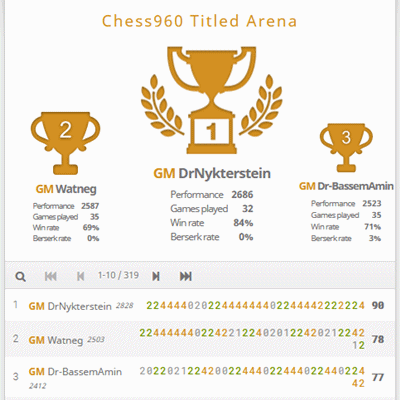
The tournament Chess960 Titled Arena #960feb19 (ditto) finished just in time to make the deadline for this week's post. Here is a copy of the winners' podium.
For future reference, I also noted the links to the three winners' Lichess pages:-

'DrNykterstein' is better known as World Champion Magnus Carlsen. His Lichess page eventually leads to a list of all games he played during the event. Last year he won an unofficial Chess960 World Championship, which I reported on this blog in 2018 Carlsen - Nakamura (February 2018).

Second place Watneg is an anonymous GM, while third place went to Egyptian GM Bassem Amin. The game between Carlsen and Watneg can be found at GM DrNykterstein vs GM Watneg: Analysis board (lichess.org). To document the progress of the tournament, here are a number of tweets I picked off the Lichess Twitter page:-

Who said chess960 levels the playing field between experienced chess players?

16 February 2019

A Stockfish Experiment

Last year, in the aftermath of the Carlsen - Nakamura chess960 match, Chess.com published an article, What's The Most Unbalanced Chess960 Position?. The essence of the piece was:-
Recently, the Norwegian "supercomputer" Sesse analyzed all 960 variations using Stockfish 9. At a depth of 39-40 ply for each position, which took about two to three hours each, its findings were published.

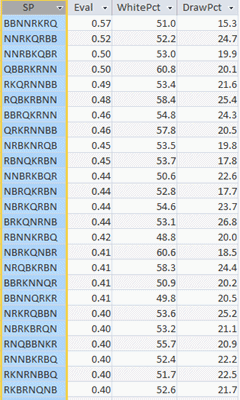
I downloaded the referenced spreadsheet and compared it with the data currently displayed on the CCRL (see link in the right sidebar). The results are shown below.

The first column shows the start position, followed by the Sesse evaluation in centipawns, followed by the CCRL overall percentage score for White and the precentage of draws. For example, the top row says that BBNNRKRQ was evaluated by Sesse at 0.57 (a little more than a half-Pawn), with a CCRL result of 51.0% in White's favor and 15.3% of games ending in a draw.

The chart gives the top-25 positions flagged by Sesse, down to a cutoff of 0.40. I could have added the numeric ID for each start position and will do so if I ever come back to the data.

At first glance, there doesn't seem to be a high correlation between the Sesse results and the CCRL results. The first position where there is agreement between the two sources is QBBRKRNN. I once discussed this position in A Difficult SP for Black (April 2013). By coincidence, I'm currently playing the position in a pair of correspondence games and hope to have more to say about it in the future.

As for the Sesse results, they confirm that engines just don't evaluate chess960 start positions particularly well. Long term positional considerations are not the engines' strong point.

26 January 2019

FIDE Chess960 Ratings

Believe it or not, a recent post about FIDE on my main blog, Spectating the 89th FIDE Congress (December 2018) is also relevant to chess960. Here are a couple of excerpts from the minutes:-
89th FIDE Congress; General Assembly; Batumi, Georgia; 3-5 October 2018; Minutes [...]

7.2. Qualification Commission. [...] Annex 10 is Proposal from Icelandic Chess federation for the rating of Fischer Random (Chess 960) Games.

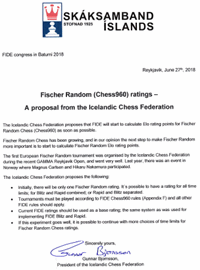
Annex 10 can be found by following the links in the 'Spectating' post. It consists of a single page, pictured below. Titled...

'FIDE congress in Batumi 2018; Reykjavik, June 27, 2018; Fischer Random (Chess960) ratings - A proposal from the Icelandic Chess Federation',

...and signed...

'Gunnar Bjornsson, President of the Icelandic Chess Federation',

...the document starts:-

'The Icelandic Chess Federation proposes that FIDE will start to calculate Elo. rating points for Fischer Random Chess (Chess960) as soon as possible.'

After a few introductory paragraphs it continues, 'The Icelandic Chess Federation proposes the following' with four main points:-

  • 'Initially, there will be only one Fischer Random rating. It's possible to have a rating for all time limits; for Blitz and Rapid combined; or Rapid and Blitz separated.

  • 'Tournaments must be played according to FIDE Chess960 rules (Appendix F) and all other FIDE rules should apply.

  • 'Current FIDE ratings should be used as a base rating; the same system as was used for implementing FIDE Blitz and Rapid.

  • 'If this experiment goes well, it is possible to continue with more choices of time limits for Fischer Random Chess ratings.'

The mention of 'FIDE Chess960 rules (Appendix F)' probably refers to an old version of the rules. The current version is under 'Handbook :: E. Miscellaneous', Fide Laws of Chess taking effect from 1 January 2018 (fide.com), in a section titled 'Guidelines II. Chess960 Rules'.

A report on the meeting of the Qualification Commission (QC), FIDE Congress Update: Chess 960 and an Illegal Move Quiz (uschess.org), by 'International Arbiter and Organizer Grant Oen (US Chess FIDE Events Manager)', explains,

QC is perhaps the most relevant commission to many of our members, as it regulates over-the-board titles and title applications, and the rating of all FIDE-rated games.

The report devotes four paragraphs to chess960 and starts,

The most heated topic of the QC meeting was the discussion of introducing ratings for Chess960 (Fischer Random Chess) following a proposal from the Icelandic Chess Federation.

I'm not completely convinced that a separate international rating system for chess960 is justified at this time, but anything which gets people to talk about Bobby Fischer's greatest invention is fine with me.

19 January 2019

First Post, New Year

The first post on this blog for the year 2019 is an appropriate time to reflect on the chess960 activities of 2018 -- and what a year it was! Of the 24 posts I wrote during the year, I count four that were for top-level chess960 events:-

Should I retire the 'rare birds' series, last seen in (Not so?) Rare Birds, Summer 2017 (July 2017)? No, I'm a patient person, so I'll give it more time. I haven't seen any relevant announcements and all of the events mentioned above could have been one-offs.

Chess960 was dropped for Chess.com's 2018 Speed Chess Championship, where Hikaru Nakamura defeated Wesley So in the final. It never made much sense to include a single chess960 game in a tournament for traditional chess, although the exposure for chess960 can only have helped. As for 2018's '1st Chess.com Chess960 Championship', I note that it wasn't the '1st annual' event and I'll keep watching for any announcement of a '2nd annual' tournament.

Does a decline in top-level chess960 events mean a decline in the number of posts for this blog? Of course not! I might actually find the time to study some of the many top-level chess960 games that were played in 2018...

29 December 2018

'Hitting the Mainstream!'

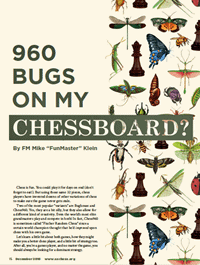
Seen in Chess Life Kids, December 2018 (p.12): '960 Bugs on My Chessboard?' by FM Mike "FunMaster" Klein. The article started,
Chess is fun. You could play it for days on end (don’t forget to eat!). But using those same 32 pieces, chess players have invented dozens of other variations of chess to make sure the game never gets stale. Two of the most popular "variants" are Bughouse and Chess960. Yes, they are a bit silly, but they also allow for a different kind of creativity. Even the world’s most elite grandmasters play and compete in both!

No one will argue that bughouse isn't a variant -- the four players' strategies have little to do with traditional chess -- but I'll raise my hand once more to question the word when used with chess960. It is, after all, one of the first bullets in Top 10 Myths About Chess960 (May 2012)...

No.2: 'It's a variant of traditional chess'

...and I've given the better part of at least one post to the subject, Chess960 Encounters, Past & Future (October 2011), where I said, 'The classification of chess960 as more than a variant is not a simple difference of opinion on semantics.'

Let's get back to the rest of the Chess Life Kids article. The magazine appears six times per year, is 24 pages long, and is the 'Official Scholastic Publication of US Chess'. FM Klein's article was featured on the December 2018 cover, and was introduced on the contents page with 'Chess variants are hitting the mainstream!'

The three page article gave a page to bughouse and a page to chess960. A page was enough to explain the basics of chess960, i.e. the meaning of the name, the setup of the pieces, the 'funny' castling rules, and examples of castling ('Weird!'). It also gave the main reason for playing it.

So why did Bobby Fischer propose this game? Simple -- studying openings is useless. You know how masters can play 20 or 30 moves of "book"? Well, there’s no such thing in Chess960. Pretty much every game is an unexplored kingdom of newness and some grandmasters think more creativity is possible.

That paragraph gives me plenty of justification to overlook negative words like 'silly', 'funny', and 'weird'. Instead I'll concentrate on the positive : explaining chess960 to a new generation.

The introduction of bughouse to the U.S. chess scene preceded the introduction of chess960 by almost 25 years, a full generation. In Fischer Random Bughouse (July 2011), I once showed that the two chess offshoots can even be merged. That would make yet another 'unexplored kingdom of newness'.

22 December 2018

Knight Opposition

Last month I looked at two books by Gene Milener, one entirely on the subject of chess960, the other a coda to the first work:-
  • 2018-11-17: Chess960 Phase Zero • 'Gene Milener's groundbreaking book "Play Stronger Chess by Examining Chess960"' (2006)

  • 2018-11-24: Milener's Month • 'Milener's epilogue' in his more recent book (2018)

My focus on the two books at the same time was rewarded by an insight that had eluded me for years. In 'Play Stronger Chess', Milener wrote (p.130):-

Due to the particulars of the chess1 setup and to the fact it never varies, we do not think of knights as having a light v. dark shade aspect anything like bishops have. But again, it is healthy to consider the possibility that our chess experiences have been harmfully limited by our exclusive adherence to chess1.

For analyzing chess960 setups it is useful to gently apply the idea that each knight is either a light or dark knight, though only for the first portion of the game. These square shadings are central to a setup feature we can call "knight opposition". Some chess960 setups have knight opposition, strongly or weakly, while others have no knight opposition.

My reaction to this was, 'So what?' What difference does it make whether the Knights start on the same color square? The explanation on the following three pages did nothing to alleviate my lack of understanding. In the second book, in 'Milener's epilogue', the author wrote (p.373):-

A non-traditional start setup would offer welcome relief from: [...] The maximization of Knight opposition created by the one traditional setup. Knight opposition is seen in common cases such as when Nb8-c6 follows Ngl-f3, leaving both Knights in a tilt shape with each other. The two Knights oppose each other's pressures on the same center squares of d4,e5. Setups where the two White Knights start on squares of the same shade provide welcome variety from the traditional setup.

That was my 'Aha!' moment. The start positions of the Knights determine how they will engage each other in the opening moves of the game. In the traditional start position, the Knights enter the game during the earliest moves and then proceed to spar for control of the center squares. The same sequence happens in nearly every traditional opening (like the Ruy Lopez and the Queen's Gambit) : first the Pawns enter the play, then the Knights, then the other pieces. The Knights enter the battle with regard to the position of the Pawns, and the other pieces follow their lead.

Several years ago, the 'Chess960 Jungle' blog made a similar observation in a post Chess960: Naming the Knight Pairs (May 2011; 'Military Knights', 'Chivalry Knights', etc.), then went on to discuss the different combinations in subsequent posts. Since I failed to grasp the importance of the concept than, it would be worth my while to review all of those relevant posts.

24 November 2018

Milener's Month

In the first post this month, Chess960 Phase Zero, I explored an important concept from Gene Milener's first book 'Play Stronger Chess by Examining Chess960'. In the second post for this month, I'll return to New Book by Gene Milener (September 2018), where I wrote,
Since there is no way I can ignore the mention of my name in a printed book, I'll come back to the subject in another post. [...] I have at least two posts to write: a continuation of 'Promise of Chess960' and a reaction to Milener's epilogue.

In a section of his epilogue titled 'Mark Weeks and GeneM Disagree', Milener summarized our disagreement in two bullets:-

1. Disagree about Corner Bishops
2. Disagree about 'Random'

I have nothing particularly new to say about either of these topics. About the first, I've posted several times:-

About the second, which Milener covers in a section of his epilogue titled 'Changed My Mind: "Random" Is Bad' I've posted even more, usually in passing. See, for example:-

Moving on to more interesting topics, in one of the end notes to his epilogue Milener mentions the 2016 Carlsen - Karjakin match:-

A World Chess Championship match was held between M. Carlsen - S. Karjakin in 2016/November. After the first seven games were drawn, Karjakin won game 8 when Carlsen recklessly pressed in a draw-ish endgame. Even though a third of the match remained, everyone knew that there might not be enough games left for Carlsen to generate a win and tie the match. That rigid reality sucks excitement from these chess matches. For comparison, imagine that only one of the first eight games ended in a draw, as in nearly every other sport.

While I'm writing this post, the 2018 Carlsen - Caruana World Championship match has reached game 11 out of 12 regulation games. The first ten games were all drawn. This apparent bloodlessness has led to the usual handwringing that something has to be done to improve professional chess. It doesn't matter how artistic or creative the individual games might be, an event is judged by its final score. Spotted on Facebook: Karjakin, during the live commentary..., from the challenger in the 2016 match:-

Karjakin, during the live commentary of #CarlsenCaruana, game 6, on a Russian "Match TV" channel: "Indeed, the classical chess has already been... no, of course by no means has it been exhausted or become boring... but... there is some sort of tiredness, so to speak. We have just seen this today – Black can equalise very rapidly. And at times, indeed, one would like to play for fun. And the fun is... talking of the classic rules, it's the rapid and blitz; while talking about experimenting, #FischerChess is an extremely interesting game which has not been researched yet -- the players have to think from the very first moves. Maybe, in the long term – let's say in the coming 20 years – I think there might be a massive transition to #FischerChess. In some time, when it's entirely... when the theory and powerful engines simply force this transition."

That Facebook post was created by Andrey Deviatkin, also seen on this blog in 'The Essence and the Rules of Chess' (June 2017). Instead of a 'massive transition', perhaps some sort of an evolution is possible. How do we get from here to there?