Popular Posts (Last 7 Days)

Showing posts sorted by relevance for query pgn. Sort by date Show all posts

27 May 2023

Two PGN Challenges

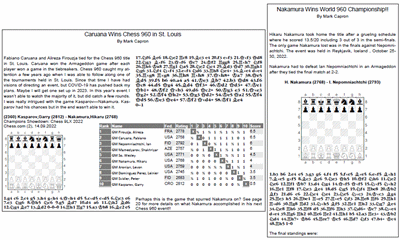
A few days ago I was working on a post for my main blog, 2023 CJA Awards Announcement (May 2023; Chess Journalists of America), and took the time to catch up on The Chess Journalist Magazine (chessjournalism.org). The issue for October 2022 carried a couple of small articles by its editor, both shown in the following composite image.


By Mark Capron
Left: 'Caruana Wins Chess 960 in St. Louis'
Right: 'Nakamura Wins World 960 Championship!!'

Since I had no idea that anyone associated with the CJA leadership had any interest in chess960, this caught me by surprise. In his introduction to the St.Louis article, editor Capron explained,

Chess 960 caught my attention a few years ago when I was able to follow along one of the tournaments held in St. Louis. Since that time I have had visions of directing an event, but COVID-19 has pushed back my plans. Maybe I will get one set up in 2023.

That is all very good news indeed and I could end this post here, but the two small articles got me thinking about chess960 reporting in general. Both articles use the same structure: an introduction, a selected game with a diagram, and the final result of the event. [NB: The eight top finishers of the World Championship (aka '2022 FWFRCC', as used below) have been cropped out of my image. The last line says, 'The final standings were:' ...]

Both diagrams have been used to identify the game's start position. This could have also been done with the relevant portion of the FEN string -- RBBNKNRQ and BRKRQNNB, respectively -- leaving the diagram to convey a more interesting position from the game. Of course, we have more powerful tools online ... or do we?

In the nearly 15 years that I've been blogging about chess960, I can't remember ever using a chess960 PGN viewer to present a game online. There were no such tools when I started and I haven't been paying sufficient attention to know if any have been developed since then.

Even that assumes the PGN is available for download in digital format. I wrote blog posts on the two events mentioned in the CJA journal...

...and I can't remember downloading PGN for either event. Here are two challenges for a future post: 1) Locate the PGN for both events, and 2) Locate a PGN viewer that understands chess960. I would hope that both challenges are trivial, but I suspect that I'm dreaming.

27 January 2018

A World Class Match and Some Top-level Games

Before continuing the previous post, Two Important Chess.com Events, let's go back to Three Chess960 Developments to Watch (October 2017), where I noted,
In February 2018, there may be an unusual exhibition match held between Magnus Carlsen and Hikaru Nakamura, playing chess960 (also known as Fischer Random).

The web site for the match can be found at Fischer Random Chess – The Unofficial World Championship in Fischer Random Chess (frchess.com), where the Regulations page says,

The match will be played in Henie Onstad kunstsenter, at Høvikodden outside Oslo in Norway, from February 9 to February 13 2018. The match will include a total of 16 games. The first eight games are played like slow rapid chess with 45 minutes for the first 40 moves and then 15 minutes for the rest of the game, no increment. The last eight games are played as fast rapid chess with 10 minutes and 5 seconds incremental for each move. All 16 games will be played even if the match is decided. Games will not be rated.
Start positions will be chosen just before a pair of games, for example:-

For the slow rapid games, set up of the pieces will be decided by a drawing made by computer with both players present 15 minutes before the start of the game. This set up then will be used for both games of that evening.

I've already noted Friday, 9 February, 5 PM CET (aka 1700 Central European Time) in my calendar, because live streaming is promised.

***

Back to 'Two Chess.com Events', I located the games for the 'Speed Chess Championship' using the technique documented in GM Blitz Battle PGN (March 2017), and created a PGN file that is available here:-

Speed Chess Championship PGN : 45 games (15 matches with three chess960 games per match)

I had a number of unexpected problems to create and upload the file, but hope that it is usable. The PGN header tags are not the same as they were for the March 2017 upload and I'm not sure whether the Chess.com format changed or my manipulations created differences.

As for the Chess.com 'Chess960 Championship', a preliminary analysis counted 372 games in the PGN file provided by Chess.com. I wanted to look at the file in more depth, but ran out of time.

***

Looking again at the upcoming Carlsen - Nakamura 'Unofficial World Championship', the two players met in the final match for both the 2016 GM Blitz Battle and the 2017 Speed Chess Championship. Although Carlsen won both matches, Nakamura won the chess960 minimatches with identical scores: +2-0=1. Nakamura appears to be the stronger player at chess960.

28 August 2021

New Label 'Download'

Last week's post, TWIC's Chess960 Data 2017-21 (August 2021), mentioned four chess960 events covered by TWIC. It turns out that I covered all four in posts on this blog:-

Of those four events, I provided PGN game scores for only one, the 2018 Carlsen - Nakamura match. TWIC provided PGN for all four. In addition to that, I've provided PGN for other events; ditto for TWIC. To help identify any overlap, I created a new category to catalog my posts having a related PGN file: Showing posts with label Download.

If I take the time to identify editions of TWIC that had chess960 PGN files, I'll be able to catalog the overlap. Watch this space.

17 June 2023

Two PGN Challenges Met

At the end of my previous post, Two PGN Challenges (May 2023), I wrote,
Here are two challenges for a future post: 1) Locate the PGN for both events, and 2) Locate a PGN viewer that understands chess960.

Not long after writing the post, I received an anonymous comment pointing to a number of resources on Lichess; see that post for details. I also discovered that the PGN for the two events is available from TWIC:-

I added the first of the three links to the list because I found it using a search on 'chess960'. The other two links appeared on searches for '9LX' and 'random' (i.e. FRC).

The Lichess comment described a method for embedding games from Lichess. Here's a game from the 2022 FWFRCC.

After I post this, I'll check if the Lichess functionality has survived the Blogger/Blogspot environment.

***

Later: Re 'I'll check if the Lichess functionality has survived the Blogger/Blogspot environment', the functionality to scroll through the game is there, but the moves have disappeared and there is a useless scrollbar on the right. The embed provided by Lichess had dimensions 600x371. Since I use width=400 for images, I resized to 400x248 to get the results shown above.

Resizing to 400x300 eliminates the scrollbar, but doesn't make the moves appear. I tried width=420, which is close to the maximum for my blog template, but the moves still don't appear. The following uses 400x300, which is the best I can do for now. Note the three vertical dots between the left and right arrows. They open a menu for additional functions including viewing the game on Lichess.

20 November 2021

An Engine Iceberg

In the previous post, CCC C960 Blitz Championship (October 2021), I wrote,
Given that engines' evaluations for every move are available in the event's PGN game scores, perhaps there is something to be learned about the 960 different start positions. That investigation would make a good follow-up post.

Make that two good follow-up posts. The first post was on my main blog, Evaluating the Evaluations (November 2021), where I concluded,

Now that I have a tool for rapidly evaluating the engine evaluations, what can I do with it? The first task will be to put it to work on the 960 start positions used in chess960.

The second post is this one. I had already downloaded a few PGN files from recent engine vs. engine events, so the first question was which one to use. I decided to continue with the games from an event that I covered earlier this year in another post on this blog, TCEC C960 FRC3 (March 2021). At that time I noted,

Except for an occasional CCRL game, I can't remember ever looking at an engine vs. engine chess960 game. Is there anything to be learned from such an exercise, or is the play of the engines beyond comprehension?

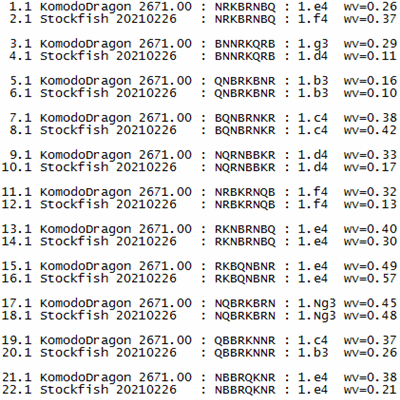
TCEC FRC3 was a 50 game match won by KomodoDragon over Stockfish on a final score of +2-1=47. The seven mandatory tags in the PGN header for the first game look like this:-

[Event "TCEC Season 20 - FRC3 Final"]
[Site "https://tcec-chess.com"]
[Date "2021.03.14"]
[Round "1.1"]
[White "KomodoDragon 2671.00"]
[Black "Stockfish 20210226"]
[Result "1/2-1/2"]

I loaded the file into my database, added the concept of SP, and produced the following chart. It covers the first 22 games of the match. Each start position (SP) was played twice, where KomodoDragon always had White in odd-numbered games. In a match between humans, this pattern would risk giving an advantage to one of the players, but in games between engines, it's harmless.

The last two columns show the first move, as chosen by White, and the value ('wv') calculated by the engine for that move. I could have also shown the principal variation ('pv') calculated by White, but that wouldn't add much to an initial understanding of the data. The same data is available from the PGN file for all moves by both sides in a game.

Since the data covers only the first move of 25 SPs (50 games) out of the full set of 960 SPs, it's obviously just scratching the surface. Suppose we had data for the first few moves of all 960 SPs from many different engines played over a long period of time. What might we learn from this? I would want an answer to that question before spending too much effort collecting more data.

31 March 2018

2018 Fischer Random Cup PGN

The 'Blog Archive' on the right shows that my normal schedule is two posts per month, usually on the third and fourth Saturday of the month. Since this month has five Saturdays, I used the extra day to collect games from the recent Fischer Random Cup in Reykjavik.

For an overview of data about the event available from Chess-results.com, see the first post from this month, Lenderman, Rapport Take Reykjavik. For an overview of data available from Chessbomb.com, see More on the Fischer Random Cup. In that post I wrote,

How about some games? Since 100 players participated, 50 games were played per round -- nine rounds should give 450 games for the tournament. The page Fischer Random Cup (reykjavikopen.com) has results for 20 games per round, presumably for games which were recorded automatically while they were in progress. [...] A similar interface producing the same information is on GAMMA Reykjavík Fischer Random Chess Memorial 2018 (chessbomb.com).

I used Chess-results.com to identify the top five boards per round, then used Chessbomb.com to create a PGN file of those games. That makes 45 games from the event (in fact, 46 games, because one game from round one defaulted after the first move). The following table shows the start position used in each round. The start position for round five was not recorded correctly at Chessbomb.com, so those games are effectively missing.

Rd Start Position (SP)
01 SP342 NRBKQBRN
02 SP592 BBRQNKRN
03 SP570 RNKNBBRQ
04 SP276 NBBRKNRQ
05 SP???
06 SP244 NBBRKQNR
07 SP095 NNRKRQBB
08 SP752 BBRKNNRQ
09 SP013 QNNBRKBR

The PGN file can be found at m-w.com/c960/blog/c96-ic31.pgn. If you find a problem with the file, please flag it using the comment section for this post.

03 November 2012

Correspondence Chess Ratings and Chess960

On the right side of this page I maintain a list of of online chess960 play sites. A site to be added to the list of 'Correspondence (Turnbased) Chess960' sites is ICCF.com, the International Correspondence Chess Federation. Their page, ICCF Diamond Jubilee 1st Chess 960 World Cup, recently announced that
All preliminary sections are now completed! After 1 year and 522 games, the preliminary rounds are finished.

along with a link to the 'ICCF Games Archive'. I downloaded the file for 'Complete 960 chess until 2012-07-31' and found that it contained 560 games in PGN format.

On top of the required game info -- Event, Site, Date, etc. -- the PGN headers for each game included rating information for the players. Since there was no chess960 rating history on the site, I guessed that the ratings were carried over from the players' experience at traditional chess, making this a good opportunity to check the frequently asked question, 'Does skill in traditional chess carrry over to chess960?' I am almost certain that it does, but it never hurts to check one's assumptions.

I loaded the PGN header info into a database and did some simple calculations. Of the 560 games, there were 488 with ratings for both players. I couldn't think of a clever way to present the data graphically, so I just produced the table shown on the left.
The first column in the table shows the rating difference between White and Black, rounded to the nearest 50 points. The next three columns show a count of the results for that rating difference. For example, the first row shows there was one game where the White player outrated his opponent by about 1050 points, and White won. The last row shows one game where the Black player was higher rated by 1050 points and Black won. In total, White won 216 games, Black won 190, and 82 were drawn.

The table appears to show that the higher rated player of traditional chess does indeed have some advantage when playing chess960. I'm not sure how significant is a sample of 488 games and I'm not sure how well the findings compare to the familiar bell curve of difference in Elo ratings. I'll leave that investigation for another day.

22 September 2018

Champions Showdown, St. Louis

In the previous post, 10th Anniversary! (August 2018), I mentioned 'the Champions Showdown in St. Louis next month':-
Twenty games times five matches means 100 games of chess960 played by some of the best chess players in the world, including a few veterans of the Mainz chess960 tournaments. What will we learn from those games?

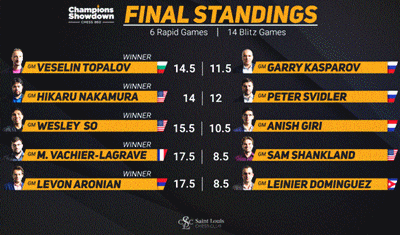
The event was played 11-14 September, and is documented on the official site, Champions Showdown: Chess 960 (uschesschamps.com). From the 'Regulations':-

In the Champions Showdown, each round will begin with the same starting position on all boards, and new positions will be drawn after every fourth game according to the Schedule of Events. If the standard starting position is randomly selected, it shall be discarded and a new position shall be drawn.

Positions will be drawn in the playing hall. Once drawn, players will have time to prepare, but must remain in the playing hall. Players may have a second to assist, but may not use electronic devices such as computers or phones.

From the 'Standings' on the same site:-


Matches:
Topalov - Kasparov, Nakamura - Svidler, Wesley So - Giri,
Vachier-Lagrave - Shankland, Aronian - Dominguez

Although all of the major chess news sites had significant reports, Chess24.com produced the most comprehensive reporting. Their reports on the four rounds were by Colin McGourty:-

The first report in that list explained,

The first three days, the participants will play two rapid games followed by two blitz games -- all four games will be played with the same starting position. On Friday, they will play the remaining eight blitz games -- the starting positions will be drawn twice, once at the beginning and once before the final four games.

I noticed one anomaly that I don't understand. The official site's 'Results' page noted the start positions and their numbers for each round, but the numbers don't correspond to the system that I'm familiar with. For example, it gives the first day using 'Position 598: NQBBRKRN'. I prepared the following table for this post, where the first column is the round number and the second column is the numeric start position:-

1: SP309 NQBBRKRN
2: SP444 RBNNQKBR
3: SP802 BRKQNBRN
4: SP833 BRKBNRQN
5: SP641 BRNBKRQN

That mystery aside, I loaded the PGN file for all 100 games to a ZIP file in a directory on my own site: m-w.com/c960/blog/. In the past, I've loaded the PGN file without compression, but I discovered that my domain host now restricts uploads to a 'List of Supported File Types' that doesn't include PGN.

I'd like to come back to the games in a future post. There are also many comments from fans (and non-fans) scattered across different resources that could be surveyed.

18 February 2023

Chess.com Pinpoints a Tactical Error

In last month's post, The Fascinating World of Chess960 (January 2023), I discussed a shift in focus for my own chess960 games. In a nutshell, to play chess960 I switched from a site allowing engines to a site forbidding them. I finished the post saying,
That's the background for a series of posts that I plan to write for my games on Chess.com. There are several aspects to be covered, e.g. Game review tools

I introduced those tools on my main blog in Chess.com's Game Review Tools (February 2023), using an example chess960 game. I'll use the same game in this current post. After four wins, it was the first game I lost on Chess.com starting June 2022, when I adopted the no-engine approach.

The 'Game Review Tools' post used numbers to identify the different screen shots and I'll follow the same numbering scheme in this current post. There are three different review tools that I numbered '02', '03a', and '05a'. The '02' tool shows the moves of the game and the times used for each move. It also provides (1) an entry into the '03a' and '03b' tools, and (2) a PGN download of the moves of the game, without variations or comments.

At this point, I don't see much difference between the '03a' and '05a' tools. The differences seem mainly cosmetic, so I'll continue with the '05a' tool. It's accessed via a feature called 'Saved Analysis'. In the game I was outplayed tactically and didn't know where I had gone wrong.

I had Black in a game starting 'SP350 NRKQRBBN'. I was pleased with my position after the first few moves and thought that I had equalized, maybe even gained a slight advantage. Then suddenly I had an inferior game. Why?

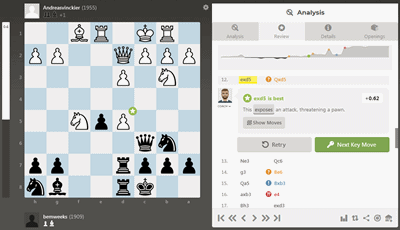
The '03a' and '05a' tools offer commentary on each move played in the game. I won't discuss the early comments in this post, because I'm not yet convinced they are helpful. The critical position is shown in the following screenshot, Black to move.


AV vs. bemweeks | Analysis - Chess.com • After 12.e4-d5(xP)

White has just captured a Pawn on d5 with 12.exd5, and Black has four possible recaptures. The move 12...Rxd5 is a '??' blunder, allowing the family fork 13.Ne7+. That leaves three other moves. Since White's last move also discovered an attack on the e5-Pawn, I played 12...Qxd5, protecting that Pawn. That was a mistake, which the tool flags with the remark '(?) Qxd5 is a mistake'.

What's better? The tool suggests 12...Nxd5. Now if 13.Rxe5, Black has 13...Qf6, when White is in trouble. I didn't see that possibility during the game and never recovered. Following is the PGN as provided by the '02' tool.

[Event "Let\\'s Play! - Chess960"]
[Site "Chess.com"]
[Date "2022.07.05"]
[Round "?"]
[White "Andreasvinckier"]
[Black "bemweeks"]
[Result "1-0"]
[Variant "Chess960"]
[SetUp "1"]
[FEN "nrkqrbbn/pppppppp/8/8/8/8/PPPPPPPP/NRKQRBBN w EBeb - 0 1"]
[WhiteElo "1977"]
[BlackElo "1907"]
[TimeControl "1/86400"]
[EndDate "2022.07.23"]
[Termination "Andreasvinckier won by resignation"]
[initialSetup "nrkqrbbn/pppppppp/8/8/8/8/PPPPPPPP/NRKQRBBN w EBeb - 0 1"]

1. e4 e5 2. f4 Nb6 3. fxe5 f6 4. Nb3 fxe5 5. Ng3 Qf6 6. Be3 O-O-O 7. d3 d5 8. Qd2 Qc6 9. Bg5 Be7 10. Bxe7 Rxe7 11. Nf5 Red7 12. exd5 Qxd5 13. Ne3 Qc6 14. g3 Be6 15. Qa5 Bxb3 16. axb3 e4 17. Bh3 exd3 18. O-O-O dxc2 19. Bxd7+ Rxd7 20. Rxd7 Qxd7 21. Qxa7 Nf7 22. Qa5 Nd6 23. Nd5 1-0

The Chess.com tools offer several different PGN downloads. I'll discuss those in another post on my main blog.

25 June 2022

FWFRCC PGN

Last week's post, FWFRCC Game Scores (June 2022), started, 'The year 2019 was the year of the 'FIDE World Fischer Random Chess Championship' (FWFRCC)', then developed a table documenting the tournament's various stages. It finished,
That table should allow me to identify the individual game scores. The games from later stages are more important than those from earlier stages.

The first important stage, 'Qualifying Stage 3: Knockout Qualifier Phase [Q3]', consisted of six knockout (KO) events, each with 16 strong players. Let's look more closely at the first KO event [KO1], which was reported in Nepomniachtchi Qualifies For FIDE World Fischer Random Chess Championship (chess.com; 13 August 2019).

Each of the 15 KO1 matches had at least two games (some had more). Three of those games were embedded in the Chess.com news article. Embedded games have an 'analysis' icon (lower left) that opens an analysis window, which in turn has a 'share' icon (lower right) that displays the PGN, permitting its download. That's fine for embedded games, but what about the other games?

Each player on Chess.com has a profile page. For example, the winner of 'Q3-KO1' has a page titled GM Ian Nepomniachtchi (lachesisQ) - Chess Profile (chess.com). The profile pages lead to a page 'Chess Opening Explorer & Database', initialized for that player. Unfortunately, a help page How do I use the Game Explorer? (support.chess.com), informs,

Currently, the Explorer does not index Live Chess games shorter than 5|0, Chess960 games, or any games of fewer than four moves in length.

Fortunately, the site offers an API which is documented in Published-Data API (chess.com). For GM Nepomniachtchi, all of his Chess.com games are available via lachesisq/games/archives. One of the entries there is lachesisq/games/2019/08, i.e. the month when 'Q3-KO1' was played. The FWFRCC chess960 games are mixed in with other games that Nepomniachtchi played that month, but these could be separated.

We seem to have all the pieces to build a database of 2019 FWFRCC PGN game scores. It would be a non-trivial job to gather all of the games, but it should be possible.

***

Later: Strike everything that's misleading! Re '"Chess Opening Explorer & Database" initialized for that player', I overlooked a checked option under 'Live Games' named 'All Live Types'. Uncheck that and check 'Live Chess 960' instead. For GM Nepo's games in 'Q3-KO1', the result is lachesisQ's Games (8).

It would still be a non-trivial job to gather all of the games, but nevertheless a lot easier than my original suggestion. There's no need to get into the weeds for '[player]/games/archives'. The Chess.com interface works great.

10 January 2010

Queens Lead the Attack

Continuing with Finding Games by Good Chess960 Players, I looked at some of the games played by Chess.com's highest rated chess960 players. The following position arose after two moves in a game between the current highest rated player (name 'John Doe') and his 'Best Win' (i.e. win over highest rated opponent).


SP263: NRBKNQRB

It's a definite candidate for Extravagant Openings in Chess960.
Here's the PGN game score.

[Event "Chess960 Players Group vs American Group - Board 1"]
[Site "Chess.com"]
[Date "2009.09.24"]
[White "desperadoes"]
[Black "SeverusSnape"]
[Result "0-1"]
[WhiteElo "1942"]
[BlackElo "2173"]
[TimeControl "1 in 3 days"]
[Termination "SeverusSnape won by resignation"]
[Variant "Chess960"]
[SetUp "1"]
[FEN "nrbknqrb/pppppppp/8/8/8/8/PPPPPPPP/NRBKNQRB w KQkq - 0 1"]

1.e3 g5 2.Qb5 Qh6 3.Nf3 g4 4.Nd4 Qxh2 5.Rf1 Nd6 6.Qa5 a6 7.g3 b6 8.Qa4 c5 9.Ne2 Bb7 10.Bxb7 Rxb7 11.Qxa6 Nc7 12.Qa4 b5 13.Qa3 b4 14.Qa4 Ne4 15.Ke1 c4 16.d4 e5 17.Bd2 Rg6 18.Bxb4 Rf6 19.dxe5 Rxf2 20.Rxf2 Qxf2+ 21.Kd1 Bxe5 22.Be1 Qxe3 23.Qxc4 Rb6 24.c3 Rd6+ 25.Kc2 Rd2+ 26.Bxd2 Qxd2+ 27.Kb3 d5 28.Qc6 Qxe2 29.a3 Nd2+ 30.Ka2 Nxb1 31.Kxb1 Qf1+ 32.Ka2 Qc4+ 33.Qxc4 dxc4 34.Nc2 Bxg3 35.Ne3 h5 36.Nxc4 h4 37.Ne3 h3 38.Nxg4 f5 39.Nh6 f4 40.Nf7+ Ke7 41.Ne5 h2 42.Nc6+ Kd6 0-1

Compare the PGN against the other examples I listed in Chess960 PGN.

09 January 2011

More on Chess960 Engines

The last link in my previous post, C960 & Fullchess (see 'Chessprogramming - Perola Valfridsson'), led me to a resource that I had never explored properly -- chessprogramming.wikispaces.com. Chess960 is only a small portion of the site, which probably explains why there is a major gaffe on its Chessprogramming - Chess page : 'Chess Variants -> Fisher Random Chess (FRC) or Chess 960'.

A search for mentions of chess960 pulls in a number of interesting pages, of which the most valuable is currently Livingston Chess960 Computer World Championship, a list of the Chess Classic Mainz (CCM) events involving chess960 engines. This consolidates in one place the same info I've covered in Chess960 @ Chess Classic Mainz and CCM9: Nakamura, Grischuk, and Rybka. Reference material is better maintained on a structured site like a wiki than on a blog.

This brief foray into the world of chess960 engines reminded me that I covered the topic of advanced chess (aka freestyle chess) in a recent post on my main blog: Chess of the Future -or- Chess of the Past? There I discovered that a couple of the best resources on chess engines are Rybkaforum.net and Computerschach.de. A search on Rybkaforum.net for chess960 pulls up material like Rybka @ 5th Livingston World Computer Chess960 Championship, written by Mr. Rybka himself, Vasik Rajlich.

The 5th Livingston World Computer Chess960 Championship [2009] was held this past week in Mainz and Rybka won ahead of Shredder, Deep Sjeng and Ikarus. A huge thanks to Hans-Walter Schmitt, Eric van Reem, Hans Secelle and the rest of the Chess Tigers staff for putting on a great event. They get everything right, from the big things down to the little things, and it's really fun to be there.

Don't miss the further link to Rybkachess.com which has another report and lots of photos. A search for chess960 on Computerschach.de is little more problematic, because all of the interesting pages are in German (not to mention undated). Since they are somewhat slow to load, Google Language Tools gives up on the URL with a message saying 'Sorry, we are unable to access the page you requested'. That means you have to copy / paste the German text into the Google tool. The results can be worth the effort, as in Stefan Meyer-Kahlen über Fischer-Schach ('Stefan Meyer-Kahlen [Mr. Shredder] on Fischer Chess'):

CSS Online: Why do you have installed in FRC Shredder? • SMK: The reason was that I would like to play with Shredder in the Chess960 World Championship in Mainz. • CSS Online: There were already proposals to FEN and PGN. Why did you not use? Where exactly are the differences between the two FRC FENs? • SMK: There were suggestions on how to expand FEN and PGN so that it works with Chess960. These extensions, however I have not really liked because it is very cumbersome and very error prone. Prone to errors both in programming as well as during subsequent reading PGN games.

I'll try to explore both resources in more depth for a future post.

24 March 2018

More on the Fischer Random Cup

After last week's post Lenderman, Rapport Take Reykjavík, what more can be said about the event, aka the 'European Fischer Random Cup'. How about some games? Since 100 players participated, 50 games were played per round -- nine rounds should give 450 games for the tournament.

The page Fischer Random Cup (reykjavikopen.com) has results for 20 games per round, presumably for games which were recorded automatically while they were in progress. Clicking on a game opens a viewer to play through and download the game. Clicking on the PGN download button gives only the message 'Not logged in'. Logging in to Chessbomb.com gives the message 'Only Premium accounts can download PGN'. A similar interface producing the same information is on GAMMA Reykjavík Fischer Random Chess Memorial 2018 (chessbomb.com).

Back to Reykjavikopen.com, a number of side events were held in conjunction with the Fischer Random Cup (GAMMA Reykjavík Open 2018 – Bobby Fischer Memorial):-

The page announcing the Fischer Memorial Tour I, 'a trip to the Fischer Center in Selfoss and Fischer’s Grave nearby', included a map of Selfoss:-

For more about the Fischer Center, see Welcome to the Bobby Fischer Center (fischersetur.is).

28 July 2012

Never Move a Pawn Twice in the Opening?

Q: What's almost as rare as chess960 tournaments? A: Published chess960 OTB games, where OTB is 'Over-The-Board', i.e. face-to-face, in contrast to online or correspondence games. In my previous post, Recent Comments, I was pleased to find a few games along with the results of the 2012 Schachclub Waldbronn - Chess960 Open. The seven round rapidplay event attracted 36 players and saw FM Josef Gheng and GM Klaus Bischoff emerge as co-winners with 6.0 points each, a full point ahead of third place.

The winners met in the fifth round with GM Bischoff playing White in a game that started with SP888 RBQKBRNN. After a few fairly routine moves, White played 5.d3, reaching the position shown in the top diagram; the start position is still discernible. Black replied 5...Nf7, when White pushed the d-Pawn once more, 6.d4.

Why not play the Pawn to d4 on the fifth move? I'm really not sure. Perhaps White was concerned about 5...Bf7, when the square c4 is available to the Bishop. After ...Nf7, the Bishop move is no longer an option. Whatever the reason, after 6.d4, the game took a tactical turn with 6...d6 7.c4 e5 8.Bc3 e4 9.d5 Ng4 10.Nd4 Bd7 11.h3 Ngh6, reaching the position shown in the bottom diagram.

The next few moves saw both players castle to the same side: 12.O-O c5 13.Nde2 O-O. Now White owned the long a1-h8 diagonal, where he built a Queen / Bishop battery. Black had no effective counterplay and was lost after 30 moves. To play through the complete game, here is the PGN as provided by schachclub-waldbronn.de.

[Event "Waldbronner Chess960 Open Deutsche Meisterschaft 2012 20'+5''/Zug"]
[Site "Waldbronn"]
[Date "2012.06.17"]
[Round "5"]
[White "Bischoff,Klaus"]
[Black "Gheng,Josef"]
[Result "1-0"]
[WhiteElo "2503"]
[BlackElo "2397"]
[WhiteTitle "GM"]
[BlackTitle "FM"]
[WhiteType "human"]
[BlackType "human"]
[Variant "Chess 960"]
[Variation "Chess 960"]
[SetUp "1"]
[FEN "rbqkbrnn/pppppppp/8/8/8/8/PPPPPPPP/RBQKBRNN w KQkq - 0 1"]
[Opening "960 Stellung 888"]
[Termination "normal"]
[PlyCount "59"]
[EventDate "2012.06.17"]
[EventSponsor "Sparkasse Karlsruhe-Ettlingen"]
[EventType "swiss (rapid)"]
[EventRounds "7"]
[Section "Open"]
[TimeControl "1200+5"]
[Mode "OTB"]
[ECO "Chess 960"]
[Annotator "Schachclub Waldbronn"]
[Editor "Clemens Linowski"]

{Runde 5: Chess960-Start-Position 888} 1.f4 f5 2.Nf3 c6 3.e3 Nf6 4.Ng3 g6 5.d3 Nf7 6.d4 d6 7.c4 e5 8.Bc3 e4 9.d5 Ng4 (9...exf3 10.Bxf6+) 10.Nd4 Bd7 11.h3 Ngh6 12.O-O c5 13.Nde2 O-O 14.b3 Bc7 15.a4 Bd8 16. Ra2 Re8 17.Ba1 Be7 18.Bxe4 {W steht positionell besser, sodass er hier einschlagen kann} Bf8 {S nimmt nicht:} (18...fxe4 19.Nxe4 Nf5 20.Qc3 Qd8 21.N2g3 Bf8 22.Nxf5 Rxe4 23.Nxd6 Rxe3 24.Qxe3 (24.Nxf7 Rxc3 25.Nxd8 Rxb3 26.Ne6 Bxe6 27.dxe6 Re3 28.Be5) 24...Bxd6 25.Qc3 Bf8 26.Re2 Qh4) 19.Bd3 Bg7 20.Bxg7 Kxg7 21.e4 Qd8 22.exf5 Bxf5 23.Bxf5 Nxf5 24. Nxf5+ gxf5 25.Ng3 Kg6 26.Re1 Rxe1+ 27.Qxe1 Qf6 28.Kh2 h6 29.Re2 Qd4 30.Re7 {S gibt auf - Black abandoned} (30.Re7 Rf8 31.Qe6+ Qf6 32.Qe2) 1-0

That must set some kind of a record for most tags in a single PGN game score.

25 July 2009

What's the Logic?

Combining the games I collected for my post on CCM PGN Game Scores together with the CCM games I received from Chess Tiger, which chess960 players have been the most active at Chess Classic Mainz (CCM)? The top five active players are listed in the following table along with the number of games I have on file (there might be some games missing):-

66 Aronian
56 Svidler
53 Bacrot
45 Almasi
34 Naiditsch

GM Levon Aronian's latest CCM appearance was in 2007, where he won the overall title (see Chess960 World Championships for details). Here's the start position of his game against GM Rustam Kasimdzhanov from round two of the preliminary section in that event.


Start Position 383

And here's the PGN, as provided by CCM.

[Event "FiNet Chess960 Rapid World Championship"]
[Site "Chess Classic Mainz"]
[Date "2007/8/14"]
[Round "2"]
[White "Aronian"]
[Black "Kasimdzhanov"]
[Result "1-0"]
[Variant "chess 960"]
[SetUp "1"]
[FEN "nrkrnqbb/pppppppp/8/8/8/8/PPPPPPPP/NRKRNQBB w DBdb - 0 1"]

1.f4 Nb6 2.f5 f6 3.Nb3 e5 4.fxe6 dxe6 5.g3 Nd6 6.Nd3 Qe7 7.Ndc5 Bf7 8. Na5 O-O 9.Ncxb7 Be8 10.Nc5 f5 11.Qf3 Nbc4 12.Nc6 Bxc6 13.Qxc6 g6 14.c3 Ne5 15.Qa4 c6 16.Nd3 Rb7 17.Bc5 Rc8 18.Nxe5 Bxe5 19.d4 Bg7 20.O-O Qd7 21. Bxd6 Qxd6 22.e4 fxe4 23.Bxe4 e5 24.Qc4+ Kh8 25.d5 c5 26.b4 Rbc7 27.b5 Rd8 28.a4 Qb6 29.Kg2 Rd6 30.a5 Qxa5 31.Ra1 1-0

White's first move 1.f4 is easy to understand. It opens lines for a couple of pieces, prepares Nf3, and attacks the Pawn on a7. Black's response 1...Nb6 is also straightforward. It blocks the attack on a7 by developing the Knight to its natural square. Then there's a mystery -- what to make of 2.f5?

In Differences Between Chess and Chess960, I wrote that regarding the Initial moves, in chess 'Moves are chosen according to repertoire, respecting chess logic as necessary', while in chess960, 'Moves are chosen according to chess logic'. What's the logic behind 2.f5?

Here's my answer: If White plays something straightforward like 2.Nb3, Black will answer 2...f5, maintaining the symmetry along with the balance (or equilibrium) in the position. With 2.f5, White prevents Black from getting this easy equality. The advanced Pawn on f5 is not in any danger, because: (1) It is protected against any immediate attack by the Queen on c1, and (2) Black must eventually play ...g6 (or ...g5) to develop the Bishop on h8, when the f-Pawn can be swapped off by f5xg6. • Does this make sense to you or do you have a better line of reasoning?

13 February 2011

Oversight or Intentional?

In my previous post, Nakamura Sac Attack, I covered GM Hikaru Nakamura's qualification from the 2008 Chess Classic Mainz (CCM8) Chess960 FiNet Open to the 2009 (CCM9) Chess960 Rapid World Championship, where he beat GM Levon Aronian for chess960's most prestigious title. A few months before the FiNet event Nakamura won entry and expenses to the open by finishing first in the Internet Chess Club's (ICC) 2008 Chess960 Championship.

The ICC Chess960 Championship was held from 2007 to 2009, and in each year the winner won entry and expenses to Mainz (links to Chessclub.com):-

In 2009, just like Nakamura had done the previous year, Grischuk went on to win the FiNet Open, qualifying for the 2010 Chess960 Rapid World Championship, an event which was subsequently cancelled due to lack of sponsors. The games from the 2008 and 2009 ICC finals are available on the ICC site, but were played at a blitz tempo that renders many of them less interesting because of early blunders.

In the following game, the sixth and last game in Nakamura's final 2008 ICC match against GM Dmitry Andreikin (DSquared), I couldn't tell if the critical moves were an oversight or intentional. In start position NRBKNBQR (SP262), Andreikin opened 1.Nb3 and Nakamura (Smallville) replied 1...e5, arriving at the position shown in the first diagram.

Now White played 2.f4, with a double attack on the a- and e-Pawns. The a-Pawn is particularly sensitive, because Qxa7 attacks a Rook that can't be defended. Black played 2...Nb6, when 3.fxe5 left White a Pawn to the good. At this point Nakamura played for complications and open lines with 3...f6 4.Nf3 fxe5 5.Nxe5 d6 6.Nf3 Nf6. The game continued 7.d3 a5 8. c4 a4 9.Nbd4 d5, reaching the position shown in the second diagram.


Here White could have held the extra Pawn with several moves, where 10.cxd5 is one obvious choice, not necessarily the best. Instead he played for rapid development with 10.Bg5 dxc4 11.O-O-O, and the game continued with material equality. Was 1...e5 an oversight? What about 10.Bg5? Whatever the reasons for the two moves, Black went on to win the game for the fifth consecutive full point by the Black pieces. Here is the game's PGN, courtesy the ICC.

[Event "ICC tourney 865 (w22 3 1)"]
[Site "Internet Chess Club"]
[Date "2008.06.22"]
[Round "21"]
[White "DSquared"]
[Black "Smallville"]
[Result "0-1"]
[TimeControl "180+1"]
[SetUp "1"]
[FEN "nrbknbqr/pppppppp/8/8/8/8/PPPPPPPP/NRBKNBQR w KQkq - 0 1"]

1.Nb3 e5 2.f4 Nb6 3.fxe5 f6 4.Nf3 fxe5 5.Nxe5 d6 6.Nf3 Nf6 7.d3 a5 8. c4 a4 9.Nbd4 d5 10.Bg5 dxc4 11.O-O-O c3 12.Nb5 cxb2+ 13.Kxb2 Qd5 14. Nc3 Qd6 15.Qd4 Qxd4 16.Nxd4 Be7 17.e4 Ng4 18.Bxe7+ Kxe7 19.Re1 Rd8 20. Nf5+ Bxf5 21.exf5+ Kf8 22.Nb5 Rd7 23.Be2 Nf2 24.Rhf1 Nxd3+ 25.Bxd3 Rxd3 26.f6 Rd2+ 27.Ka1 gxf6 28.Rxf6+ Kg7 29.Rf3 Rxg2 30.Nxc7 Kh8 31.Ne8 Nd5 32.Re5 Nb4 33.Rf7 a3 34.Re6 Rg1+ {White resigns} 0-1

Note that the PGN lacks a 'Variant' tag, a glitch which did not cause a problem with either program that I used to step through it.

20 January 2018

Two Important Chess.com Events

At the end of 2017, chess960 fans were in a holding pattern, waiting for a couple of Chess.com events to terminate:-
  • 2017-10-17: Three Chess960 Developments to Watch • Chess.com's 2017 Speed Chess Championship ('One chess960 game will be played in each time control at the end of each time period')
  • 2017-12-23: 2018 Fischer Memorial • 1st Chess.com Chess960 Championship ('you can win a ticket to the Bobby Fischer Memorial in March in Reykjavik')

Both events finished within a few days of each other. Here are Chess.com's final reports:-

Congratulations to both GM Carlsen and GM Maxime Vachier-Lagrave. Now that the events are over, where can we find the games?

Last year, when I discussed the precursor of the 'Speed Chess Championship' in GM Blitz Battle PGN (March 2017), I noted, 'To search on games, you need to know the players' names on Chess.com.' The full results of the event, including all preliminary matches, are detailed in 2017 Speed Chess Championship Schedule, Results, Information (chess.com), from which I copied the following chart.

The results of the each match include links to a full report. Here is a summary of the first round matches.

Nakamura 20.5 (Hikaru), Grigoriants 7.5 (sergiochess83)
Karjakin 19.0 (SergeyKarjakin), Meier 7.0 (GeorgMeier)
So 15.5 (gmwesley_so), Giri 14.5 (AnishGiri)
Grischuk 17.5 (Grischuk), Rapport 9.5 (Lordillidan)
Nepomniachtchi 15 (lachesisQ), Aronian 13 (LevonAronian)
Caruana 19 (FabianoCaruana), Hou 8 (yifan0227)
MVL 19 (LyonBeast), Xiong 12 (jefferyx)
Carlsen 20.5 (MagnusCarlsen), Guseinov 5.5 (GGuseinov)

In my next post, I'll try to gather all of the chess960 games from those matches. As for the chess960 championship, the 'MVL Wins' report provides the possibility to 'Download Tournament PGN'. In the next post, I'll also look at that file.

18 March 2017

GM Blitz Battle PGN

In my previous post, Chess.com's GM Blitz Battle (February 2017), I wrote,
Seven matches times three chess960 games per match gives 21 chess960 games played by the world's top grandmasters. I didn't see an easy way to collect those games, but a little perseverance should pay off.

Indeed it did. After signing into Chess.com, I accessed the game archive and selected 'Others' games'. The subsequent procedure was:-

  • Search on games between both players,
  • Open relevant game,
  • Share, and
  • Download [with or without thinking times]

To search on games, you need to know the players' names on Chess.com. These are all available from the 'Blitz Battle' post via the reports on the individual matches. Here they are for the matches from the first round, the winner given first.

  • Grischuk vs. LevonAronian
  • Hikaru vs. GMharikrishna
  • LyonBeast vs. FabianoCaruana
  • MagnusCarlsen vs. TigranLPetrosyan

These four matches plus the other matches are shown in the same chart used in that previous post.

Revisiting the Chess.com report on the final match, Carlsen Beats Nakamura To Win GM Blitz Battle Championship (October 2016), we learn,

Just like the quarterfinals and the semifinals, all three time disciplines opened with a chess960 game, but for the finals, a twist. The players did not get advance notice of the starting positions. Nakamura would go on to take 2.5/3 in the three iterations of chess960, one of the few bright spots for him on the day.

The file containing the chess960 games is here:-

GM Blitz Battle PGN : 21 games

While assembling the file, I learned that all of the matches in the same round used the same start position at each time control. For example, the first chess960 games of the first round, with 5 minutes for each player (plus one second per move), used SP768 BBQRKNRN. Given that the players had advance notice of that start position, it might be instructive to examine their opening moves.

29 January 2011

Getting Organized

Reading a blog isn't like reading a book. The posts often jump from subject to subject without any connecting thread and it's never easy to find related posts, especially if they were written long before or long after a post of interest. One of the tools to organize posts sensibly is the label (aka category or tag). Unfortunately, when you start a blog, it's difficult to see what labels will be useful afterwards. It's best done after you've been blogging for some time.

In a few months I'll reach the two year anniversary with this blog and, counting the time I blogged about chess960 on my main blog, next month I'll reach the two and a half year mark overall. That means I know where the main points of chess960 are. By adding a few more labels (also listed in the right column of every page), I can now attach at least one label to each of the 150 posts on the blog. Without further ado, here are four new labels and the posts on the predecessor blog that are relevant to those labels

Posts with label 'Jargon': This is an area I have to watch constantly. As I wrote in Who Says 'Chess960 Array'?, 'There are enough obstacles to promoting chess960 without introducing unnecessary jargon into the explanation.' On the other hand, there are certain concepts that don't exist in traditional chess and these need names.

Posts with label 'Pros and Cons': Some chess players like chess960, but many don't. This leads to recurring discussions about its advantages and disadvantages. Some of the arguments are valid, but many aren't.

Posts with label 'Resources': This is a vague area, but there are many subjects that could also be called 'Tools'.

Posts with label 'Theory': After learning the rules of chess960, this is the subject that interests most players. In chess960, the term 'theory' doesn't mean book moves as it does in traditional chess. It means something else, but what exactly?

I'm sure I've overlooked relevant posts, both on this blog and on the predecessor blog. I'll add them to the appropriate labels as I discover them.